
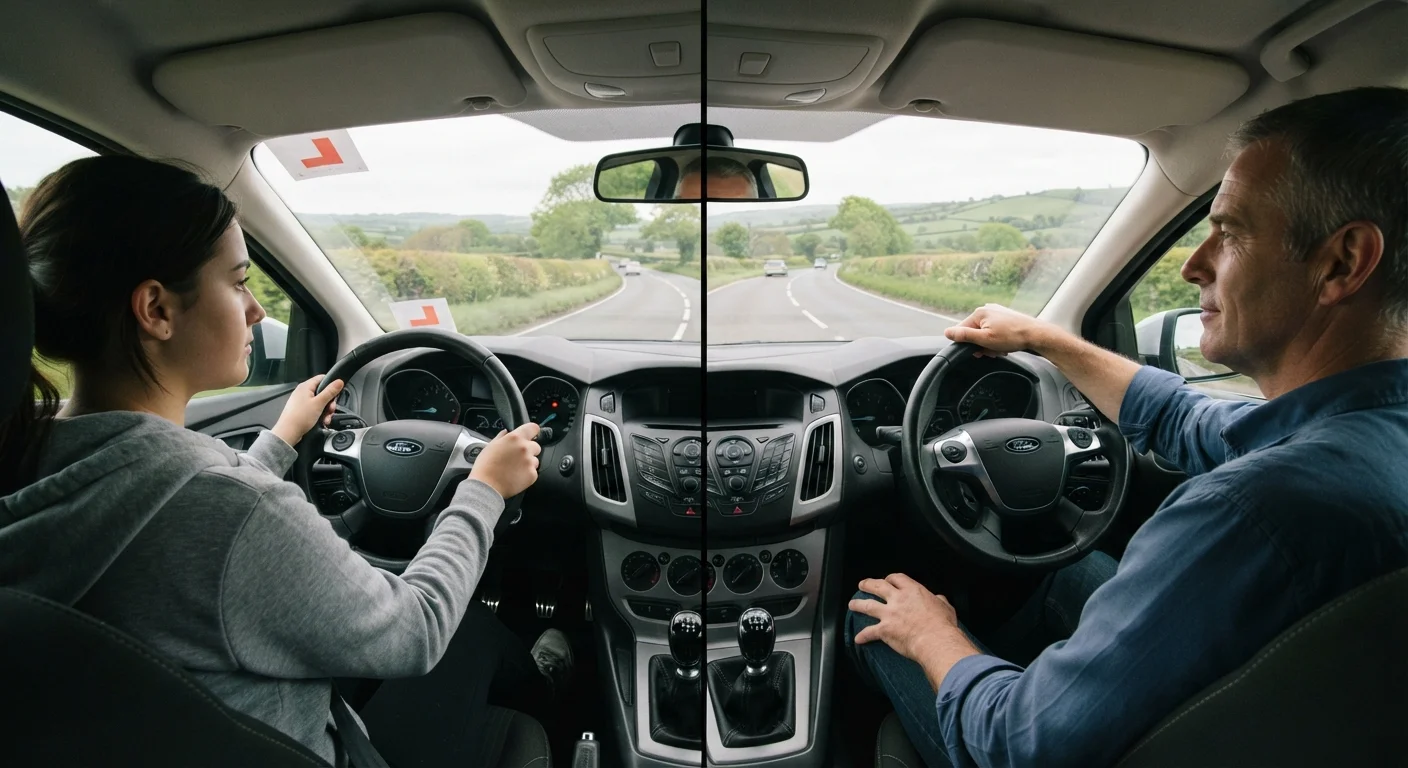
What Is Risk Perception and Why Does It Matter?
Risk perception in driving refers to a driver's ability to identify, interpret, and respond to potential hazards before they become emergencies. It is not simply about reacting quickly - it is about reading the road far enough ahead that a calm, controlled response is possible.
Think of it like reading a book versus decoding individual letters. Experienced drivers absorb the whole scene - pedestrian behaviour, road surface, traffic flow - and sense what might happen next. New drivers are still working letter by letter, focusing on immediate tasks like steering and gear changes, leaving little mental capacity for anything further.
Road safety researchers use the term hazard perception to describe this skill, and it is now formally tested as part of driver licensing in many US states and internationally. But passing a hazard perception test and being genuinely skilled at it in live traffic are very different things. Understanding why that gap exists is the first step toward closing it.
~3x
Crash rate of newly licensed drivers vs. experienced drivers
Multiple national highway safety studies indicate crash risk per mile driven is roughly three times higher in the first year after licensure.
16-19
Age group with the highest fatal crash rate in the US
According to the CDC, teenagers have the highest crash rates of any age group in the United States, with inexperience as a leading contributing factor.
2 seconds
Minimum recommended following distance in ideal conditions
Road safety guidance widely recommends at least a two-second gap, extending to four seconds or more in rain, darkness, or heavy traffic.
Why New Drivers Face Higher Crash Risk
The statistics around new drivers are sobering. Crash rates are disproportionately high in the first one to two years after licensure - not because young people are reckless by nature, but because of a specific and predictable set of skill deficits.
- Limited experience with rare but dangerous scenarios - A new driver may have never encountered a car pulling out unexpectedly from a side street or a pedestrian stepping from behind a parked vehicle. Without that experience, the brain has no ready template for anticipating it.
- Divided attention overload - New drivers devote significant mental effort to basic vehicle control. This leaves less cognitive bandwidth for scanning mirrors, reading road markings, or tracking other road users. Our article on understanding blind spots explores one direct consequence of this narrowed attention.
- Speed misjudgement - Many new drivers underestimate how dramatically speed affects stopping distance. Wet road conditions compound this further, often catching newer drivers off guard.
- Social pressure in the vehicle - Research consistently shows that carrying peer passengers increases crash risk for young drivers, partly through distraction and partly through pressure to drive more boldly.
Passengers Can Double New-Driver Crash Risk
Research consistently links carrying peer passengers - particularly multiple passengers of similar age - with significantly higher crash risk for newly licensed drivers. This is not about blame; it is about cognitive load and social dynamics. Many graduated licensing programmes restrict passenger numbers specifically because the data supports it. New drivers benefit from building solo confidence before regularly carrying others.
How Risk Perception Develops Over Time
Risk perception is not a switch that flips after a certain number of miles. It builds through a gradual accumulation of varied, reflective experience. Several mechanisms drive this development:
Pattern Recognition
Each time a driver navigates a hazardous situation - whether they handle it well or not - the brain adds another template to its library. Over time, certain cues (a ball rolling into the road, a parked truck obscuring a junction) trigger an automatic alertness that feels almost instinctive but is actually learned.
Attention Efficiency
As vehicle control becomes automatic, mental resources free up for scanning. An experienced driver does not consciously think about clutch pressure or lane position - those actions run on autopilot, leaving attention available for the full traffic picture.
Calibrated Confidence
Good risk perception includes knowing the limits of your own ability. Experienced drivers tend to slow down earlier in low visibility, increase following distance on wet roads, and avoid driving while fatigued - habits grounded in accurate self-assessment. See our article on fatigue and distraction for a closer look at how impairment creeps in unnoticed.
When you arrive safely at a destination, mentally replay one moment during the drive when a hazard could have developed differently. Even uneventful drives contain learning opportunities if you look for them.
Active reflection after driving - sometimes called post-trip debriefing - is a technique used in professional driver training programmes to accelerate hazard perception development beyond what mileage alone provides.
Treat the two-second following distance rule as a floor, not a target. In rain, low light, or when following a large vehicle, double it automatically without waiting to feel uncomfortable.
Perception and reaction time remain fairly constant, but the physics of stopping distance change dramatically with speed and conditions - making a larger buffer the only way to preserve your margin of safety.
The Overconfidence Trap in Mid-Experience Drivers
A counterintuitive finding in road safety research is that drivers with two to five years of experience sometimes show riskier behaviour than either novices or highly experienced drivers. Having moved past the visible awkwardness of being new, they can develop an inflated sense of competence before their actual hazard perception skills have fully matured.
This can manifest as following too closely, underestimating speed-related risks, or dismissing safe driving habits as unnecessary caution. Speed limits are not performance targets - a principle that mid-experience drivers are particularly prone to blur in their minds.
Similarly, assumptions about what is safe - for example, that hands-free phone use eliminates distraction - can persist long into a driving career. The evidence on phone use at the wheel challenges many of those assumptions directly.
Feeling Comfortable Is Not the Same as Being Safe
Comfort behind the wheel is a normal and welcome part of growing as a driver. But comfort can quietly lower vigilance if it is not paired with genuine skill. If you find yourself regularly driving at the speed limit in poor conditions, following closely in traffic, or dismissing basic checks as unnecessary, treat that as a signal to recalibrate - not a sign of expertise.
Practical Habits That Accelerate Safer Driving
Mileage alone does not guarantee better risk perception. Deliberate, conscious practice in varied conditions accelerates the skill far more efficiently. These habits help at any stage:
- Drive in unfamiliar conditions intentionally - Night driving, highway merging, and wet roads each demand different attention skills. Avoiding them keeps your hazard library thin. Our guide to night driving hazards outlines what specifically changes after dark.
- Commentary driving - Narrating what you observe aloud (or silently) forces active scanning rather than passive cruising. Instructors use this technique formally; you can practice it informally any time.
- Debrief near-misses honestly - When something startles you, reflect on what cues were available earlier that you missed. This reflection is how the brain builds better templates.
- Check your vehicle fundamentals - Risk perception is only half the equation. A car that cannot stop or steer predictably removes the margin that good perception creates. Tyre condition is one often-overlooked factor.
- Understand road markings - Many drivers never fully learned what road markings communicate. A reference guide to road markings can fill gaps that may have persisted since your test.
Try Commentary Driving on Your Next Trip
Pick any routine drive and narrate aloud what you see: 'Car parked ahead, could pull out - checking mirror - pedestrian near the kerb.' This forces active scanning rather than passive autopilot. Even five minutes of commentary driving per week builds the habit of reading the road rather than just reacting to it.
Supporting Young Drivers Beyond the Test
Passing a driving test marks the beginning of skill development, not its completion. Parents and supervisors play a measurable role in how safely new drivers progress. Research from road safety organisations suggests that graduated driver licensing (GDL) programmes - which restrict night driving, passenger numbers, and phone use in the early months - are among the most effective policy tools available.
At the individual level, continuing to accompany new drivers on varied trips after licensure, discussing near-misses without blame, and modelling good habits yourself all contribute. Young drivers often adopt the norms they observe in the adults around them, for better or worse.
Motorway driving is a particular gap. Many new drivers pass their test without ever having merged onto a high-speed road. Motorway merging errors are disproportionately common in this group, and a few supervised practice runs before driving that environment solo can make a significant difference.
Risk perception will keep developing for years. The drivers who progress fastest are those who approach every drive - not just lessons - as an opportunity to learn.