
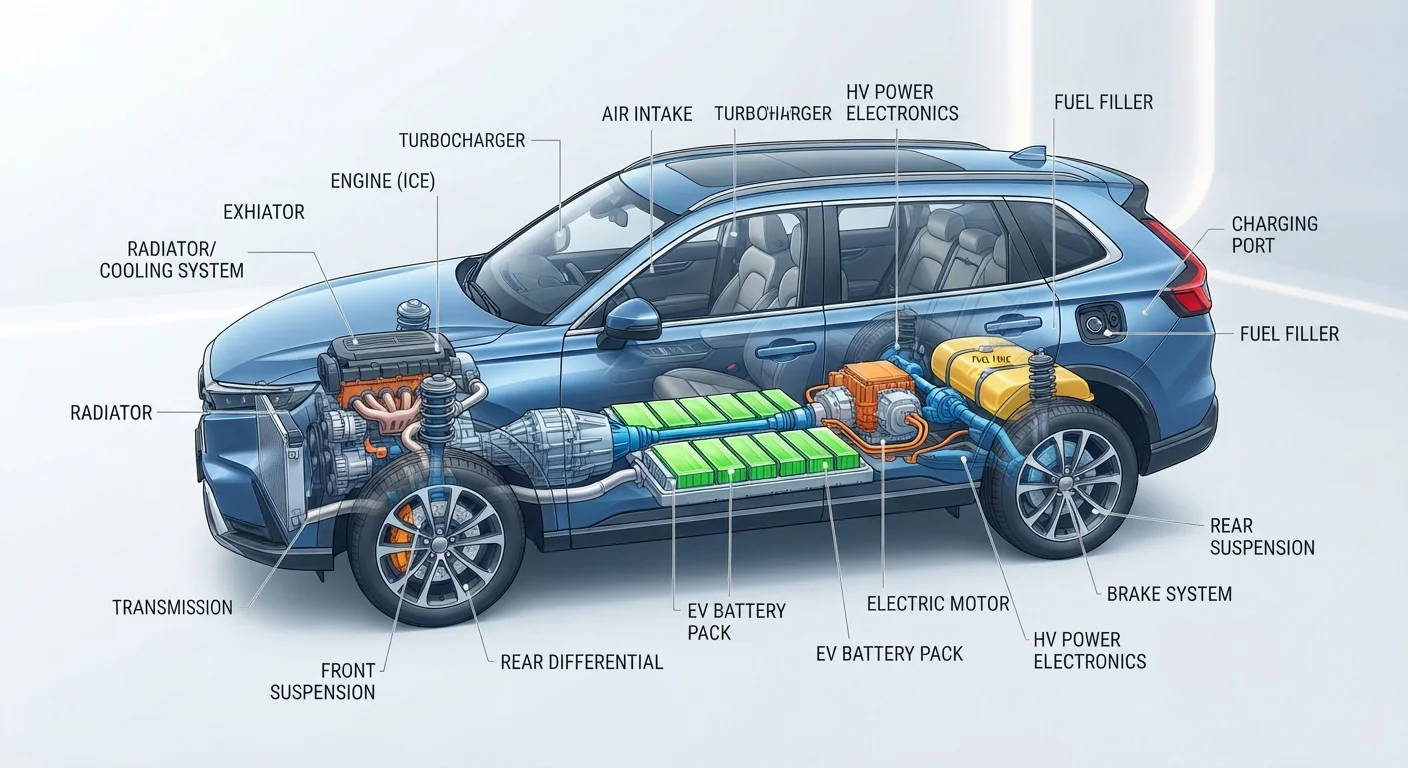
The Big Picture: A Car Is a System of Systems
Think of a car the way you'd think of a human body. No single organ does everything - the heart pumps, the lungs breathe, the nervous system coordinates. A car is exactly like that: a collection of distinct systems that each do one job and rely on the others to keep the whole machine alive.
The major systems you'll encounter are the engine, the fuel system, the transmission (sometimes called the drivetrain), the electrical system, the cooling system, the braking system, and the steering and suspension. Each system has dedicated components, its own fluids (often), and its own warning signs when something goes wrong.
Understanding how they connect is the foundation of being an informed driver. You don't need to fix anything yourself - but knowing what a warning light means or why a noise might be serious is genuinely useful. For a full reference of the vocabulary you'll encounter, see our car systems glossary.
The Engine: Where Energy Comes From
The engine is the heart of a conventional gasoline-powered car. Its job is to convert chemical energy stored in fuel into the mechanical energy that moves the vehicle. It does this through a process called internal combustion.
Here's the short version: fuel and air are mixed together inside a sealed cylinder. A spark plug fires, igniting the mixture. That small, controlled explosion pushes a piston downward with force. Most car engines have four, six, or eight cylinders doing this in rapid sequence, thousands of times per minute.
The up-and-down motion of the pistons is converted into rotational motion by the crankshaft - picture a bicycle pedal turning a wheel. That rotation is what ultimately drives your wheels. The engine also needs oil to lubricate its moving parts, coolant to prevent overheating, and air fed in through the intake. When any of those inputs fails, the engine suffers quickly.
The Best Habit: Check Your Oil Regularly
Engine oil is inexpensive and easy to check with the dipstick under the hood. Running an engine low on oil is one of the most common - and most avoidable - causes of serious engine damage. Check it once a month and before any long trip.
Transmission, Steering, and Brakes: Turning Power Into Motion
Raw engine power alone doesn't get you anywhere useful. The transmission is the middleman - it takes the engine's rotational output and delivers it to the wheels at the right speed and force for any given situation. When you're accelerating from a stop, you need high torque (pulling force) at low speed. On a highway, you need less torque but sustained high speed. The transmission manages that balance continuously, whether you're driving an automatic or a manual.
From the transmission, power flows through the driveshaft to the axles and then to the wheels themselves. The specific path depends on whether your car is front-wheel drive, rear-wheel drive, or all-wheel drive.
The steering system translates your steering wheel inputs into actual wheel movement. Most modern cars use power-assisted steering - either hydraulic or electric - to make turning feel effortless. The suspension system (springs, shock absorbers) keeps your tires in contact with the road and smooths out bumps.
The braking system uses friction to slow the car. When you press the brake pedal, hydraulic fluid transmits that force to calipers that squeeze brake pads against discs (rotors) attached to each wheel. That friction converts kinetic energy into heat, slowing the car. Brake fluid condition and pad thickness matter enormously for safety.
Never Ignore Brake Warning Signs
A grinding, squealing, or pulsating sensation when braking almost always indicates worn brake pads or rotor damage. Brakes are a safety-critical system - if you notice any of these symptoms, have the brakes inspected by a qualified mechanic promptly rather than waiting for a scheduled service.
Electrical and Fuel Systems: The Supporting Cast
The electrical system is far more extensive than most people realise. It starts with the battery, which stores electrical energy and powers the starter motor when you turn the key. Once the engine is running, the alternator takes over - it generates electricity to run every powered component and simultaneously recharges the battery. Dashboard lights, windows, the radio, sensors, the engine control unit (the car's onboard computer) - all of it runs on this system.
The fuel system is responsible for getting gasoline from the tank to the engine in precisely the right quantity. A fuel pump pushes fuel from the tank through a filter and into the fuel injectors, which spray a fine mist directly into the engine cylinders. Modern cars control this process electronically for maximum efficiency. Learn more in our dedicated guide: fuel system journey explained.
The cooling system prevents the engine from overheating by circulating coolant (antifreeze mixed with water) through the engine block and out to the radiator, where the heat dissipates. If coolant runs low or the radiator fails, engine temperatures can spike dangerously fast.
Electric Vehicles Follow Different Rules
Battery electric vehicles (EVs) replace the combustion engine and fuel system with an electric motor and a large battery pack. They still have braking, steering, and suspension systems that work on similar principles - but they have no oil to change, no fuel injectors, and no alternator. If you drive or are considering an EV, some of the specifics here won't apply, though the underlying logic of interconnected systems still does.
Why Understanding This Makes You a Better Driver
You'll never need to rebuild a transmission or machine a cylinder head. But knowing what each system does gives you real, practical advantages as a driver and car owner.
When your temperature gauge climbs toward red, you'll know to pull over immediately rather than push on. When a dashboard light shaped like an oil can illuminates, you'll know that's not a suggestion - it's a warning that engine lubrication may be compromised. You'll understand why skipping an oil change matters, why tire pressure affects fuel economy, and why a grinding noise when braking deserves prompt attention.
This knowledge also helps you communicate with mechanics more clearly, so you're less likely to feel lost or misled during a service visit.
Ready to go further? Our first-timer's maintenance overview walks you through the essential checks and habits every car owner should build - no prior experience needed. And for a broader look at keeping your car in good shape, the complete car care guide covers everything from fluids to service schedules.
Car Systems Glossary: 40 Terms Every Driver Should Recognise
A plain-language reference for the mechanical and electrical terms you'll encounter as a car owner - from alternator to torque. A useful companion while reading any technical car content.
Getting Started With Car Maintenance: A First-Timer's Overview
Covers the essential checks, terminology, and habits that form the foundation of good car care - written specifically for new car owners with no prior experience.
Car Care Basics Hub
A curated collection of maintenance tips and how-to articles covering everything everyday drivers need to keep their vehicle running reliably.