
Why Fuel Doesn't Just Flow on Its Own
Many people assume petrol drains from the tank down to the engine the way water flows downhill. In reality, the fuel tank is often below the engine, and even when it isn't, passive gravity alone can't deliver fuel at the pressure modern engines require. That job falls to the electric fuel pump.
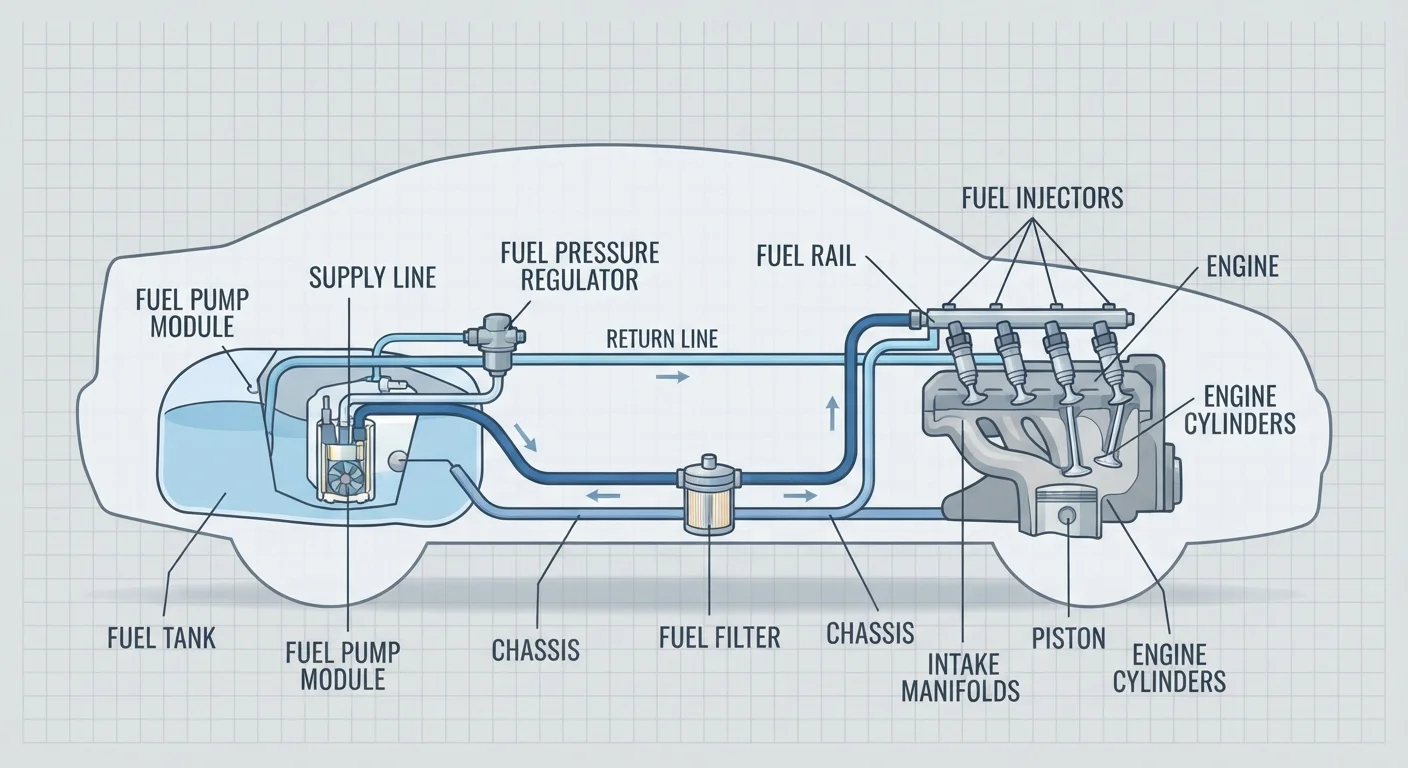
The fuel pump is typically submerged inside the fuel tank itself - a design choice that keeps the pump cool and primed. When you turn the ignition key or push the start button, the pump pressurises the fuel line almost instantly, so the engine has fuel ready before it even fires. You can often hear a faint hum or whir for a second before the engine starts - that's the pump at work.
For a broader look at how all car systems connect, see our introduction to how cars work.
Keep Your Tank Above a Quarter Full
Running on a nearly empty tank frequently can shorten the life of your electric fuel pump. The pump relies on the surrounding fuel to stay cool, so repeatedly letting the tank run very low can cause it to overheat over time. Keeping at least a quarter tank of petrol is a simple habit that costs nothing extra.
Cleaning the Fuel: The Filter's Role
Petrol may look clean in the pump nozzle, but over time, fuel tanks accumulate microscopic debris - rust flakes from ageing metal tanks, sediment from fuel storage, and even fine particulates from the supply chain. None of that should reach your engine's precision components.
The fuel filter sits in the fuel line and traps these contaminants before they reach the injectors. Think of it like a fine mesh screen that catches anything harmful while letting clean fuel pass through freely. A clogged filter restricts fuel flow, which can cause hesitation during acceleration, rough idling, or hard starting.
Filters on older vehicles were often standalone units mounted under the bonnet or beneath the car, making them straightforward to service. On many modern vehicles, the filter is integrated into the fuel pump module inside the tank, which changes how and when it's serviced. Learn more about the different filters in your car and what each one actually does.
40-65 psi
Typical fuel rail pressure in port-injected petrol engines
Direct-injection systems operate at far higher pressures - sometimes exceeding 2,000 psi - to enable precise fuel atomisation directly inside the combustion chamber.
100+ times/sec
Approximate injector opening frequency at high engine speeds
At highway RPMs, each fuel injector opens and closes many times per second, with pulse duration measured in milliseconds and controlled by the engine's ECU.
Delivering Fuel to the Engine: Injectors and the Fuel Rail
Once clean and pressurised fuel reaches the engine bay, it travels into a component called the fuel rail - essentially a pipe that runs alongside the engine and feeds each cylinder's injector. The rail keeps fuel under constant pressure so every injector gets an equal, steady supply.
The fuel injectors are where the real precision happens. Each injector is a tiny electrically controlled valve that opens and closes many times per second, spraying a fine mist of petrol rather than a liquid stream. Atomising the fuel - breaking it into a microscopic spray - is critical because fuel vapour mixes with air and ignites far more efficiently than liquid droplets would.
The engine's Electronic Control Unit (ECU), the car's onboard computer, controls exactly how long each injector stays open. It reads data from sensors monitoring engine temperature, throttle position, oxygen levels in the exhaust, and more - then adjusts the fuel spray in real time to match what the engine needs. Too much fuel wastes petrol and increases emissions; too little causes misfires and power loss.
Curious how this compares to a diesel engine's approach? See how petrol and diesel engines differ under the bonnet.
The Final Step: Combustion
With fuel atomised and mixed with air inside the cylinder, all that's needed is a spark. In a petrol engine, the spark plug fires at precisely the right moment in the piston's cycle, igniting the fuel-air mixture. The resulting controlled explosion pushes the piston down, generating the mechanical force that ultimately turns the wheels.
This whole journey - from tank to combustion - happens hundreds of times per minute at typical engine speeds. The system is designed to be seamless and self-regulating, which is why most drivers never think about it unless something goes wrong.
If you're interested in how a vehicle manages all this without any petrol at all, discover how electric cars move without a traditional engine.
Fuel Systems Vary by Engine Type
This article describes a typical modern petrol (gasoline) fuel system. Diesel engines use a different injection approach - often a high-pressure common-rail system - and the pressures involved are substantially higher. Hybrid vehicles may incorporate elements of both conventional and electric systems. If you're researching your specific vehicle, always refer to the manufacturer's documentation.