
The Core Idea: Electrons Instead of Explosions
A conventional petrol engine moves your car by burning fuel inside cylinders - a controlled series of tiny explosions that push pistons up and down and eventually rotate the wheels. If you want to understand that process in detail, our explanation of the four-stroke engine cycle covers it step by step.
An electric car does something fundamentally different. It converts stored chemical energy in a battery directly into electrical energy, then uses that electricity to spin a motor. No fuel burns. No pistons move. The entire process is quieter, simpler, and - from an energy-conversion standpoint - far more efficient.
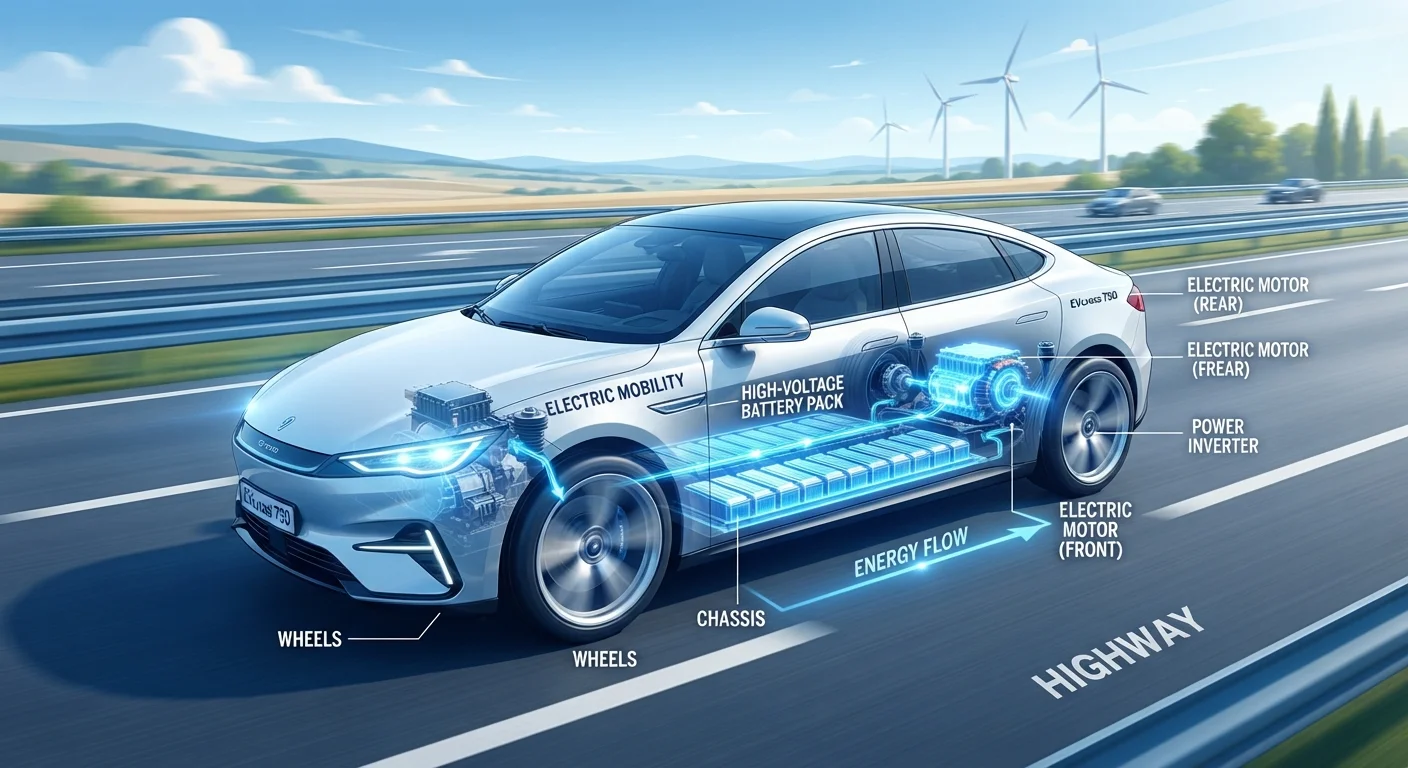
Three components do most of the work in an EV drivetrain: the battery pack, the power inverter, and the electric motor. Understanding what each one does makes the whole system easy to follow.
85-95%
Energy efficiency of a typical electric motor
Electric motors convert the vast majority of electrical input into motion, compared to roughly 20-40% for a conventional internal combustion engine.
~20
Moving parts in an EV motor vs. hundreds in a combustion engine
The reduced mechanical complexity of an electric drivetrain is frequently cited by engineers as a key long-term reliability advantage.
0 rpm
RPM at which an EV motor reaches peak torque
Unlike petrol engines that build torque as revs rise, electric motors produce maximum rotational force the instant they begin turning.
The Battery Pack: The Car's Fuel Tank and More
Think of the battery pack as both the fuel tank and the energy source. Unlike a conventional car's 12-volt starter battery, an EV's drive battery is a large, high-voltage assembly - typically 400 volts or higher - made up of hundreds or thousands of individual lithium-ion cells grouped into modules.
The cells store electrical energy chemically. When the car needs power, a chemical reaction inside each cell releases electrons, which flow as electrical current. A dedicated battery management system (BMS) monitors every cell continuously, keeping temperatures in a safe range and preventing overcharging or deep discharge that would shorten the battery's life.
The battery pack sits low in the vehicle - often along the floor between the axles - which keeps the center of gravity low and improves handling stability.
The Inverter and Motor: Turning Electricity Into Spin
Battery packs store and deliver direct current (DC) - electricity that flows in one direction. But most EV drive motors run on alternating current (AC), which reverses direction rapidly. The power inverter bridges that gap, converting DC from the battery into AC for the motor. It also controls how much power reaches the motor, giving you smooth, proportional acceleration when you press the pedal.
Inside the electric motor, the AC creates a rapidly rotating magnetic field. A central shaft - the rotor - is pulled along by that spinning field, and the result is continuous rotational motion. That rotation travels through a simple single-speed reduction gear to the drive axle and then to the wheels.
One practical benefit: electric motors produce their maximum torque (rotational force) the moment they start turning. There is no need to rev up through a power band the way a petrol engine must. This is why even modestly powered EVs feel responsive and quick off the line.
“The electric motor is one of the most efficient machines humans have ever built. The question was never whether it could move a car - it was always about storing enough energy to make it practical.”
— Automotive Engineering Educators, Consensus view among mechanical and electrical engineering faculty in EV curriculum development
Regenerative Braking: Recapturing Energy on the Way Down
One of the most elegant features of an EV drivetrain is regenerative braking. When you ease off the accelerator or apply the brake pedal, the electric motor switches roles and acts as a generator. The car's forward momentum spins the motor in reverse, producing electricity that feeds back into the battery pack.
The result is a modest but meaningful energy recovery that extends driving range - particularly in stop-and-go city driving where braking is frequent. Drivers often notice a slight slowing sensation when they lift off the accelerator; that resistance is the motor harvesting energy.
Maximize Range With Regenerative Braking
Most EVs let you adjust the strength of regenerative braking through the vehicle settings or drive mode selector. A stronger setting slows the car more aggressively when you lift off the pedal, recovering more energy. In city driving with frequent stops, a higher regenerative setting can noticeably extend your range between charges.
For context on how different this is from a conventional fuel path, see our guide to the petrol fuel system journey - from tank to combustion chamber, it is a considerably longer and more complex chain of components.
What Is Missing - and Why That Matters
Because no fuel burns, an EV has no exhaust pipe, no catalytic converter, no multi-speed transmission, and no engine oil to change. The overall mechanical complexity is substantially lower than a petrol or diesel powertrain.
Fewer moving parts generally means fewer things that can wear out or fail. Electric motors have a long service life, and without gearshifts, clutch wear is not a concern. Brake pads also tend to last longer because regenerative braking handles much of the deceleration work before friction brakes are even needed.
If you are building a mental map of how a complete car works - combustion systems, electrical systems, and everything in between - our introduction to how cars work is a useful starting point. Electric drivetrains represent one of the most significant shifts in automotive engineering in over a century, yet the underlying principle is straightforward: move electrons, spin a motor, drive the wheels.