
Think of It as a Rhythm Your Engine Never Stops Keeping
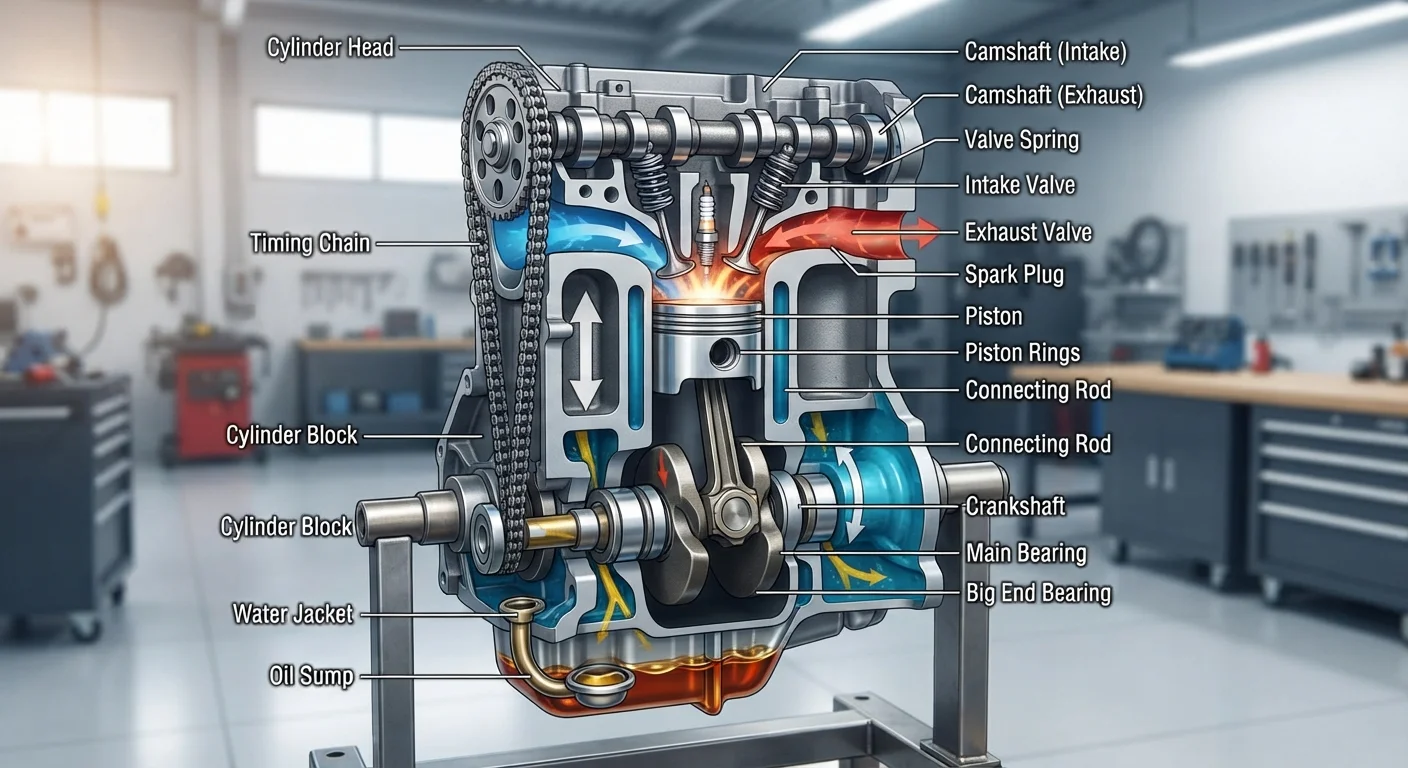
Right now, if your car is running, the engine inside it is performing the same four-step sequence over and over - dozens of times every second. It's so fast and so automatic that most drivers never think about it. But understanding what's happening gives you a clearer picture of why your car needs fuel, air, spark plugs, and oil to keep going.
This cycle - intake, compression, combustion, exhaust - is the heartbeat of almost every gasoline-powered car ever built. It's part of how all the major systems in a car connect. Let's walk through each step as if you're watching a single cylinder from the inside.
4
Piston strokes per complete engine cycle
Each cylinder completes all four strokes - intake, compression, combustion, exhaust - before repeating the sequence.
~700-4,000 RPM
Typical engine speed range from idle to cruise
RPM (revolutions per minute) reflects how many times the crankshaft rotates; two rotations equal one full four-stroke cycle per cylinder.
1 in 4
Strokes that actually produce power
Only the combustion (power) stroke generates force; the other three strokes are necessary preparation and cleanup.
Stroke 1: Intake - Letting the Good Stuff In
The cycle begins with the piston moving downward inside the cylinder. As it drops, it creates a partial vacuum - think of pulling the plunger back in a syringe. That vacuum draws in a precisely measured mixture of air and gasoline through an open intake valve at the top of the cylinder.
This is why a clean air filter matters. If the air coming in is restricted or dirty, the engine can't fill the cylinder properly, and performance suffers. The journey fuel takes from the tank to the cylinder is more involved than most drivers realise.
Stroke 2: Compression - Squeezing for Power
With the intake valve now closed, the piston reverses and moves upward, squeezing the air-fuel mixture into a much smaller space at the top of the cylinder. This compression is critical - the tighter the squeeze, the more energy the explosion will release.
This is also why engine compression matters when diagnosing problems. A cylinder that can't hold compression - due to worn piston rings or a leaking valve - won't produce much power from that stroke, no matter how good the fuel is.
Check Your Compression Ratio in Your Owner's Manual
Your car's owner's manual lists the engine's compression ratio - a number like 10:1 or 11:1. This tells you how tightly the mixture is squeezed before ignition. Higher ratios generally mean more efficiency, but they also typically require higher-octane fuel. Using the correct fuel grade protects the compression stroke from a phenomenon called engine knock, where the mixture ignites prematurely.
Stroke 3: Combustion - The Only Stroke That Makes Power
At the top of the compression stroke, the spark plug fires a tiny electrical spark into the compressed mixture. The mixture ignites, expanding rapidly and driving the piston downward with significant force. This downward push turns the crankshaft - the rotating shaft that ultimately connects to your wheels.
This is the only stroke of the four that generates power. The other three exist purely to make this one moment possible. It's worth noting that spark plugs wear over time, and a weak spark means a weaker, less efficient burn. That's one reason regular tune-ups remain important even on modern vehicles.
“The internal combustion engine is fundamentally a machine that converts the chemical energy stored in fuel into mechanical work - and that conversion happens in a very small space, very quickly, and thousands of times a minute.”
— Engineering Explained (Jason Fenske), Automotive engineer and widely followed mechanical education communicator
Stroke 4: Exhaust - Clearing the Way
After the power stroke, the piston moves back upward one final time. The exhaust valve opens, and the piston pushes the spent gases - the byproducts of combustion - out of the cylinder and into the exhaust system, which routes them toward the tailpipe.
Once the exhaust stroke completes, the intake valve opens again and the whole cycle restarts. In a four-cylinder engine, all four cylinders are doing this simultaneously but slightly out of phase with each other, so there's always one cylinder in the power stroke at any given moment - that's what keeps the engine running smoothly rather than in stuttering bursts.
Curious how this all starts when you first turn the key? Our article on what happens when you turn the ignition covers that first critical moment. And if you've wondered how an electric vehicle moves without any of this, electric cars use a fundamentally different approach.