
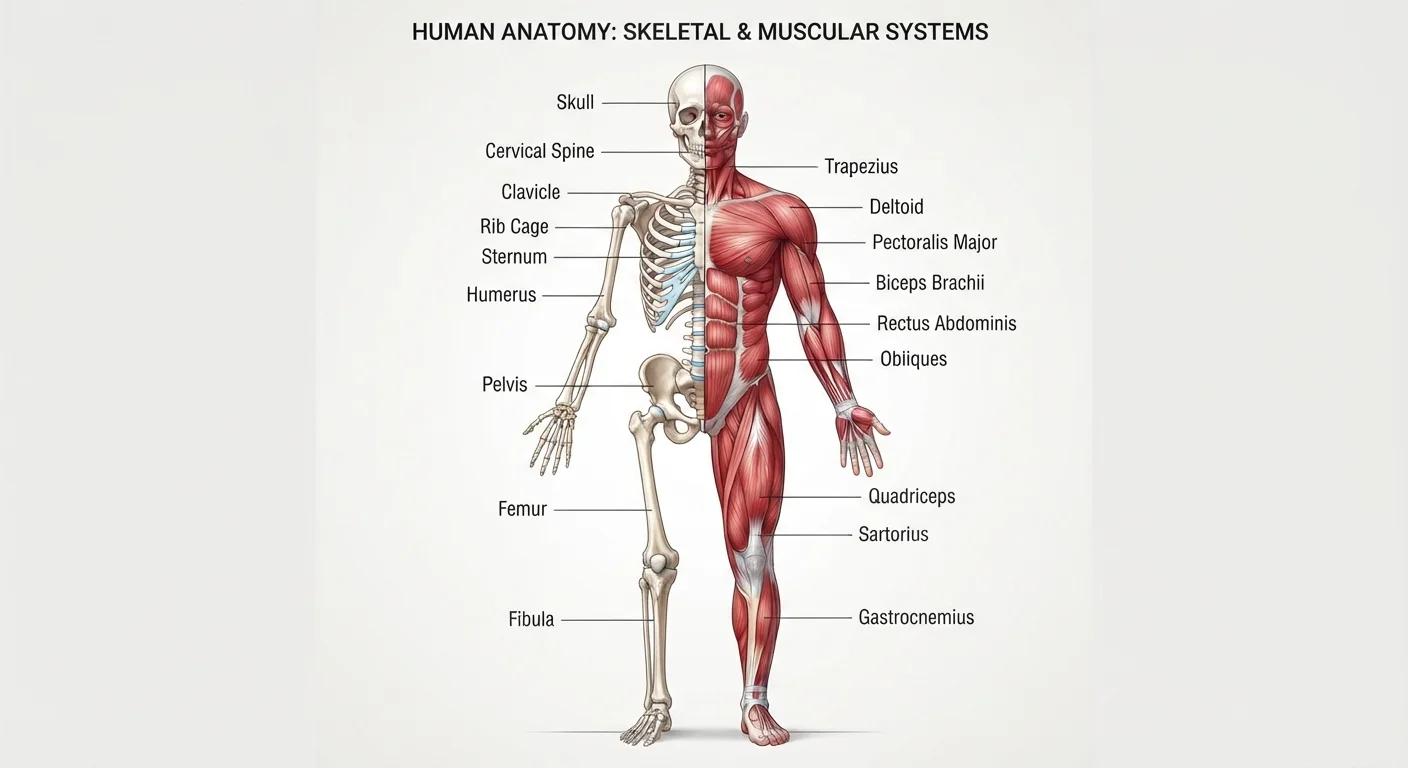
What Each System Actually Does
The skeletal system is composed of 206 bones in the average adult, along with cartilage, ligaments, and joints. Its primary roles are structural: bones form a rigid internal scaffold that supports soft tissue, gives the body its recognizable shape, and protects critical organs. The skull shields the brain; the rib cage guards the heart and lungs; the vertebral column encases the spinal cord. Bones are also metabolically active - they store calcium and phosphorus, and house bone marrow, where blood cells are produced.
The muscular system, by contrast, is built for force and motion. The body contains more than 600 named muscles, broadly divided into skeletal (voluntary), cardiac (heart), and smooth (found in organs) muscle tissue. Skeletal muscles are what most people think of when they picture muscles - they attach to bones via tendons and contract on demand, pulling bones toward one another to produce movement. But muscles do far more than move limbs; they regulate breathing, enable swallowing, control facial expression, and maintain continuous postural tone.
| Criterion | Skeletal System | Muscular System |
|---|---|---|
| Primary material | Mineralized bone tissue, cartilage | Contractile protein fibres |
| Main function | Structure, protection, support | Force generation, movement |
| Number of components | 206 bones (average adult) | 600+ named muscles |
| Active or passive? | Largely passive framework | Actively contracts on demand |
| Connects to the other via | Tendons (bone end) | Tendons (muscle end) |
| Responds to exercise by | Increasing bone density | Increasing fibre size and strength |
| Role in posture | Provides the column and joints | Actively maintains alignment |
Where They Overlap - and Why That Matters
The popular image of bones as the body's sole "support structure" is incomplete. While the skeleton provides the rigid framework, it is muscles that hold joints stable and prevent the skeleton from collapsing under load. A skeleton without muscular tension would buckle; a muscle system without a skeleton would have nothing to pull against.
Posture is a vivid example of this overlap. Sitting upright requires not just the vertebral column but a continuous, low-level contraction of spinal extensor and core muscles. Ligaments - the connective tissue linking bone to bone - also contribute, but they are largely passive; it is muscle activity that actively corrects and fine-tunes position moment to moment.
206
Bones in the average adult human body
Newborns begin with roughly 270-300 bones; many fuse together during childhood and adolescence.
~40%
Body weight accounted for by skeletal muscle
Skeletal muscle is one of the largest tissue types in the human body by mass, according to established physiology references.
4
Rotator cuff muscles stabilizing the shoulder joint
These four muscles demonstrate how muscular support compensates for a relatively shallow bony socket in one of the body's most mobile joints.
Joint stability follows the same logic. The shoulder, the body's most mobile joint, relies heavily on the rotator cuff muscles for integrity. The bones of the shoulder form a shallow socket that would dislocate easily without surrounding muscular support. In this sense, muscles often compensate for - and complete - what skeletal architecture alone cannot achieve.
Key Differences, Side by Side
Despite their interdependence, bones and muscles are distinct in composition, function, and how the body maintains them. Understanding those differences helps explain why an injury to one system has consequences for the other.
Tendons: The Critical Connector
Tendons are dense bands of connective tissue that anchor muscle to bone, transmitting the contractile force generated by muscle into skeletal movement. They are neither bone nor muscle, but the failure of a tendon - through injury or degeneration - can effectively disable both systems at once. Tendons have a relatively limited blood supply compared to muscle, which is why tendon injuries typically heal more slowly.
Bone tissue is primarily composed of collagen fibres reinforced with calcium phosphate crystals, making it hard yet slightly flexible - more like reinforced concrete than pure stone. Muscle tissue is built from protein filaments (actin and myosin) that slide past each other during contraction, a mechanism that is fundamentally different from any rigid material. Both tissues remodel in response to mechanical stress, which is why weight-bearing exercise benefits bone density and resistance training increases muscle mass.
When one system is compromised, the other often compensates - sometimes protectively, sometimes harmfully. Muscle atrophy following a fracture-related period of immobility is a well-documented consequence, and prolonged muscle weakness can alter gait patterns in ways that increase skeletal stress. This interdependence underscores why rehabilitation programs typically address both systems together rather than in isolation.
This article is for general informational purposes only and does not constitute medical advice. Always consult a qualified healthcare professional for concerns about your musculoskeletal health or any symptoms you may be experiencing.