
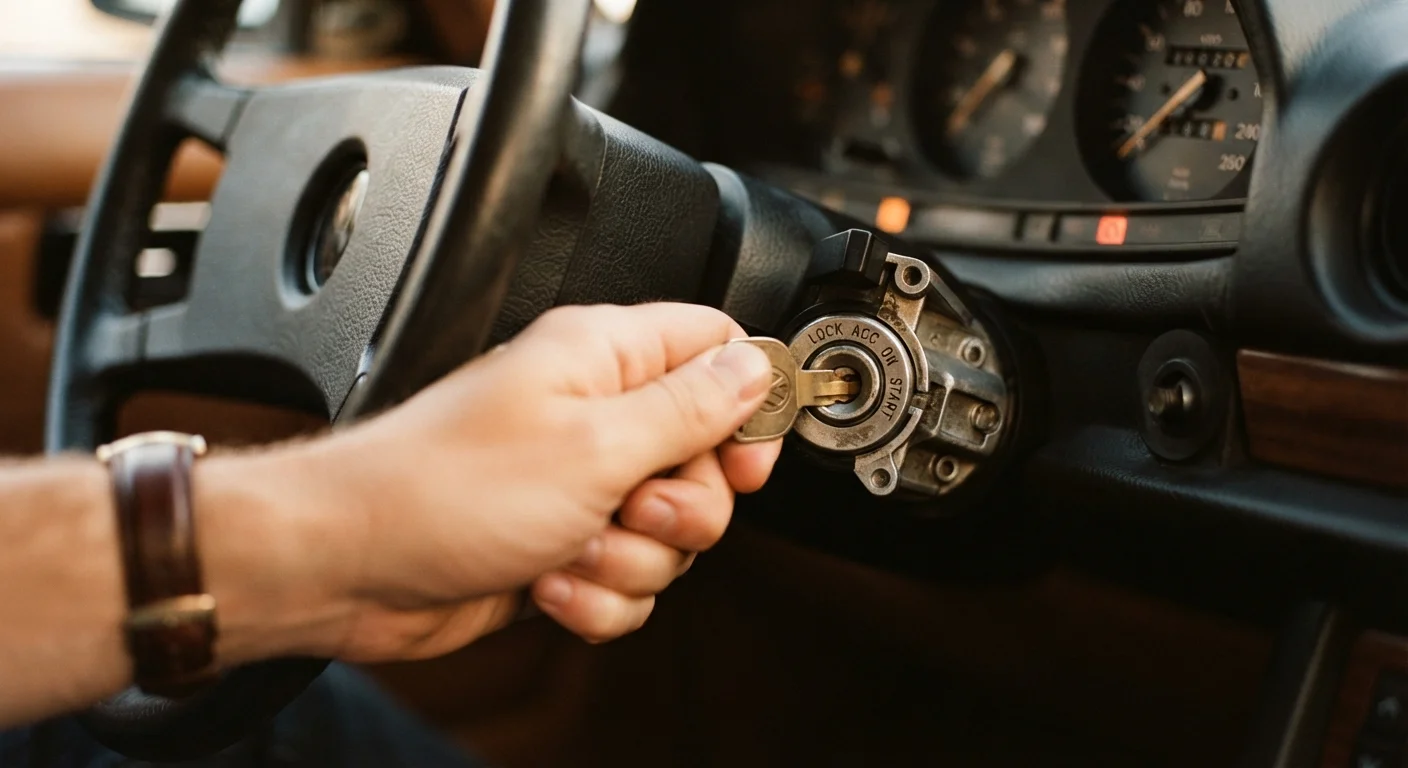
Step One: The Battery Wakes Everything Up
Before a single piston moves, your car's 12-volt battery does the heavy lifting. The moment you turn the key to the "on" position - before the full crank - the battery powers up the car's electrical systems: the fuel pump primes the fuel lines, the Engine Control Unit (ECU) runs a quick self-check, and dashboard warning lights flicker on briefly as sensors report in.
Think of it like pressing the power button on a computer. The hardware initialises before any program actually runs. If the battery is weak, this initialisation is already compromised - which is why a failing battery often shows up as sluggish electronics before the engine refuses to start entirely.
For a deeper look at how the battery fits into the bigger picture, see our introduction to how cars work.
< 2 sec
Typical time for a full ignition sequence
From key turn to a self-sustaining engine, the entire sequence in a well-maintained vehicle takes under two seconds.
~200 RPM
Engine cranking speed during startup
The starter motor spins the engine at roughly 200 RPM - well below idle speed - just enough to initiate combustion.
12 volts
Standard automotive battery voltage
Most passenger vehicles use a 12-volt lead-acid battery to power the starter motor and all electrical systems during startup.
Step Two: The Starter Motor Cranks the Engine
Turn the key all the way and you engage the starter motor - a compact but powerful electric motor mounted on the engine block. It reaches out with a small gear called a pinion, meshes with the engine's ring gear (a large toothed wheel on the flywheel), and physically spins the engine's crankshaft.
This spinning - called cranking - is what you hear as that familiar grinding-whirring sound when starting your car. The crankshaft needs to rotate fast enough to draw fuel and air into the cylinders, compress the mixture, and give the spark plugs a chance to do their job. Typical cranking speed is around 200 RPM, compared to idle speed of roughly 700-900 RPM once the engine is running on its own.
As soon as the engine fires and sustains itself, a mechanism inside the starter automatically retracts the pinion so it doesn't stay meshed with the spinning flywheel - protecting both components from damage.
Don't Hold the Key Too Long
Once the engine starts, release the key immediately. Holding it in the crank position keeps the starter motor engaged against an already-running engine, which can damage the starter's pinion gear and the flywheel ring gear. Modern push-button systems handle this automatically, but traditional key ignitions rely on you to let go.
Step Three: Fuel, Air, and Spark Create Combustion
While the starter cranks the engine, the ECU is already coordinating a precise sequence inside the cylinders. Fuel injectors spray a fine mist of gasoline; intake valves open to let air in; the piston rises to compress the mixture to a fraction of its original volume. Then the spark plug fires a small electrical spark - igniting the compressed fuel-air mix in a controlled mini-explosion.
That explosion forces the piston downward with considerable force, turning the crankshaft and generating power. With four, six, or eight cylinders each firing in a timed sequence, these pulses combine into the smooth rotation that ultimately drives your wheels.
This is where the fuel system plays its own critical role - delivering the right amount of fuel at exactly the right moment. The full journey from fuel tank to combustion chamber involves several components working in coordination with the ignition system.
When Something Goes Wrong at Startup
Understanding the ignition sequence makes it much easier to diagnose startup problems. If the engine clicks but won't crank, the battery or starter relay is the likely fault. If it cranks slowly, the battery charge is low. If it cranks normally but won't fire, the problem is usually fuel delivery or spark - a flooded engine, a failing fuel pump, or worn spark plugs.
One of the most common real-world scenarios is a flat battery, which stops the sequence at step one. In that case, jump-starting can bridge the gap. Jump-starting a car safely requires the correct cable connection sequence - getting the order wrong can damage electronics or cause a spark near the battery.
Push-Button and Keyless Start Systems
Push-button ignition systems follow the same fundamental sequence - battery, starter, combustion - but add a wireless authentication step. The key fob broadcasts a rolling security code; the car's immobiliser verifies it before allowing the starter to engage. If the fob battery is low, the car may not recognise it even if it's in your pocket.