
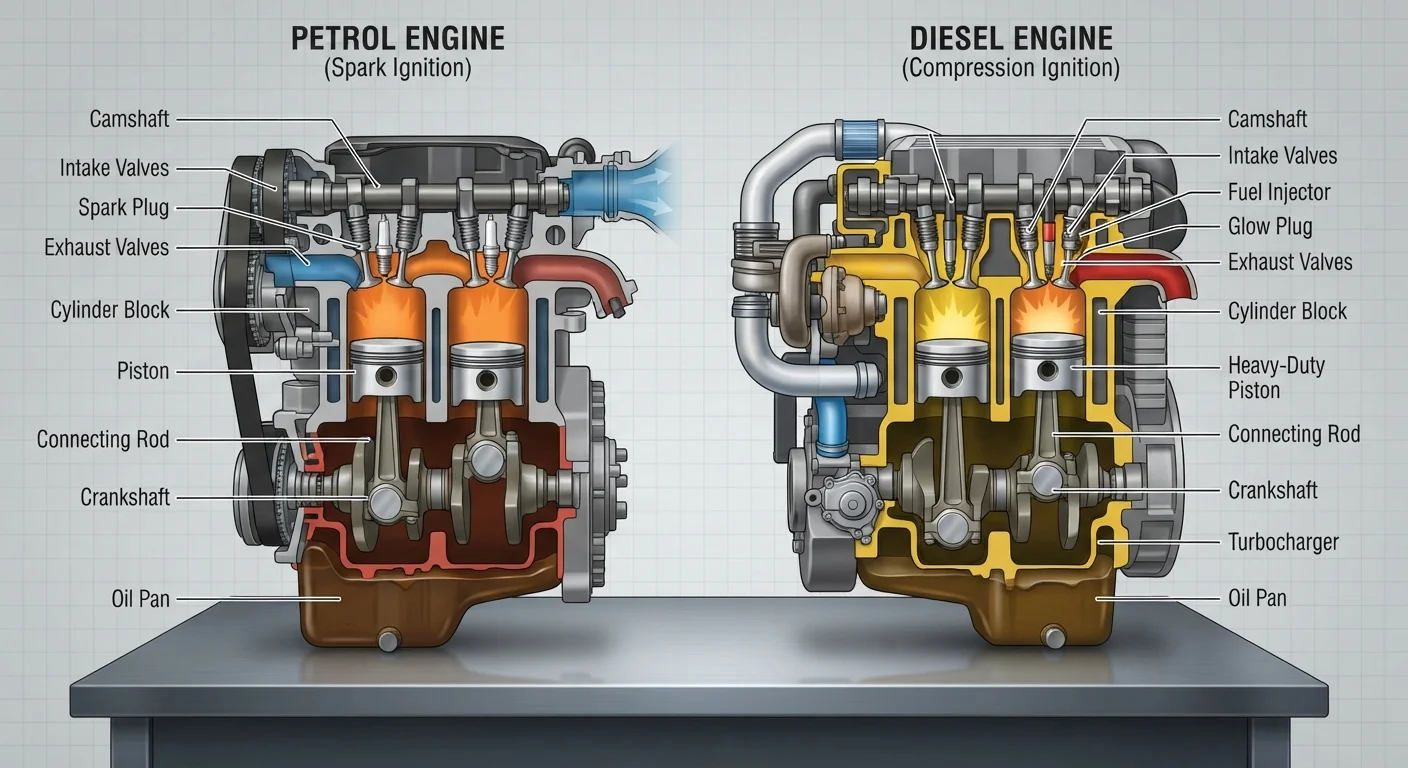
The Core Difference: How Each Engine Ignites Fuel
At their hearts, both petrol and diesel engines are internal combustion engines - they burn fuel inside a cylinder to push a piston, which ultimately turns your wheels. The four-stroke cycle (intake, compression, combustion, exhaust) applies to both. You can read a deeper breakdown in The Four-Stroke Engine Cycle, Explained Without the Jargon.
The critical difference lies in how combustion is triggered:
- Petrol engines mix fuel and air in the cylinder, then fire a spark plug to ignite that mixture at a precise moment.
- Diesel engines contain no spark plugs at all. Instead, they compress air so intensely - at ratios roughly twice that of a petrol engine - that the air becomes hot enough to ignite diesel fuel the instant it is injected. This is called compression ignition.
Think of it this way: a petrol engine is like lighting a gas grill with a starter button. A diesel engine is like pumping a bicycle pump so hard and fast that the air inside gets hot enough to start a fire on its own.
| Criterion | Petrol Engine | Diesel Engine |
|---|---|---|
| Ignition method | Spark plug ignites fuel-air mix | Compression heat ignites fuel |
| Typical compression ratio | 8:1 to 12:1 | 14:1 to 25:1 |
| Torque delivery | Peak torque at higher RPM | Peak torque at low RPM |
| Fuel economy (highway) | Good | Generally better |
| Fuel economy (city) | Comparable or better | Less efficient at low loads |
| Engine noise | Quieter, smoother idle | Louder, characteristic clatter |
| Best suited for | City driving, lighter vehicles | Towing, hauling, long distances |
| Common emission concern | Carbon dioxide (CO₂) | Nitrogen oxides (NOₓ) and soot |
Compression Ratios, Torque, and Power Delivery
Because diesel engines compress air so aggressively - typical compression ratios range from 14:1 to 25:1 compared to 8:1 to 12:1 for most petrol engines - they must be built with heavier, stronger internal components. This added robustness contributes to diesel engines generally lasting longer under sustained use.
That extreme compression also explains diesel's defining characteristic: high torque at low engine speeds. Torque is the rotational force that actually moves the car from a standstill or pulls a trailer uphill. Diesel engines deliver their peak torque at relatively low RPMs (revolutions per minute), which means strong pulling power without needing to rev the engine hard.
Petrol engines, by contrast, tend to produce peak power at higher RPMs. They feel lively and responsive when you rev them, which suits spirited city driving. However, they typically produce less low-end torque than a comparable diesel.
~15%
More energy per gallon in diesel vs petrol
Diesel fuel's higher energy density is a key factor in its fuel economy advantage on highway routes.
14:1-25:1
Typical diesel engine compression ratio
This range is roughly double the compression ratio of most petrol engines, enabling compression ignition without spark plugs.
~40%
Diesel engine thermal efficiency (approx.)
Diesel engines convert a higher share of fuel energy into usable work compared to typical petrol engines, which generally reach around 25-30%.
For drivers interested in how forced induction further shapes power delivery, see Turbochargers and Superchargers: How Forced Induction Boosts Engine Power. Both engine types are commonly turbocharged today - diesel almost universally so.
Fuel, Efficiency, and Engine Maintenance
Petrol and diesel are both refined from crude oil, but they are chemically distinct. Diesel fuel is denser and contains approximately 10-15% more energy per gallon than petrol. Combined with the diesel engine's more efficient combustion process, this generally translates to better fuel economy - particularly on the highway where engines run at steady loads.
In city driving, however, the efficiency gap narrows. Diesel engines are less efficient at idle and in frequent stop-start conditions, partly because they need to stay warm to work properly.
Maintenance profiles differ in a few key ways:
- Diesel engines often require higher-viscosity engine oil and more frequent oil changes due to the stresses of high compression. See Engine Oil Explained: Grades, Types, and Why It Matters for more on reading oil specifications.
- Modern diesel engines include a Diesel Particulate Filter (DPF) to trap soot emissions. Short city trips can prevent the DPF from regenerating properly, leading to costly blockages.
- Petrol engines use spark plugs that wear over time and need periodic replacement - something diesels skip entirely.
Understanding how fuel travels from the tank to the combustion chamber is equally relevant for both engine types. The Fuel System Journey: From Petrol Tank to Combustion Chamber walks through that path in plain language.
Putting Diesel in a Petrol Engine (or Vice Versa)
Using the wrong fuel type is a serious mistake. Diesel fuel in a petrol engine can clog injectors and prevent ignition. Petrol in a diesel engine is more damaging - it strips lubrication from the high-pressure fuel pump and can cause expensive component failure. If you accidentally misfuel, do not start the engine. Contact a roadside assistance provider to have the tank drained professionally.
Which Engine Type Suits Your Driving Life?
Neither engine type is universally superior - the right choice depends on how and where you drive. A petrol engine suits a driver who covers mostly short urban distances, values a quieter, smoother idle, and wants straightforward, familiar maintenance. A diesel engine rewards drivers who rack up long highway miles, regularly tow or carry heavy loads, or want to extract maximum range from each tank.
It's also worth noting that both engine types are increasingly being replaced or supplemented by hybrid and fully electric powertrains. If you're curious how a car can move with no combustion at all, How Electric Cars Move Without a Traditional Engine explains the fundamentals clearly.
And if you're thinking about how the gearbox interacts with either engine type, Automatic vs Manual Transmission: What the Difference Means for the Driver is a natural next read.