
Why Engines Need More Air
An engine makes power by burning a mixture of air and fuel. The more of that mixture it can ignite on each stroke, the more power it generates. A naturally aspirated engine - one with no forced induction - can only pull in as much air as atmospheric pressure allows. That's a real ceiling on performance.
Forced induction breaks through that ceiling by pushing extra air into the cylinders under pressure. With more air available, the engine can inject more fuel and produce a bigger combustion event - meaning more power from the same basic engine. If you want a refresher on what happens inside an engine on every revolution, see our guide to the four-stroke engine cycle.
The two most common forced induction systems - the turbocharger and the supercharger - both pressurize incoming air, but they tap into completely different energy sources to spin their compressors.
How a Turbocharger Works
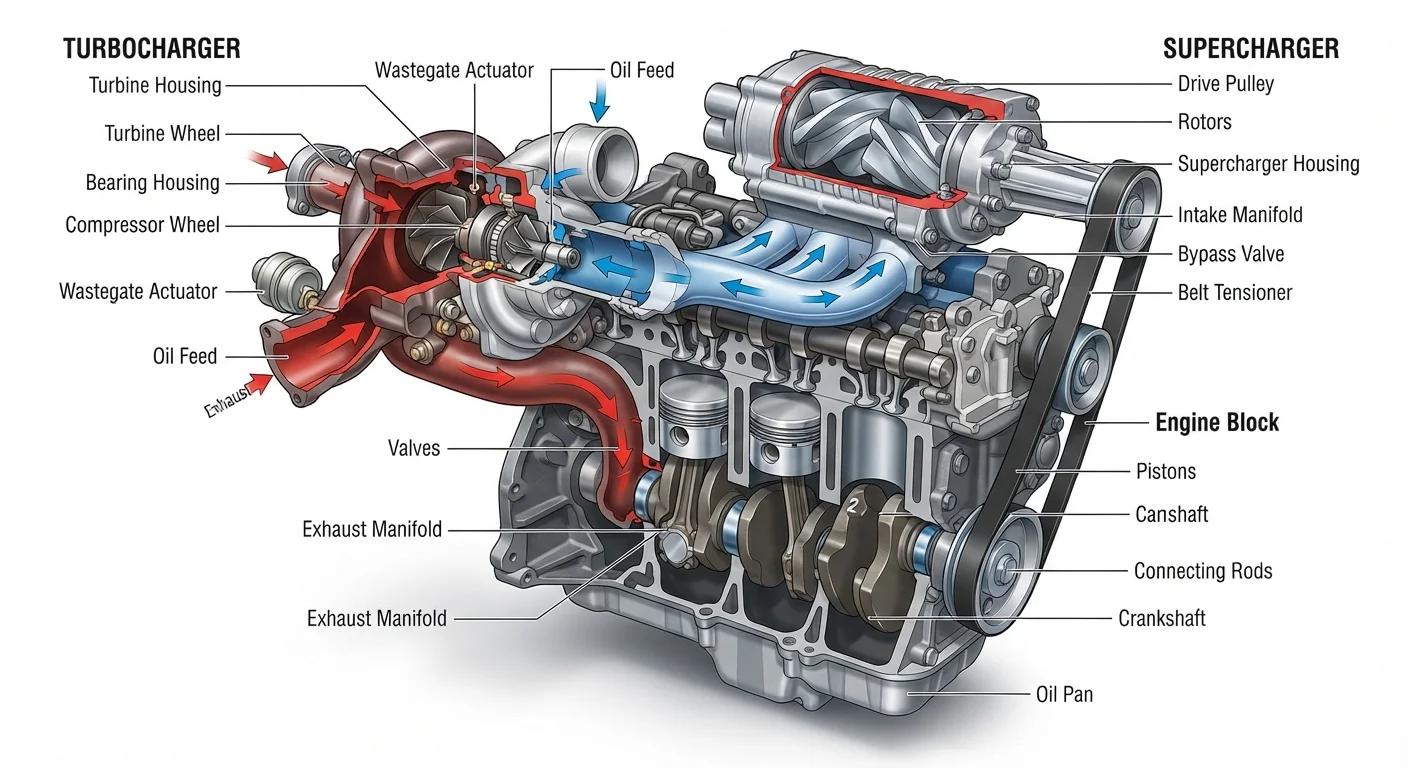
A turbocharger is essentially two small fans connected by a single shaft, housed inside a compact metal unit. One fan - the turbine - sits in the exhaust stream. Hot exhaust gases rushing out of the engine spin this turbine at extremely high speed (often 100,000 RPM or more). Because both fans share the same shaft, that spinning motion also drives the second fan - the compressor - which pulls in fresh air, compresses it, and pushes it into the engine.
In other words, a turbo is powered by energy that would otherwise be wasted out the tailpipe. That's why turbocharged engines are often more fuel-efficient than equivalent naturally aspirated engines - they recover exhaust energy rather than burning extra fuel to make power.
Reducing Turbo Lag in Modern Engines
Engineers use several strategies to minimize turbo lag: smaller turbine housings spool up faster, twin-scroll turbines separate exhaust pulses for better flow, and some hybrids add an electric motor to the turbo shaft for near-instant response. If you test drive a modern turbocharged car, lag is often barely noticeable in normal driving.
The trade-off is turbo lag - a brief delay between pressing the accelerator and feeling the full power surge. This happens because the turbine needs a moment to spin up as exhaust pressure builds. Modern engineering has reduced lag significantly through smaller turbine housings, twin-scroll designs, and variable geometry turbines.
How a Supercharger Works
A supercharger also compresses air before it enters the engine, but it gets its power from a completely different place: a belt connected directly to the engine's crankshaft. As the engine runs, it mechanically drives the supercharger's compressor at all times.
The immediate benefit is instant response. Because the supercharger is always spinning in sync with the engine, there's no lag - you press the pedal and the power arrives immediately. This makes superchargers popular in high-performance and muscle-car applications where linear, predictable power delivery matters.
The drawback is efficiency. Because the supercharger steals some of the engine's own output to run itself, it consumes power even as it creates it. The net gain is still substantial, but it's less efficient than recovering waste exhaust energy the way a turbocharger does. For context on how different engine types handle power generation differently, our petrol vs diesel comparison covers related ground.
| Turbocharger | Supercharger | |
|---|---|---|
| Power source | Exhaust gas energy | Engine crankshaft (belt-driven) |
| Throttle response | Slight lag at low RPM | Instant, no lag |
| Fuel efficiency | Higher - recycles waste energy | Lower - draws from engine output |
| Complexity | Higher (heat management needed) | Moderate (simpler installation) |
| Common applications | Modern passenger cars, diesel trucks | Performance/muscle cars, some SUVs |
| Typical power gain | 30-40% over base engine | 30-50% over base engine |
Which System Do Modern Cars Use?
Turbocharged engines have become the dominant choice in modern passenger vehicles. Automakers use small-displacement turbocharged engines - sometimes called "downsized" engines - to meet fuel economy and emissions standards while still delivering satisfying performance. A 1.5-liter turbocharged four-cylinder, for instance, can produce power figures that once required a 2.5-liter naturally aspirated engine.
Superchargers remain more common in performance-focused vehicles and in applications where packaging or throttle response is prioritized over outright efficiency. Some designs combine both technologies - known as twin-charging - using a supercharger for low-RPM response and a turbocharger for high-RPM power.
~70%
New US cars with turbocharged engines
Industry analysts estimate that roughly 70% of new passenger vehicles sold in the US now feature turbocharged engines, up from under 10% two decades ago.
100,000+ RPM
Typical turbocharger shaft speed
Turbocharger turbines routinely spin at over 100,000 revolutions per minute - roughly 30 times faster than a typical engine redline.
Neither system requires special driving habits for everyday use, but both benefit from proper warm-up periods and high-quality engine oil. Turbocharged engines in particular can be sensitive to oil quality because the turbo bearings operate at very high temperatures. A qualified mechanic can advise on the correct service intervals for any forced induction vehicle.