
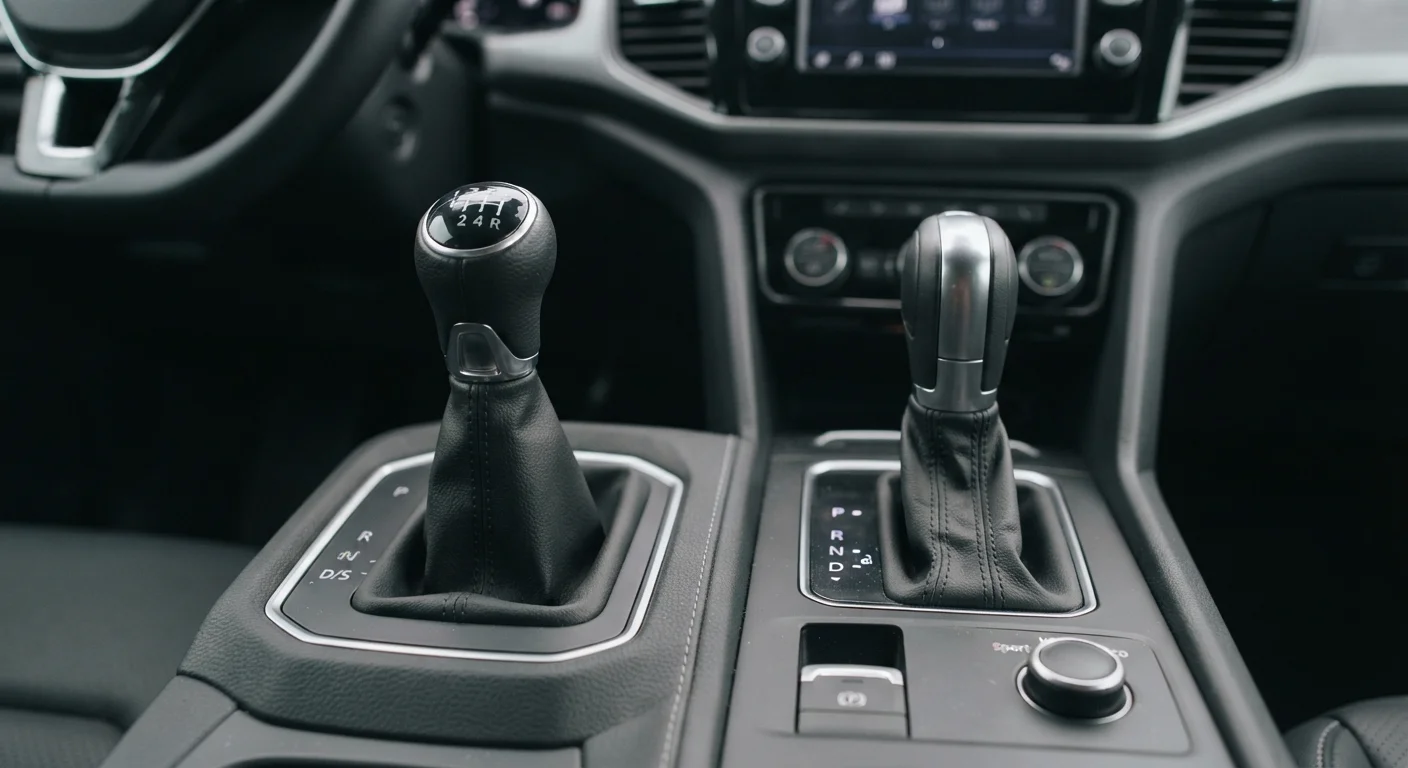
How Each Transmission Actually Works
At its core, a transmission's job is straightforward: take power produced by the engine and deliver it to the wheels at the right ratio for the current speed and driving demand. Both automatic and manual transmissions accomplish this, but they go about it very differently.
A manual transmission uses a set of physical gear pairs inside a metal housing. The driver presses the clutch pedal - which temporarily disconnects the engine from the transmission via a friction disc called the clutch plate - selects a gear with the shift lever, then releases the clutch to re-engage the engine. Each gear provides a different mechanical advantage: lower gears multiply engine torque for acceleration; higher gears allow efficient cruising at speed.
An automatic transmission replaces the clutch pedal and manual gear selection with a torque converter (a fluid coupling device) and a planetary gear set controlled by hydraulic pressure and, in modern vehicles, an onboard computer. The transmission monitors vehicle speed, throttle position, and load, then selects the appropriate gear without driver input. Some automatics also offer a manual mode or paddle shifters, letting drivers suggest a gear without fully taking over.
A third variant worth knowing is the continuously variable transmission (CVT), which uses a belt and pulley system to provide a theoretically infinite range of gear ratios - no discrete gear steps at all. CVTs are common in fuel-efficient commuter vehicles. For a broader look at how power gets from the engine to the wheels, see our guide on drivetrain layouts.
| Criterion | Automatic | Manual |
|---|---|---|
| Gear changes | Handled automatically by the vehicle | Driver selects each gear manually |
| Clutch pedal | None required | Required for every gear change |
| Learning curve | Lower - focus on throttle and brakes | Higher - clutch control takes practice |
| City traffic ease | High - no clutch fatigue | Lower - constant clutch use |
| Fuel economy (modern) | Comparable or better in many vehicles | Slight edge in older or simpler vehicles |
| Driver engagement | Lower - more passive experience | Higher - active gear selection |
| Typical repair cost | Higher if major work is needed | Clutch replacement is main wear item |
| US market availability | Very wide - majority of new cars | Limited - fewer models offer manual |
What This Means Behind the Wheel
The mechanical differences translate directly into a different driving experience. With a manual, the driver is an active participant in every gear change. Getting smooth starts from a stop takes practice - releasing the clutch too quickly causes the engine to stall; too slowly creates excess heat and wear on the clutch plate. Mastering this feel, called the friction point, is what separates smooth manual drivers from jerky ones.
With an automatic, the driver focuses on throttle and brakes. This lowers the mental load in demanding environments like dense city traffic, which is part of why automatics now represent the overwhelming majority of new vehicles sold in the United States. That said, because automatic transmissions make gear decisions algorithmically, there are moments - like when you want immediate downshift power for overtaking - where the transmission's timing may not match driver intent. Most drivers adapt quickly; performance-focused drivers sometimes find the delay frustrating.
~96%
Share of US new cars sold with automatic transmission
Industry sales data consistently shows manual transmissions representing a very small fraction of new vehicle sales in the United States.
50K-100K miles
Typical manual clutch lifespan
Clutch longevity varies widely based on driving habits, traffic conditions, and how smoothly the driver operates the friction point.
Maintenance considerations differ too. A manual clutch is a wear item that will eventually need replacement - typically somewhere between 50,000 and 100,000 miles, depending heavily on driving habits. Automatic transmissions require periodic transmission fluid changes and are generally more expensive to rebuild if problems develop. Neither type is maintenance-free, but the failure modes are different. Just as engine oil type matters for longevity, so does using the correct transmission fluid - for a comparable fluids comparison, see synthetic vs. conventional oil.
Fuel Economy, Performance, and the Modern Reality
For years, the manual transmission had a clear efficiency edge. Because the driver controlled shift points and there was no torque converter slipping power away, manuals typically returned better miles per gallon than their automatic counterparts. That advantage has largely evaporated.
Modern automatics with eight, nine, or ten speeds can keep the engine closer to its efficient operating range than most drivers would manage manually. CVTs push this further by eliminating fixed steps entirely. In EPA testing, many current vehicles achieve equal or better fuel economy with the automatic option compared to the manual.
On the performance side, dual-clutch transmissions (DCTs) - which use two clutch packs and shift in milliseconds - have made automatics genuinely faster in acceleration testing than manual equivalents in many sports cars. The manual's performance argument now rests more on driver involvement and control feel than raw speed.
Understanding how transmission choice interacts with engine type also matters. Diesel engines, for example, produce peak torque at low RPMs, which changes how gear ratios are used. Our article on petrol vs. diesel engines explains those distinctions in detail.
What About Electric Vehicles?
Electric vehicles (EVs) use neither a traditional automatic nor a manual transmission. Because electric motors deliver torque across a very wide RPM range, most EVs use a single fixed-ratio gear reduction - no shifting required at all. This is one reason EVs feel so smooth and immediate from a stop. As EV adoption grows, the automatic vs. manual question becomes less relevant for that segment of the market.