
What Does "Drivetrain" Actually Mean?
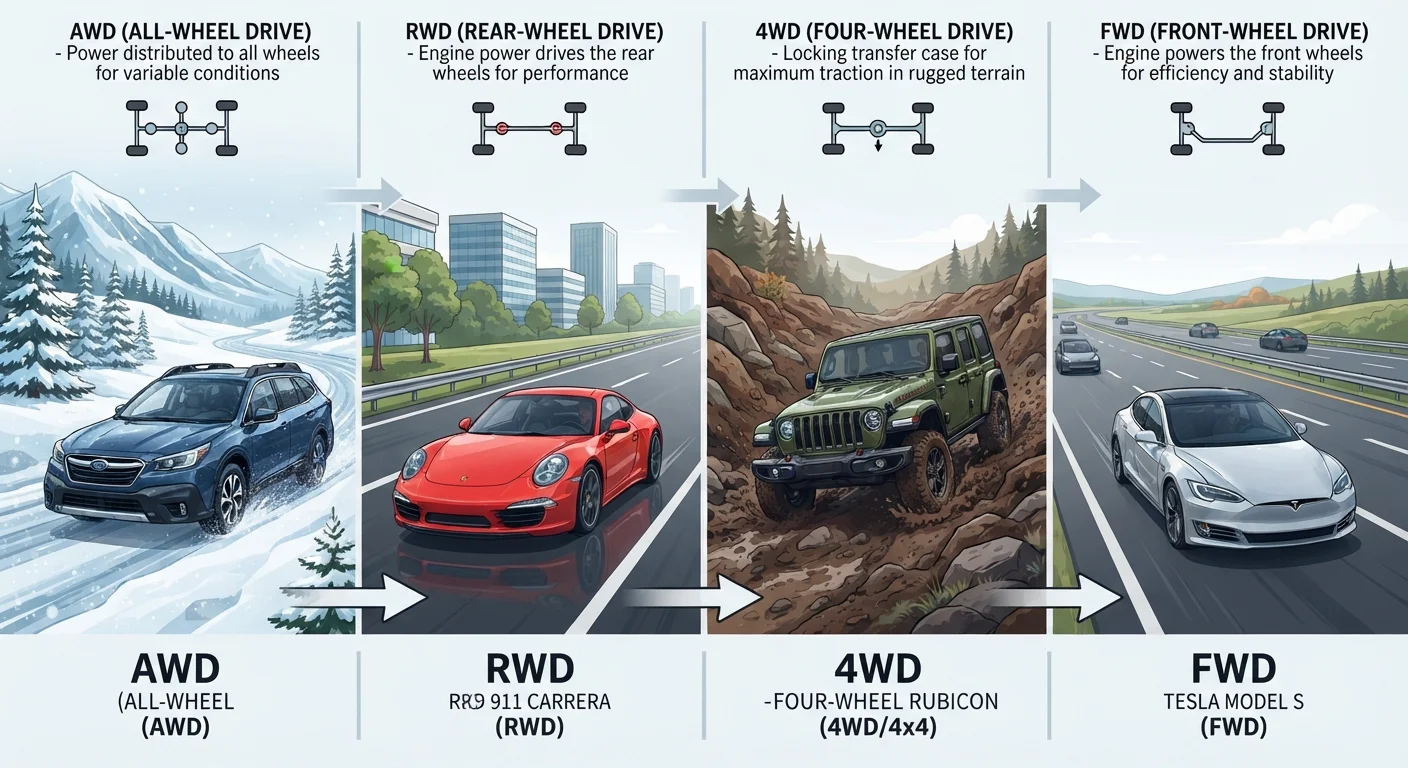
The drivetrain is the system that moves power from the engine to the wheels that actually push or pull the car forward. The Car Systems Glossary defines it plainly: it includes the transmission, driveshaft, differentials, and axles - everything between the engine and the road surface. The key question any drivetrain must answer is: which wheels receive power, and when?
There are four common layouts used in passenger vehicles today - Front-Wheel Drive (FWD), Rear-Wheel Drive (RWD), All-Wheel Drive (AWD), and Four-Wheel Drive (4WD). Each has a distinct mechanical approach, a set of strengths, and real-world limitations worth knowing before you find yourself on icy roads or a muddy trail.
The Four Layouts, Side by Side
Here's how the four drivetrain systems compare across the criteria that matter most to everyday drivers.
| FWD | RWD | AWD | 4WD | |
|---|---|---|---|---|
| Wheels powered | Front two only | Rear two only | All four, automatic | All four, driver-selected |
| Typical vehicle types | Sedans, hatchbacks, minivans | Sports cars, trucks, large SUVs | Crossovers, wagons, SUVs | Pickup trucks, off-road SUVs |
| Wet/snow traction | Good | Fair (can oversteer) | Very good | Very good (in 4WD mode) |
| Off-road capability | Limited | Moderate | Moderate | Excellent |
| Fuel efficiency impact | Minimal penalty | Minimal penalty | Slight penalty | Moderate penalty |
| Driver action required | None | None | None | Must engage manually |
| Handling character | Understeer tendency | Balanced, agile | Neutral, stable | Heavy, truck-like |
The table above captures the essentials, but each layout deserves a closer look - because the numbers and labels only tell part of the story.
FWD and RWD: The Two Most Common Setups
Front-Wheel Drive (FWD) sends engine power only to the front wheels, which both steer and propel the vehicle. Packaging the engine and drivetrain over the driven wheels gives FWD a natural traction advantage in rain and light snow, since that weight pushes down on the wheels doing the work. It's mechanically simpler than systems that power all four wheels, which keeps manufacturing costs - and often fuel consumption - lower. The trade-off is a handling behavior called understeer: when cornering hard, FWD cars tend to push wide rather than rotate neatly. For most daily driving, this is a non-issue.
Rear-Wheel Drive (RWD) sends power to the back wheels while the front wheels focus solely on steering. Separating steering from propulsion creates a more balanced weight distribution and sharper cornering feel - which is why performance cars, trucks, and many larger SUVs use it. The downside: in snow or rain, power to the rear can cause the back end to slide sideways (oversteer) if the driver isn't careful. Modern RWD vehicles use electronic stability control to catch this, but the physics remain.
Tires Matter More Than Drivetrain
A FWD car on quality winter tires will outperform an AWD vehicle on all-season tires in heavy snow. AWD helps power reach the road, but stopping and cornering grip depend almost entirely on tire compound and tread depth. If you drive in a snowy climate, invest in dedicated winter tires before upgrading drivetrain.
AWD and 4WD: When You Need More Grip
All-Wheel Drive (AWD) delivers power to all four wheels, but does so automatically and continuously using sensors that detect wheel slip. When one wheel loses grip - say, on a slick patch - the system shifts torque toward the wheels with better traction without any driver input. AWD is common in crossovers and family SUVs. It handles mixed conditions well but adds mechanical complexity and a modest fuel economy penalty. Importantly, AWD helps you accelerate on slippery surfaces; it does not shorten your stopping distance. Good winter tires still matter enormously. See our guide on driving in extreme conditions for a fuller picture of how road surface affects vehicle behavior.
Four-Wheel Drive (4WD) is a driver-engaged system, typically found on pickup trucks and body-on-frame SUVs. You select 4WD manually - usually with a switch, dial, or lever - and power locks to all four wheels simultaneously. Many 4WD systems offer a low-range gear (often labeled 4-Lo) that multiplies torque for crawling over rocks or through deep mud. Running 4WD on dry pavement can actually damage the drivetrain because the front and rear axles can't rotate at different speeds around corners. It's a purpose-built tool: formidable off-road, but not a daily-driving setup.
~80%
New US cars sold with FWD or AWD
Industry sales data consistently shows front- and all-wheel drive configurations dominate the US new-vehicle market, with RWD concentrated in trucks and performance segments.
5-10%
Typical AWD fuel economy penalty
The US EPA notes that AWD systems generally reduce fuel economy by roughly 1-3 mpg compared to equivalent two-wheel-drive models, depending on vehicle weight and system design.
Choosing What Fits Your Driving Reality
The right drivetrain depends on where and how you actually drive - not worst-case scenarios you imagine but rarely encounter. Most US commuters driving paved roads in moderate climates will find FWD entirely capable. Drivers in regions with heavy winter snowfall or those who venture onto unpaved roads regularly will notice a genuine benefit from AWD. Serious off-roaders, farmers, or those towing heavy trailers on rough terrain are the audience 4WD was built for.
One thing applies across all four layouts: the drivetrain only controls how power reaches the wheels. It cannot overcome worn tires, excessive speed, or poor road judgment. Pairing the right drivetrain with appropriate tires - including dedicated winter tires where needed - makes a far bigger safety difference than upgrading from one drivetrain type to another. The transmission you pair with your drivetrain also shapes the overall driving experience in ways worth understanding separately.