
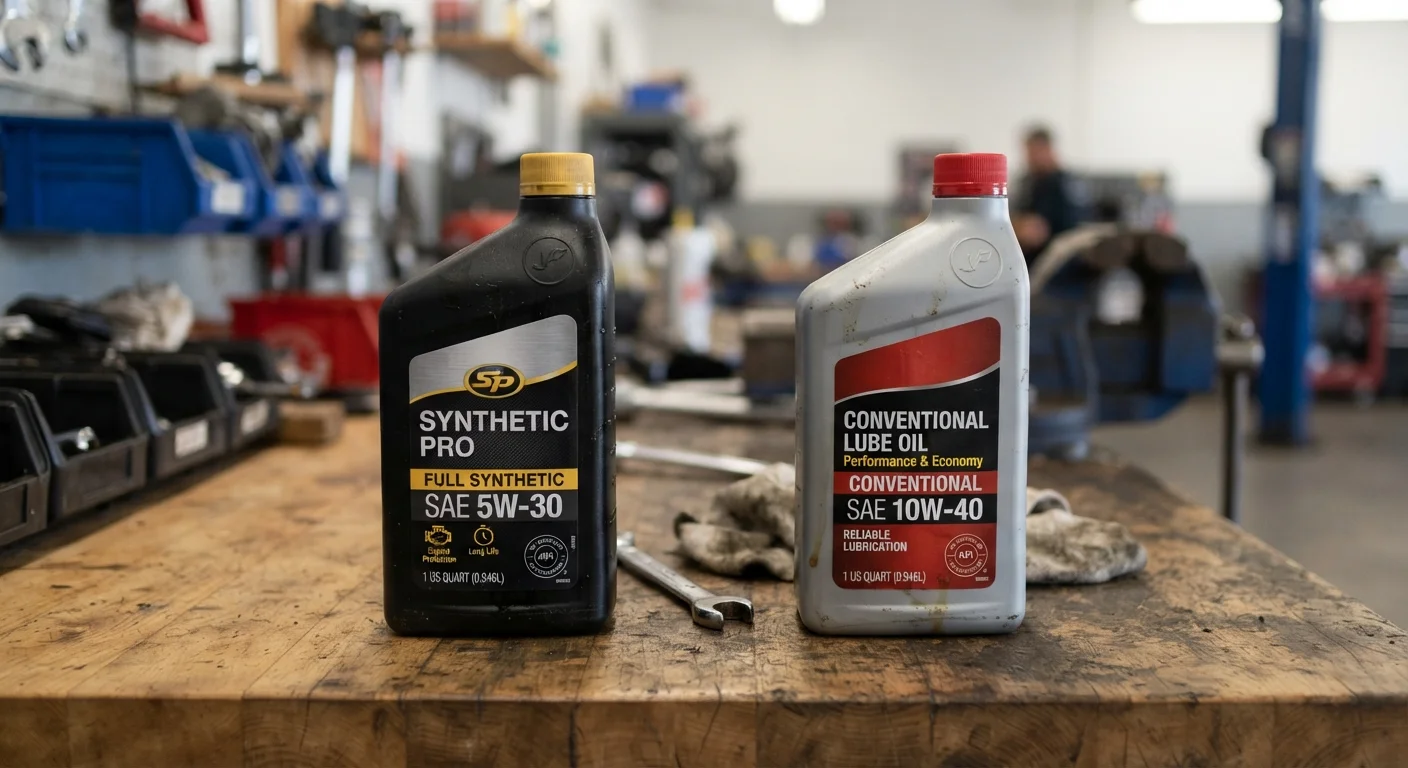
What Makes These Two Oils Different
Motor oil's primary job is to lubricate moving engine parts, reduce friction, carry heat away, and help keep internal components clean. Both synthetic and conventional oil do this - but how they're made, and how well they hold up over time, differs significantly.
Conventional motor oil starts as crude petroleum that's refined to remove impurities. The result is a lubricant with molecules that vary in size and shape. That inconsistency isn't a dealbreaker, but it does mean the oil breaks down more readily under heat and stress.
Synthetic motor oil is chemically built - either from refined petroleum that's been further processed, or from other chemical base stocks. The molecules are more uniform in size and structure, which is why synthetic oil tends to resist breakdown better, flow more consistently in cold weather, and last longer between changes.
There's also a middle option: synthetic blend oil, which mixes conventional base oil with synthetic components. It offers some of the performance advantages of full synthetic at a lower price point, and is a common recommendation for light trucks and SUVs.
| Criterion | Synthetic Oil | Conventional Oil |
|---|---|---|
| Base source | Chemically engineered molecules | Refined crude petroleum |
| Cold-weather flow | Excellent - flows quickly at startup | Slower - thickens more in cold |
| Heat resistance | Higher - resists breakdown under stress | Lower - degrades faster at high temps |
| Typical change interval | 7,500-10,000+ miles (per spec) | 5,000-7,500 miles (per spec) |
| Cost per quart | Higher upfront cost | Lower upfront cost |
| Suitability for older engines | Depends on manufacturer spec | Often well-suited |
| Turbocharged engine use | Generally required or recommended | Usually not specified |
Performance Trade-Offs Everyday Drivers Should Understand
For most driving situations, both oil types protect your engine when used correctly. The differences become more relevant at the extremes - very cold starts, high-heat towing, extended oil change intervals, or high-performance engines.
Cold-weather starts are where synthetic clearly leads. Oil thickens when it's cold, and thicker oil reaches engine parts more slowly. Synthetic oil's uniform molecules flow more freely at low temperatures, which means faster lubrication when it matters most - in those first seconds after you turn the key.
High-heat resistance is another synthetic advantage. Under sustained heat (think towing, mountain driving, or stop-and-go traffic in summer), conventional oil can oxidize and break down faster. Synthetic holds its viscosity - its resistance to flow - more reliably across a wider temperature range.
Oil change intervals reflect this durability difference. Many vehicles using full synthetic can go 7,500 to 10,000 miles or more between changes, depending on manufacturer specs. Conventional oil is typically changed every 5,000 to 7,500 miles in modern engines. Always defer to your owner's manual rather than a generic mileage rule - several common oil-change beliefs don't hold up to scrutiny.
5W-30 / 0W-20
Common viscosity grades specified by manufacturers
The viscosity grade on your oil cap or in your owner's manual tells you the oil's flow characteristics at cold and operating temperatures - always match it.
75,000+ miles
Threshold often cited for high-mileage oil formulations
High-mileage oils contain seal conditioners and additional detergents designed for engines with accumulated wear, regardless of oil type.
How to Choose the Right Oil for Your Vehicle
The single most reliable source of guidance is your vehicle's owner's manual. It specifies the oil viscosity grade your engine was designed for - something like 5W-30 or 0W-20 - and whether synthetic is required, recommended, or optional. Following that spec is more important than any general rule.
A few practical considerations worth knowing:
- Turbocharged engines run hotter and are generally better served by synthetic oil. Most manufacturers of turbocharged vehicles specify it outright.
- High-mileage vehicles (typically over 75,000 miles) may benefit from high-mileage formulations - a specialty oil that includes seal conditioners to help reduce minor leaks common in older engines.
- Switching between types is generally safe on modern engines. The old belief that once you use synthetic you can never go back is a myth - a number of widely repeated oil myths don't reflect how modern engines actually work.
Your Owner's Manual Is the Final Word
Oil marketing can make it seem like upgrading to a premium synthetic is always the right move. In reality, some engines are calibrated specifically for conventional oil, and using a different viscosity grade - even a high-quality one - can affect performance or void warranty coverage. Always check your manufacturer's specification before making a change. If your manual says 5W-20 conventional, that's the target, not a minimum.
When in doubt, a qualified mechanic can review your vehicle's service history and driving pattern to help you make an informed decision. There's no single right answer for every driver - context matters.