
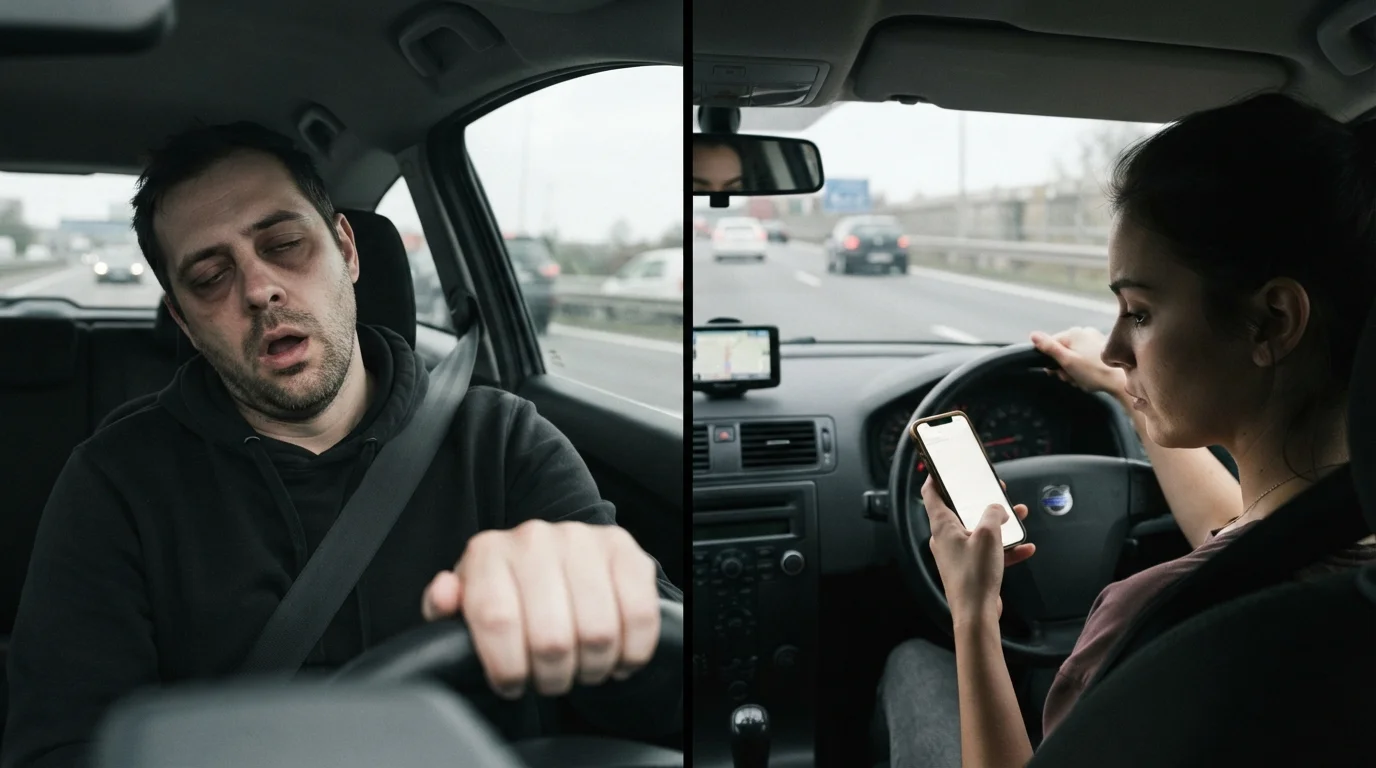
How Each Impairment Works Against You
Driver fatigue and distraction are often mentioned in the same breath when road safety comes up - and for good reason. Both erode the mental sharpness needed to operate a vehicle safely. But they work through different mechanisms, and understanding that distinction matters when it comes to prevention.
Fatigue is a cumulative physiological state. When you're sleep-deprived or have been driving for extended periods, your brain's ability to process information slows down, reaction times lengthen, and the tendency to experience microsleeps - brief, involuntary lapses in consciousness lasting just a few seconds - rises sharply. A vehicle traveling at 60 mph covers 88 feet per second, meaning even a two-second microsleep sends your car nearly two full car lengths with no one in control.
Distraction, by contrast, redirects attention rather than dulling it. It comes in three forms: visual (eyes off the road), manual (hands off the wheel), and cognitive (mind off the task of driving). Glancing at a phone for five seconds at highway speed is the equivalent of crossing a football field while blindfolded. Distraction is often brief but intense - and its effects hit immediately rather than building gradually.
| Driver Fatigue | Distraction | |
|---|---|---|
| How it develops | Gradual, cumulative over hours | Sudden, triggered by an event |
| Primary impairment | Slowed reaction time, microsleeps | Attention redirected away from road |
| Self-awareness of impairment | Often severely underestimated | Usually recognized, often dismissed |
| Main risk scenario | Long trips, night driving, shift work | Phone use, in-car tech, passengers |
| Corrective action | Stop and rest - no substitute | Remove or avoid the distraction source |
| Prevention window | Before the trip (adequate sleep) | Any time - habits and device settings |
Warning Signs to Catch Before It's Too Late
Both states give off signals that, if noticed early, allow you to act before a dangerous situation develops.
Signs of Driver Fatigue
- Frequent yawning or heavy eyelids
- Difficulty keeping your head upright
- Missing exits, signs, or turns you know well
- Drifting out of your lane without intention
- Trouble recalling the last few miles driven
Signs of Distraction
- A phone, screen, or conversation pulling your gaze repeatedly
- Slowed response to brake lights ahead
- Following distance shrinking without you noticing
- Arriving at a destination with little memory of the drive (often a sign of cognitive distraction)
One important distinction: fatigued drivers frequently misjudge their own impairment level. Research consistently shows that people who are severely sleep-deprived tend to rate their own alertness far higher than it actually is - a self-assessment problem that doesn't occur as strongly with distraction. See our guide on how risk perception develops for more on why drivers at all experience levels can misjudge hazards.
Use the 'Do I Remember?' Test
If you reach a point on a familiar route and genuinely can't recall the last several minutes of driving, treat that as a serious warning sign for both fatigue and cognitive distraction. Pull over at the earliest safe opportunity. This mental gap indicates your brain was not fully engaged with the task of driving, regardless of how awake or attentive you believed yourself to be.
What to Do When You Recognize the Warning Signs
The corrective actions for each impairment are quite different, which is another reason to tell them apart.
For fatigue, the only genuinely effective solution is rest. Pulling over safely and taking a 20-minute nap in a secure location - a rest stop or a well-lit parking area - can partially restore alertness for short periods. Caffeine can help temporarily, but it is not a substitute for sleep and will not prevent microsleeps during severe fatigue. Driving at night compounds all of these risks significantly; our article on night driving and how darkness changes the rules covers why low light and fatigue form a particularly dangerous combination.
For distraction, prevention is more straightforward because you have direct control over most triggers. Before driving: silence your phone or enable driving mode, set your GPS destination, and finish any food or grooming. If you're traveling with passengers, ask them to handle navigation and messages. While hands-free phone use reduces manual distraction, it still imposes significant cognitive load - our piece on myths about mobile phone use at the wheel examines what the research actually says.
Caffeine and Willpower Have Limits
Caffeinated drinks can temporarily reduce the feeling of sleepiness, but they do not restore impaired reaction time or prevent microsleeps once fatigue is severe. Relying on coffee to get through the last hour of a long drive is a common and genuinely risky strategy. Plan your journey to include real rest breaks rather than chemical shortcuts.
In both cases, the worst response is deciding to push through. Fatigue doesn't respond to determination, and distraction doesn't become safe just because the distraction feels brief or familiar.
When Fatigue and Distraction Combine
These two hazards don't always arrive separately. A tired driver is also more likely to seek stimulation - checking their phone, turning up the radio, or engaging in conversation - to stay alert. This creates a layered impairment: slowed reaction time from fatigue plus reduced road attention from distraction, occurring at the same time.
Conditions that already demand extra focus - rain, reduced visibility, unfamiliar roads - amplify the risks further. Wet roads extend stopping distance considerably even for a fully alert driver; adding fatigue or distraction to that equation narrows the margin for error to nearly nothing.
~20%
Of serious crashes linked to driver fatigue
The National Highway Traffic Safety Administration (NHTSA) estimates drowsy driving is a factor in a significant share of fatal crashes annually in the United States.
3,000+
Annual US deaths involving distracted driving
NHTSA data consistently shows thousands of fatalities each year in crashes where distraction was reported as a contributing factor.
The safest approach is to treat both risks as non-negotiable before every trip: get adequate sleep, eliminate in-vehicle distractions, and plan for stops on longer journeys. Neither risk is fully manageable once you're already impaired - the time to act is before you turn the key.