
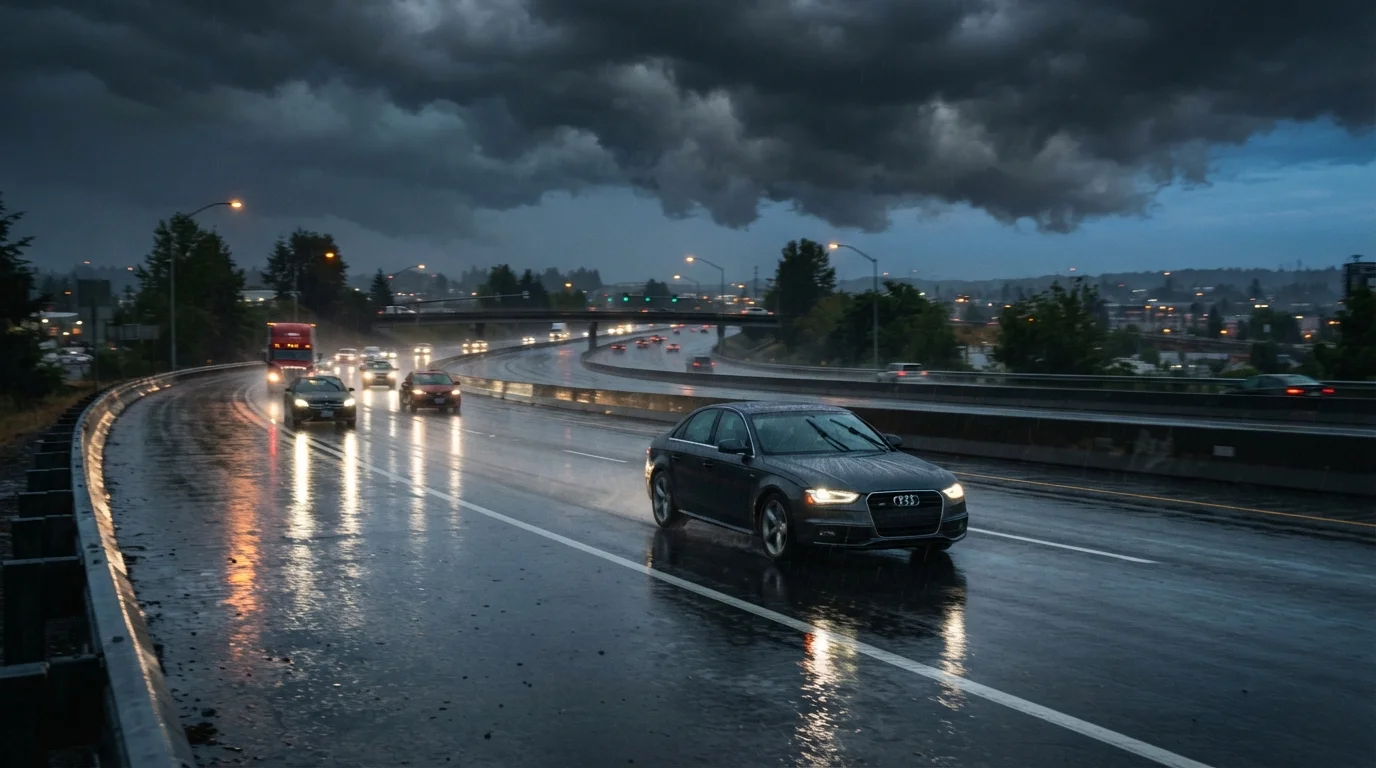
Why Water Changes Everything Under Your Tires
Dry pavement gives tires a firm, high-friction surface to grip. Add rain, and that relationship changes fast. Water acts as a lubricant between the tire and the road, reducing the friction that your brakes rely on to slow the vehicle. Less friction means the tires need more road surface - and more time - to bring the car to a halt.
Two physical forces are at work here: adhesion (the direct grip between rubber and pavement) and viscous friction (resistance from the water film itself). Neither replaces the grip you get on a dry road, which is why wet-weather braking is fundamentally less efficient no matter how good your brakes are.
It's also worth noting that the first few minutes of rainfall are often the most dangerous. Road oil and grime, which accumulate during dry periods, mix with the early rain to create an especially slick surface before the water eventually washes it away. This is a window many drivers underestimate.
The First Rain After a Dry Spell Is Especially Slick
Roads accumulate oil, rubber dust, and debris during dry periods. When light rain first falls, it blends with these residues before washing them away, creating a slippery film that can be more hazardous than heavier, sustained rainfall. This early-rain window is when extra caution pays off most.
The Speed Factor: Why Going Faster Multiplies the Risk
Speed doesn't just add to stopping distance in a straight-line way - it compounds it. Because braking distance increases with the square of speed, doubling your speed roughly quadruples the distance needed to stop. At 30 mph on a wet road you might stop in around 90 feet; at 60 mph, you could need over 350 feet or more, depending on conditions.
This relationship is why speed limits are lowered in school zones and construction areas, and why experienced drivers reduce speed well before posted limits when it rains. The physics aren't forgiving, and reaction time - typically 1.5 seconds for an alert driver - adds even more distance before the brakes even engage.
~30-40%
Reduction in tire grip on wet pavement
General engineering estimates suggest wet roads reduce tire-to-road friction by this margin compared to dry conditions.
4x
Increase in braking distance when speed doubles
Because braking distance scales with the square of speed, doubling your speed roughly quadruples the stopping distance needed.
35 mph+
Speed at which hydroplaning risk rises sharply
Traffic safety research identifies speeds above approximately 35 mph as the threshold where hydroplaning becomes a significant risk on wet roads.
Fatigue and distraction make reaction time worse, layering additional risk onto already reduced grip. Our article on driver fatigue vs. distraction explains how these factors can quietly erode the buffer you depend on in emergencies.
Tires, Tread, and the Grip You Can't See
Your tires are the only part of the vehicle in contact with the road, which makes their condition the single most important hardware variable in wet-weather stopping. Tire tread is specifically designed with grooves and channels that push water outward from the contact patch - the small area of rubber actually touching the road - so the rubber can grip the pavement beneath.
As tread wears down, water has fewer channels to escape through. Below roughly 4/32 of an inch of tread depth, wet braking performance degrades noticeably. Below 2/32 of an inch, tires are legally considered unsafe in most U.S. states. A quick check using a quarter: if you insert it into a tread groove with Washington's head facing down and can see the top of his head, your tread may already be dangerously low.
Tire pressure also plays a role. Under-inflated tires have a deformed contact patch that can trap water rather than channel it effectively. Our companion article on tire pressure and grip covers this relationship in detail.
Check Tread Depth Before Wet Season Begins
Use the quarter test or a tread depth gauge to check all four tires before rainy seasons arrive. If any tire reads below 4/32 of an inch, consider replacement sooner rather than later - your wet-weather stopping distance will already be compromised. Don't wait until the legal minimum of 2/32 of an inch to act.
Hydroplaning: When Brakes Stop Working
Hydroplaning is the most extreme version of wet-road grip loss. It happens when vehicle speed and water depth combine so that tires can't push water away fast enough. The tire essentially rides up onto a thin film of water, losing direct contact with the pavement. At that moment, steering and braking inputs have little effect.
Hydroplaning is most likely at speeds above 35 mph on roads with standing water, especially with worn tires or low tire pressure. If it happens, the right response is to ease off the accelerator smoothly, avoid sharp steering inputs, and let the vehicle slow naturally until the tires regain grip. Hard braking during hydroplaning can make the situation worse.
Rain isn't the only condition that demands adjusted driving habits. Fog, ice, and high winds each impose their own demands on vehicle control and stopping ability.
“Stopping distance is not just a physics problem - it is a decisions problem. The distance your car needs to stop is set the moment you choose your speed and following gap.”
— National Highway Traffic Safety Administration, U.S. federal vehicle safety agency