
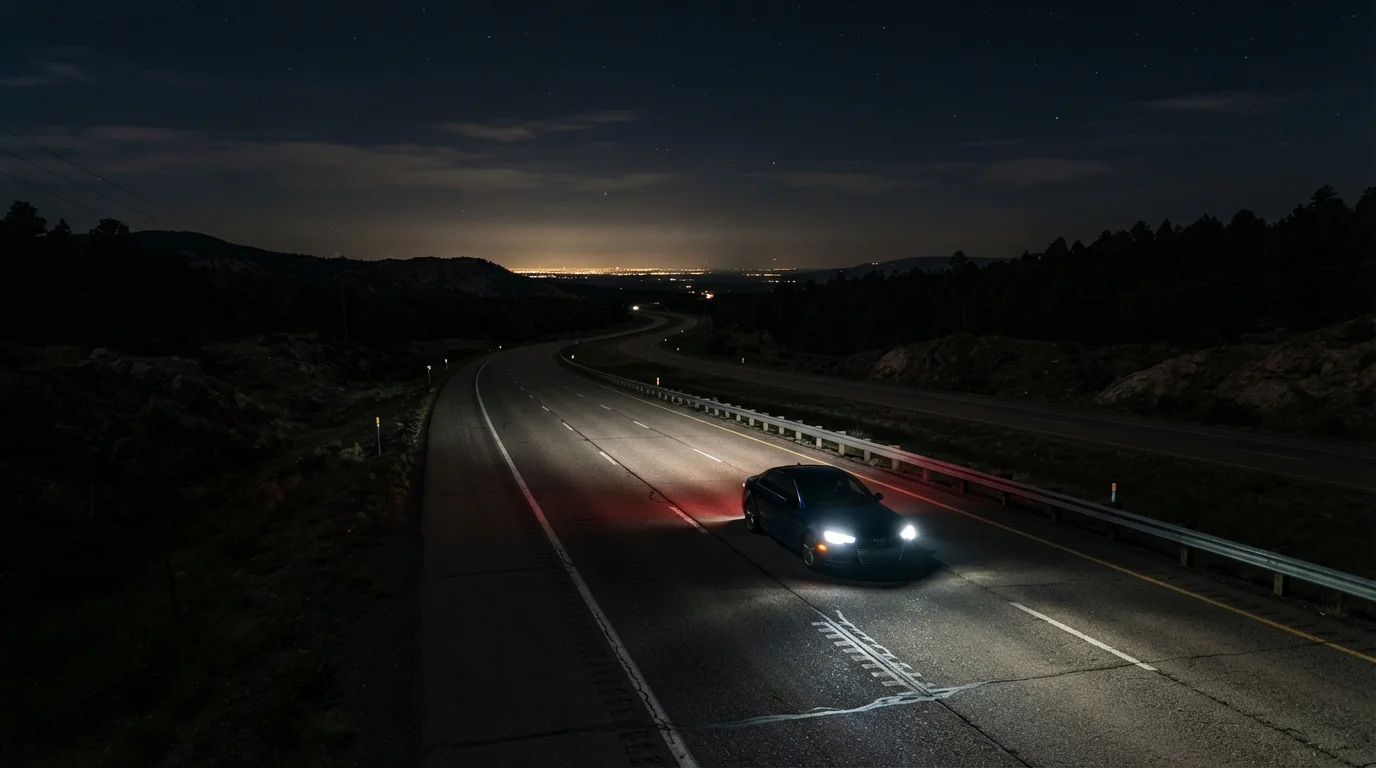
Why Night Driving Is Statistically Riskier
Traffic volume drops substantially after dark, yet a disproportionate share of fatal crashes occur at night. This isn't coincidence. Multiple compounding factors - limited visibility, driver fatigue, and a higher proportion of impaired drivers - converge during nighttime hours in ways that simply don't happen during a typical afternoon commute.
Understanding why darkness raises the stakes is the foundation for driving through it more safely. As you build experience behind the wheel, developing good risk perception matters enormously - something explored in more depth in our article on how risk perception develops in drivers.
Dark adaptation
The process by which your eyes gradually become more sensitive to low light after entering a dark environment. Full adaptation can take up to 30 minutes.
Rods and cones
Light-sensitive cells in the eye. Cones handle color and detail in bright light; rods manage low-light vision but provide far less sharpness.
Circadian rhythm
The body's internal 24-hour clock that regulates sleep and wakefulness. It creates predictable peaks of drowsiness during late-night and early-morning hours.
Glare recovery
The time your eyes need to regain normal night vision after being exposed to a bright light source, such as oncoming high beams.
Overdriving headlights
Driving at a speed where your stopping distance exceeds the distance your headlights illuminate ahead - a common and dangerous night driving mistake.
What Darkness Does to Your Vision
The human eye contains two types of light-sensitive cells: cones (responsible for color and fine detail in bright light) and rods (which handle low-light detection but offer far less sharpness). After sunset, your visual system leans heavily on rods, which means reduced acuity, limited color discrimination, and a narrowing of your effective field of view.
Your eyes also take time to fully adapt when moving from a lit interior - a gas station, a restaurant - back into darkness. Full dark adaptation can take up to 30 minutes, meaning the first stretch of driving after a brightly lit stop carries heightened risk. Add to this that depth perception and peripheral vision both degrade in low light, and you have a meaningful perceptual disadvantage compared to daytime driving.
Night also obscures blind spots more effectively than daylight. Checking mirrors and scanning intersections requires conscious effort after dark. Our guide on blind spots and what your mirrors miss covers the mechanics of this problem in detail.
Headlight Glare and the Blinding Problem
Modern vehicles increasingly use high-intensity LED and HID headlights, which are brighter than older halogen systems. When an oncoming driver uses high beams - intentionally or by forgetting to switch - the glare can temporarily overwhelm your night-adapted eyes, creating a window of near-blindness that lasts several seconds even after the vehicle passes.
Don't Retaliate With Your High Beams
When an oncoming driver blinds you with their high beams, it's tempting to switch yours on in response. Doing so creates the same hazard for them - and potentially for both of you simultaneously. Keep your low beams on, look right, and focus on your lane edge until the vehicle passes.
The instinctive reaction of staring directly at bright oncoming lights actually prolongs recovery time. Instead, shift your gaze to the right edge of your lane, using the road markings to guide your path until the glare fades.
Your own headlights also matter. Dirty or fogged headlight lenses significantly reduce output. A lens that looks clear from the outside can still diffuse light in ways that cut effective range by a substantial margin. Many states include headlight condition as part of routine vehicle inspections for exactly this reason.
Fatigue: The Hidden Multiplier
Fatigue and darkness are deeply linked. The body's natural sleep drive - governed by a process called circadian rhythm - produces strong drowsiness peaks between roughly midnight and 6 a.m. and again in mid-afternoon. Driving during the first window means fighting your own biology.
Drowsy driving impairs reaction time, attention, and decision-making in ways that parallel alcohol impairment. Crucially, fatigued drivers often underestimate how impaired they are - the brain's ability to assess its own performance degrades alongside performance itself. Our companion piece on driver fatigue vs. distraction breaks down exactly how these impairments manifest behind the wheel.
Schedule Stops on Long Night Drives
Plan a rest stop every 90 to 120 minutes on extended night drives rather than waiting until you feel tired. Fatigue often builds gradually and is easy to underestimate in the moment. A 15-minute break with fresh air can help restore alertness temporarily, though it is not a substitute for adequate sleep before departing.
There is no reliable way to push through severe drowsiness. Caffeine can delay the onset of sleep pressure temporarily, but it doesn't restore reaction time to an alert baseline. Pulling over, resting, or switching drivers are the only genuinely safe options when fatigue sets in on a night drive.
Practical Habits That Reduce Night Driving Risk
Awareness of the risks is the first step; adjusting your behavior is the payoff. Several straightforward habits meaningfully reduce exposure to night driving hazards:
- Slow down. Standard low beams illuminate roughly 160 feet ahead. At highway speeds, that reaction window is very short. Reducing speed gives your brain more time to process what your headlights reveal.
- Increase following distance. The two-second following distance rule is a minimum in good conditions - at night, adding extra buffer is prudent.
- Keep optics clean. Wipe both the inside and outside of your windshield regularly. Clean your headlight lenses. These small maintenance steps have a noticeable impact on visibility.
- Dim your dashboard. High interior brightness reduces your eyes' adaptation to the dark outside. Most vehicles allow you to lower instrument cluster lighting.
- Plan around fatigue. If a long night drive is unavoidable, schedule rest stops and avoid departing when you're already tired. Night driving in adverse weather compounds every risk discussed here - our guide on driving in fog, ice, and high winds addresses those additional layers.
NHTSA Drowsy Driving Resources
The National Highway Traffic Safety Administration publishes research and guidance on drowsy driving risks, statistics, and prevention strategies relevant to US drivers.
AAA Foundation for Traffic Safety
Offers research reports and educational materials on night driving, driver fatigue, and visibility - useful for drivers who want to go deeper into the data.