
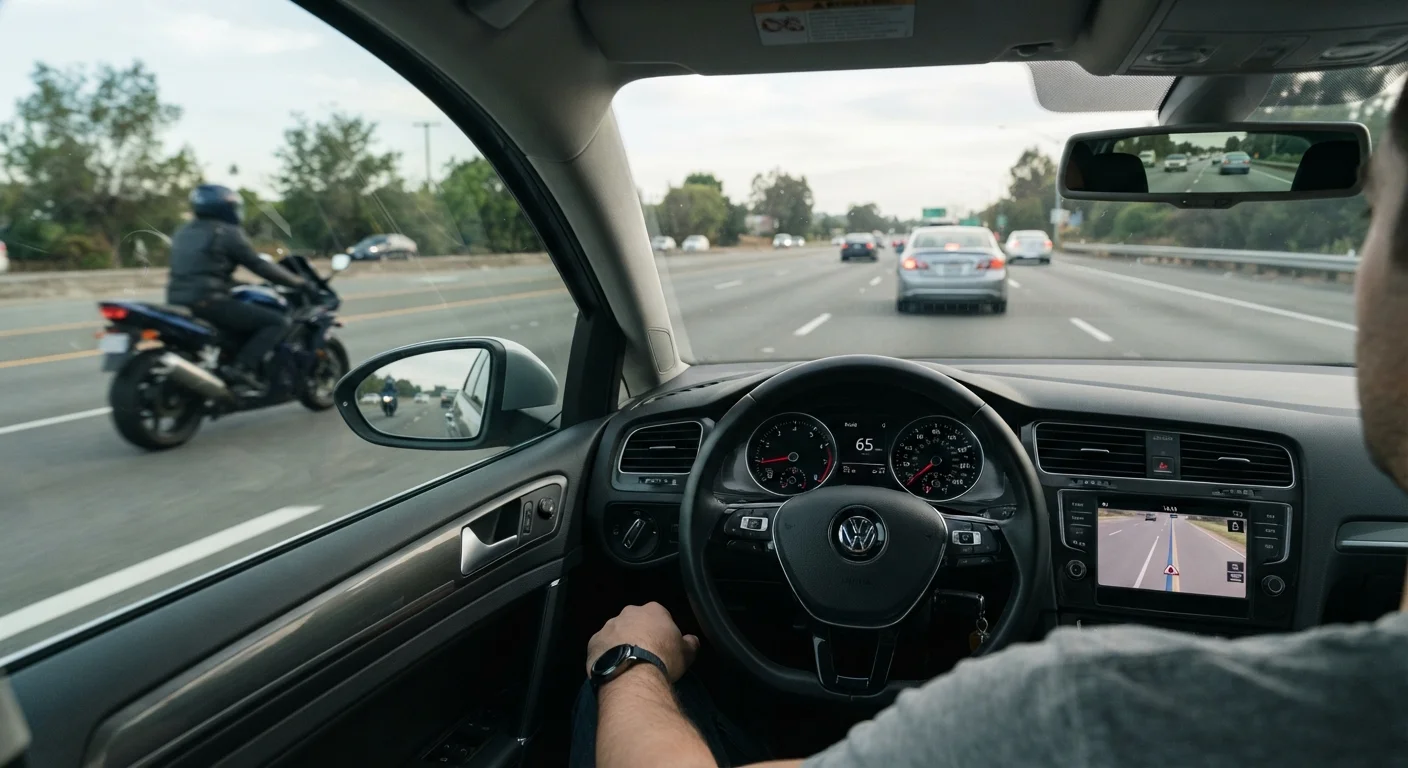
Why Mirrors Never Show the Full Picture
Mirrors are an essential tool, but they are a tool with hard physical limits. A flat rearview mirror reflects a narrow slice of what is behind you, and your two side mirrors each cover an arc that points mostly rearward - not sideways. The gap between those arcs and your own peripheral vision is where blind spots form.
Think of your mirrors as three overlapping spotlights aimed behind the car. They illuminate a wide corridor to the rear, but the edges of each spotlight fade. The unlit space on either side, level with your rear doors and back seats, is where another vehicle can sit completely invisible to you. At highway speeds, a car can enter that zone and stay there for several seconds - enough time for a lane change to become a collision.
Blind spots also exist at the front and rear of the vehicle. The hood itself blocks a zone directly ahead, which matters when pulling out of parking spaces or navigating tight intersections. Immediately behind the bumper is a rear blind spot - the reason backing cameras became federally required on all new US passenger vehicles sold after May 2018.
Blind Spots Vary by Vehicle and Driver Height
The same car can produce different blind spot sizes depending on the driver's height and seat position. A shorter driver sitting lower sees less over the door line; a taller driver may find the C-pillar (the structural post between the rear side window and rear windshield) blocks more of their rearview. Adjusting seat height as well as mirror angle helps tailor coverage to your specific sightline.
How Mirror Placement Shapes the Hidden Zone
The size of your blind spots is not fixed - it shifts depending on how your mirrors are positioned. Many drivers angle their side mirrors inward so they can see the edge of their own vehicle, which feels intuitive but wastes coverage. That portion of the mirror is showing you your own car, something you already know is there.
A more effective approach: with your head in its normal forward position, adjust each side mirror outward until your vehicle's body is just barely visible at the inner edge of the frame. This angles the mirror toward the lane beside you rather than back at your own bodywork. When done on both sides, the mirror coverage starts to overlap with your peripheral vision, narrowing - though not closing - the gap.
The Society of Automotive Engineers has published research on mirror-angle configurations that reduce blind spot overlap between the rearview and side mirrors. The core finding is consistent: most drivers leave their side mirrors aimed too far inward, which creates unnecessarily large blind zones alongside the vehicle.
Check Mirror Aim With a Parking Lot Test
Park beside another car so your vehicles are side by side. Sit in your normal driving position and check your side mirror. You should be able to see the adjacent car clearly with minimal overlap from your own vehicle's body. If the neighboring car disappears when it is directly beside you, your mirrors may still be angled too far inward. Make small outward adjustments and repeat the test.
See our pre-drive safety check guide for a simple routine that includes confirming your mirrors are correctly set before every trip.
The Shoulder Check: Your Most Reliable Tool
No amount of mirror optimization replaces the physical act of turning your head. A shoulder check - also called a head check - involves briefly rotating your head toward the rear quarter on the side you intend to move toward. It takes roughly one second and directly views the zone mirrors cannot reach.
The technique matters. You are not looking backward; you are glancing at the space just behind your shoulder, where another vehicle would be traveling parallel to you. Keep the movement short and deliberate. Beginners sometimes swing their head so far that they lose sight of the road ahead - practice makes the check quick and accurate.
Timing is equally important. The sequence most driving instructors recommend: check mirrors, signal, mirror check again, shoulder check, then steer. Signaling before you check gives surrounding traffic a moment to react. The final shoulder check happens immediately before the steering input, confirming the picture is still clear. This sequence is especially critical on higher-speed roads - see common motorway merging mistakes for how blind spot errors contribute to merge collisions.
840,000+
Annual US crashes linked to blind spot failures
The National Highway Traffic Safety Administration has estimated that hundreds of thousands of lane-change crashes per year involve a driver failing to detect a vehicle in an adjacent blind zone.
~12 ft
Typical rear blind zone behind a passenger car
Studies measuring pedestrian and object detection found that the average rear blind zone of a passenger car extends roughly 12 feet directly behind the bumper - the primary motivation behind the federal backup camera mandate.
2-4×
Larger blind zones in pickups vs. compact cars
Vehicle safety research consistently shows that full-size pickup trucks and large SUVs produce rear and side blind spots two to four times larger than those of a typical compact sedan, depending on body configuration.
Technology Helps - but Doesn't Replace Awareness
Blind spot monitoring (BSM) systems use radar sensors, usually embedded in the rear bumper, to detect vehicles traveling in the adjacent lanes. When a vehicle enters the monitored zone, a warning light illuminates in or near the corresponding side mirror - sometimes accompanied by an audible tone if you signal toward that side.
These systems are genuinely useful, particularly in heavy highway traffic where a vehicle can drift into your blind spot between mirror checks. But they have documented limitations. Radar can struggle to detect motorcycles, cyclists, or narrow vehicles in certain approach angles. Sensors can be obscured by ice, mud, or physical damage. And the monitored zone, while wide, does not always extend to the full physical blind spot of every vehicle type.
Treat BSM as an additional layer of awareness, not a replacement for the shoulder check. The same principle applies to rear cameras, parking sensors, and any other driver-assist technology. How risk perception develops in drivers is a useful complement here - experienced drivers integrate these tools without over-relying on any single one.