
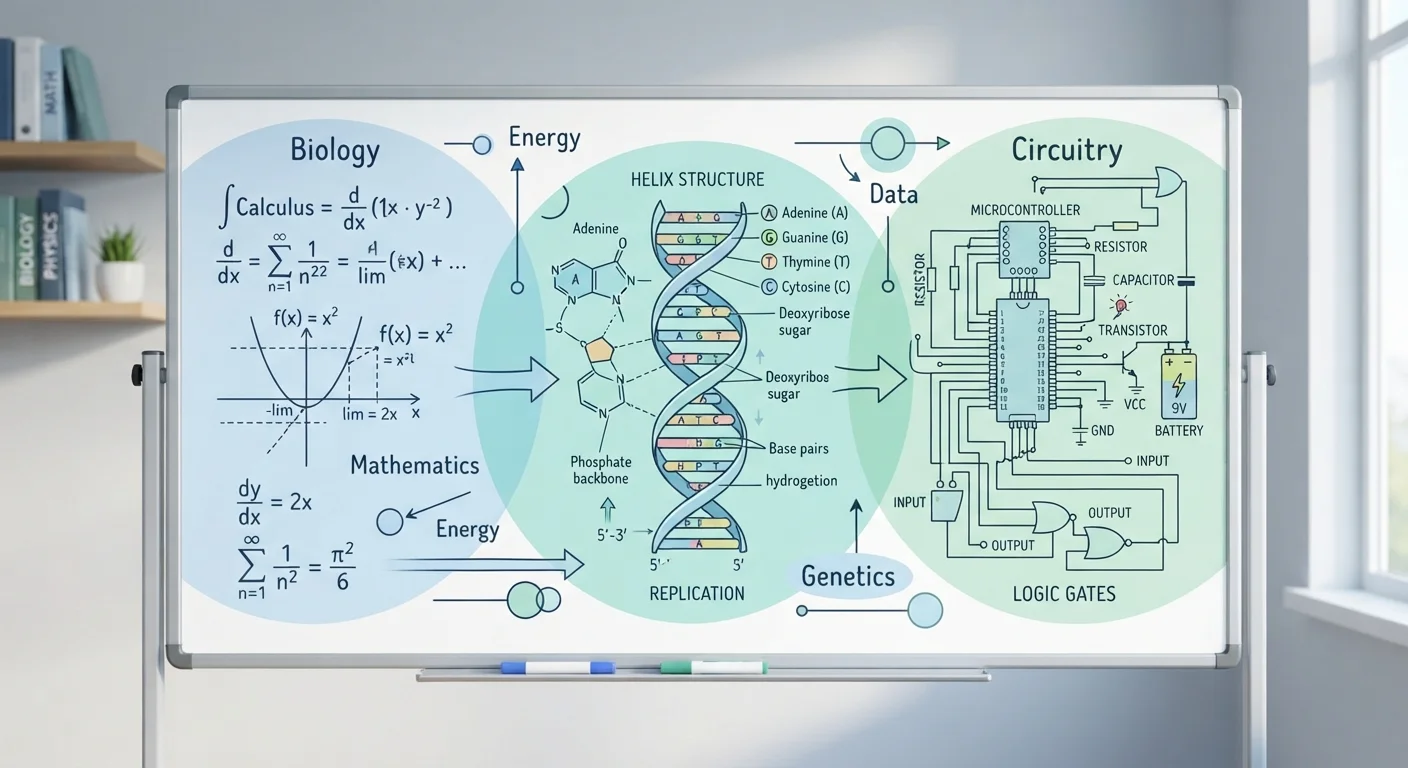
Why STEM Subjects Don't Live in Separate Boxes
Many students first encounter maths, science, and technology as entirely separate classes on their schedule - different teachers, different textbooks, different rules. But look more closely at what each subject actually does, and the boundaries dissolve quickly. They share methods, vocabulary, and foundational ideas in ways that make each one stronger when the others are understood.
The reason STEM subjects cluster together isn't just administrative convenience. It reflects the fact that scientific discovery depends on mathematical reasoning, that technology is built on scientific principles, and that mathematics itself gains meaning through application in the natural and digital worlds. This isn't a modern invention - Johannes Kepler used geometry to describe planetary orbits in the 1600s, and that tradition of cross-disciplinary thinking has only deepened since.
For students, recognizing these links early is genuinely useful. See our practical scheduling strategies for tips on how to balance multiple subjects efficiently - especially when reinforcing connected content across STEM courses.
75%
STEM jobs requiring mathematical skills
According to U.S. Bureau of Labor Statistics occupational analyses, the vast majority of STEM-classified occupations list quantitative or mathematical reasoning as a core requirement.
2×
Growth rate of STEM occupations vs. all others
The U.S. Bureau of Labor Statistics has projected STEM occupations to grow roughly twice as fast as non-STEM occupations over a multi-year period.
K-12
Grade span where integrated STEM is taught
The National Science Teaching Association advocates for integrated STEM education across all K-12 grade levels, recognizing that cross-disciplinary thinking develops over a student's full school career.
Maths as a Shared Language
Mathematics is perhaps the most universal thread running through all STEM disciplines. In chemistry, students use ratios and proportions to balance equations. In physics, algebra and calculus model motion, force, and energy. Even in biology, statistics underpin population studies, genetics probabilities, and experimental data analysis.
This is why each stage of maths education builds toward tools that science and technology will demand later. A student who understands linear equations has a genuine advantage when they encounter velocity-time graphs in physics class. The maths isn't decoration - it's the mechanism.
Applied mathematics, in particular, exists precisely at this boundary. As explored in our guide on pure maths vs. applied maths, applied branches like statistics, calculus, and linear algebra were developed specifically to solve scientific and engineering problems.
Study One Subject to Strengthen Another
When you're struggling with a science concept, check whether the underlying difficulty is actually a maths skill. For instance, if balancing chemical equations feels impossible, revisiting simple algebra may resolve the block faster than re-reading the chemistry chapter. Cross-subject review is often more efficient than staying within one subject alone.
Where Technology Meets Science and Maths
Technology classes - whether they involve coding, engineering design, or digital tools - require students to think algorithmically: breaking problems into logical, ordered steps. That same thinking supports algebraic reasoning and the structured methodology of scientific experimentation.
Coding, for example, uses variables, conditions, and loops - concepts that map directly onto algebraic thinking. A student who writes a loop to calculate averages is performing the same mental process as one solving a formula by hand. Data science, one of the fastest-growing fields, sits squarely at the intersection of mathematics (statistics), science (hypothesis and evidence), and technology (computing platforms).
Earth science offers a vivid case study. As our article on geography vs. Earth science explains, Earth scientists use satellite technology and mathematical modeling to study climate, geological change, and ocean currents - none of which would be possible without the other disciplines involved.
Making the Most of Subject Overlap
For students, the practical takeaway is this: time spent mastering a concept in one STEM subject often pays dividends in another. Graphing a function in maths is the same skill as plotting experimental results in science. Writing structured arguments in coding is related to writing logical justifications in maths proofs.
Biology may seem like the least mathematical of the sciences, but core biology concepts like genetics ratios, population modeling, and cellular chemistry all involve quantitative reasoning. Students who approach biology with strong number sense find these sections significantly more manageable.
In contrast, subjects like social studies operate differently - as explained in our overview of what students actually learn in social studies, that discipline blends qualitative reasoning, civic knowledge, and geographic understanding rather than mathematical modeling. Recognizing which subjects share methods - and which don't - helps students study smarter, not just harder.
STEM Overlap Varies by Course Level
The degree of overlap between subjects increases as students advance. Early elementary science requires very little formal maths, while high school physics and chemistry are deeply mathematical. Students should expect the connections to become more explicit - and more demanding - as they move through secondary school. This progression is by design, not a flaw in the curriculum.