
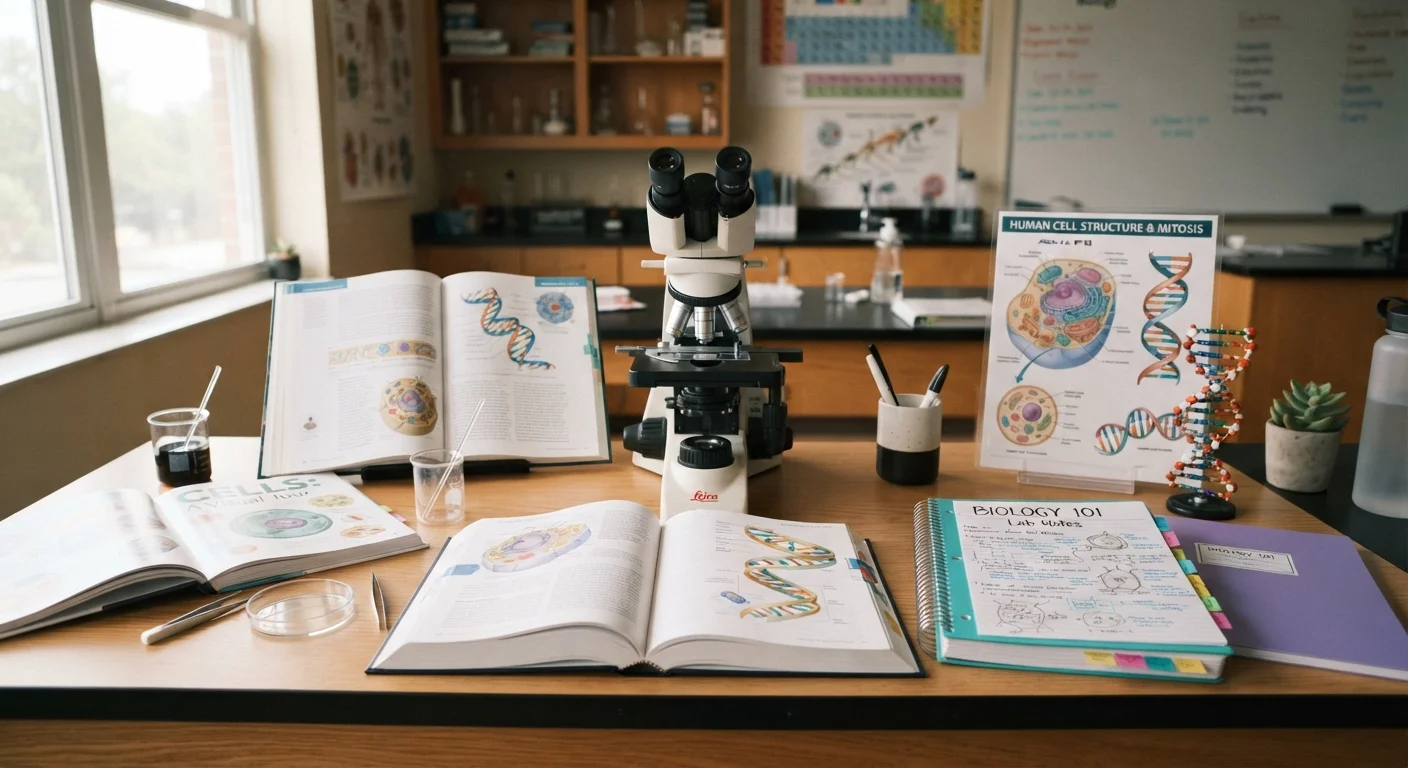
What Biology Class Is Really About
Biology is the study of life - and since life takes an enormous variety of forms, biology class covers a wide range of ideas. Rather than a disconnected list of facts to memorize, these concepts form an interconnected framework. Understanding one idea genuinely helps you understand the next.
At its core, school biology organizes around a handful of big questions: What are living things made of? How do they grow and reproduce? How do they interact with each other and their environment? How does life change over time? The topics below reflect how most biology curricula answer those questions.
| Number of known species on Earth | Approximately 8.7 million (estimated) (PLOS Biology, 2011 estimate by Mora et al.) |
| Typical biology topics in grades 6-12 | Cells, genetics, evolution, ecology, human body systems |
| Number of cells in the adult human body | Approximately 37 trillion (Annals of Human Biology, 2013) |
| Levels of biological organization | Atom → Molecule → Cell → Tissue → Organ → System → Organism → Population → Ecosystem |
| DNA structure discovered | 1953, by Watson and Crick (building on Franklin's X-ray data) |
| Primary domain divisions of life | Bacteria, Archaea, Eukarya |
Biology also overlaps meaningfully with other school subjects. See how it connects to chemistry, mathematics, and technology in our companion piece on subjects that blur the lines between science, maths, and technology.
Cells: The Starting Point for Everything
Every living organism is made of cells - biology's fundamental unit of life. Students learn early that all cells share basic features: a membrane that encloses the cell, genetic material (DNA), and the machinery to use energy. From there, the curriculum distinguishes between prokaryotic cells (simple, no nucleus - think bacteria) and eukaryotic cells (more complex, with a defined nucleus - found in plants, animals, and fungi).
Organelles - structures within eukaryotic cells - each have specific jobs. The mitochondrion generates energy; the nucleus houses DNA; the ribosome builds proteins. Plant cells add chloroplasts (for photosynthesis) and a rigid cell wall.
Understanding cells sets the stage for human anatomy. Our related guide on organ systems at a glance shows how cells scale up into tissues, organs, and the body's major systems.
Cell
The smallest structural and functional unit of all living organisms. Every living thing is made of one or more cells, each enclosed by a membrane and capable of carrying out basic life processes.
DNA (Deoxyribonucleic Acid)
The molecule that carries genetic instructions in all known living organisms. DNA is organized into genes, which determine traits and are passed from parent to offspring.
Natural Selection
The process by which organisms with traits better suited to their environment tend to survive, reproduce, and pass those traits to offspring. Over time, this drives evolutionary change in populations.
Photosynthesis
The process by which plants, algae, and some bacteria convert light energy, water, and carbon dioxide into glucose and oxygen. It is the foundation of most food chains on Earth.
Ecosystem
A community of living organisms interacting with each other and with their physical environment, including soil, water, air, and climate. Ecosystems can range in scale from a pond to a rainforest.
Organelle
A specialized structure within a eukaryotic cell that performs a specific function, much like an organ does in a body. Examples include the nucleus, mitochondria, and ribosomes.
Taxonomy
The science of naming, describing, and classifying organisms into hierarchical groups based on shared characteristics. The system uses ranks from domain (broadest) down to species (most specific).
Cellular Respiration
The process by which cells break down glucose to release usable energy (in the form of ATP). It occurs in the mitochondria and is essentially the reverse of photosynthesis.
Genetics, Evolution, and Classification
Genetics explains how traits pass from one generation to the next. Students learn about DNA as the molecule that encodes instructions, how genes are expressed as physical traits, and how mutations introduce variation. The classic experiments with pea plants by Gregor Mendel remain a standard teaching tool for dominant and recessive inheritance.
Evolution builds on genetics by explaining how populations change over time. Natural selection - the principle that individuals with advantageous traits are more likely to survive and reproduce - drives much of this change. Students typically examine evidence from fossils, comparative anatomy, and molecular biology.
Classification (taxonomy) gives biology a shared language. The major groupings - domain, kingdom, phylum, class, order, family, genus, species - allow scientists and students alike to discuss relationships among organisms precisely. Vertebrates offer a familiar example: understanding how mammals, reptiles, birds, amphibians, and fish differ is a foundational exercise. Our plain-language field guide to animal classes walks through those distinctions clearly.
~99.9%
DNA shared between any two humans
According to the National Human Genome Research Institute, humans share approximately 99.9% of their DNA sequence - the 0.1% variation accounts for all individual differences.
3.5 billion years
Estimated age of life on Earth
Fossil evidence suggests single-celled life existed on Earth at least 3.5 billion years ago, making life nearly as old as the planet itself.
~30,000
Genes in the human genome
The Human Genome Project estimated that the human genome contains between 20,000 and 25,000 protein-coding genes, far fewer than early researchers predicted.
Ecosystems, Energy, and the Living World
Biology class eventually zooms out from individual organisms to examine how they interact. An ecosystem includes all the living organisms in an area plus the physical environment they inhabit - soil, water, climate, and more. Students explore food chains and food webs, which map how energy and nutrients flow from producers (plants) through consumers (animals) to decomposers (fungi and bacteria).
Two chemical processes anchor this unit: photosynthesis, through which plants convert sunlight and carbon dioxide into glucose; and cellular respiration, through which organisms release energy from glucose. These processes are mirror images of each other and explain the cycling of carbon and oxygen through the living world.
Ecology also connects biology to Earth science and geography, where climate, landforms, and natural systems overlap. And since many biological reactions depend on chemistry - enzyme function, pH levels, molecular bonds - it's worth exploring how chemistry explains everyday phenomena alongside your biology studies. These connections reinforce both subjects and reflect how science actually works.
For learners who want to go deeper after the classroom, lifelong learning strategies can help you continue building on what biology introduces.