
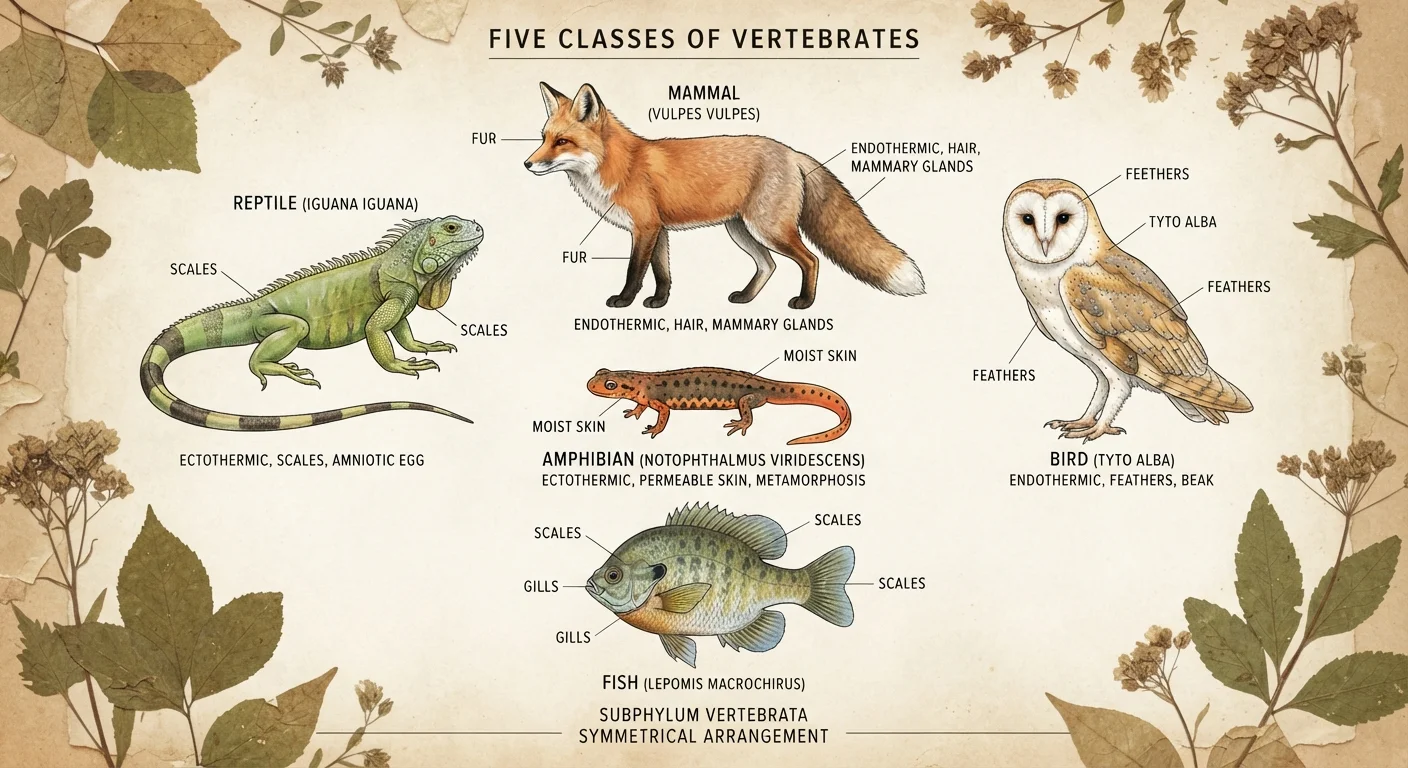
What All Five Classes Have in Common
Mammals, reptiles, birds, amphibians, and fish belong to a larger grouping called vertebrates — animals with a backbone (also called a spinal column). That shared skeleton sets them apart from invertebrates like insects, worms, and jellyfish. Beyond the backbone, though, the five classes diverge considerably. They differ in how they breathe, whether they produce their own body heat, how they reproduce, and what their skin or outer covering looks like.
Understanding these distinctions is one of the first steps in animal biology. For a broader map of how these groups fit into the entire animal kingdom, see the Animal Kingdom at a Glance overview. And if you're curious about how temperature regulation works at a deeper level, warm-blooded vs. cold-blooded animals explained covers that topic in detail.
| Total known vertebrate species | Approximately 66,000+ (Catalogue of Life, general estimate) |
| Most species-rich vertebrate class | Fish (~34,000 species) (FishBase, general estimate) |
| Warm-blooded classes | Mammals and birds |
| Only class with feathers | Birds |
| Class with permeable skin | Amphibians |
| Egg-laying mammals | Monotremes (platypus, echidna) |
The Five Vertebrate Classes: Defining Traits
Mammals
Mammals are warm-blooded vertebrates that nurse their young with milk produced by the mother. Most give birth to live young, though a small group called monotremes — which includes the platypus — lay eggs. Mammals breathe air through lungs, have hair or fur at some life stage, and generally have a four-chambered heart. Humans, dogs, whales, bats, and elephants are all mammals.
Reptiles
Reptiles are cold-blooded (ectothermic), meaning they rely on external heat sources — like sunlight — to regulate body temperature. They breathe through lungs, have dry scaly skin, and most lay eggs with leathery shells on land. Snakes, lizards, turtles, crocodilians, and tuataras are all reptiles. Unlike amphibians, reptiles do not require water to complete their life cycle.
Birds
Birds are warm-blooded vertebrates distinguished by feathers, beaks, and lightweight hollow bones adapted for flight (though some birds, like penguins and ostriches, cannot fly). All birds lay hard-shelled eggs and breathe through lungs. They share a common ancestor with theropod dinosaurs — a well-supported finding in modern paleontology.
Amphibians
Amphibians — frogs, toads, salamanders, and caecilians — are cold-blooded and uniquely tied to water for reproduction. Most lay eggs in water, hatch into gill-breathing larvae (like tadpoles), and later develop lungs for life on land. Their skin is moist and permeable, meaning they can absorb water and gases directly through it. This sensitivity makes amphibians useful indicators of environmental health. For a striking example of biological outliers in this group, see animals with surprisingly unusual traits.
Fish
Fish are aquatic, cold-blooded vertebrates that extract dissolved oxygen from water using gills. They are the most species-diverse vertebrate class, with roughly 34,000 known species. Fish are divided into three sub-groups: jawless fish (lampreys, hagfish), cartilaginous fish (sharks, rays), and bony fish (salmon, tuna, goldfish). Scales cover most species, though some, like catfish, are scaleless.
Vertebrate
An animal possessing a backbone (vertebral column). The five major vertebrate classes are mammals, reptiles, birds, amphibians, and fish.
Endotherm
An animal that generates and regulates its own internal body heat through metabolism. Commonly called warm-blooded. Mammals and birds are endotherms.
Ectotherm
An animal that relies on external heat sources — such as sunlight or warm surfaces — to regulate body temperature. Commonly called cold-blooded. Reptiles, amphibians, and fish are ectotherms.
Metamorphosis
A biological process in which an organism undergoes a dramatic change in body form during development. Most amphibians transform from gill-breathing larvae into lung-breathing adults.
Gill
A respiratory organ that extracts dissolved oxygen from water. Fish use gills throughout their lives; amphibian larvae use gills before transitioning to lungs.
Monotreme
A rare sub-group of egg-laying mammals. Platypuses and echidnas are the only living monotremes, making them notable exceptions to the live-birth rule for mammals.
Key Differences at a Glance
Several characteristics are especially useful for telling these classes apart quickly:
- Body temperature: Mammals and birds are warm-blooded (endothermic); reptiles, amphibians, and fish are cold-blooded (ectothermic).
- Skin covering: Mammals have hair or fur; birds have feathers; reptiles have scales; amphibians have moist, bare skin; most fish have scales (sometimes mucus-coated).
- Breathing: All classes breathe through lungs except fish (gills) and larval amphibians (gills that later transition to lungs or skin-based gas exchange).
- Reproduction: Most mammals give birth to live young; birds and most reptiles lay hard-shelled eggs; most fish and amphibians lay soft eggs in water.
Color signals often vary dramatically across these classes too — for a deeper look at what animal coloration communicates, explore what bright patterns signal in the wild.
Why Classification Can Get Complicated
Some animals challenge intuitive classification. Bats are mammals despite flying; whales are mammals despite living entirely in water. The platypus lays eggs but is still classified as a mammal because it nurses young with milk and has fur. Classification is based on a suite of shared traits — not just one feature. When studying biology, looking at multiple defining characteristics together gives a more reliable answer than any single trait alone.