
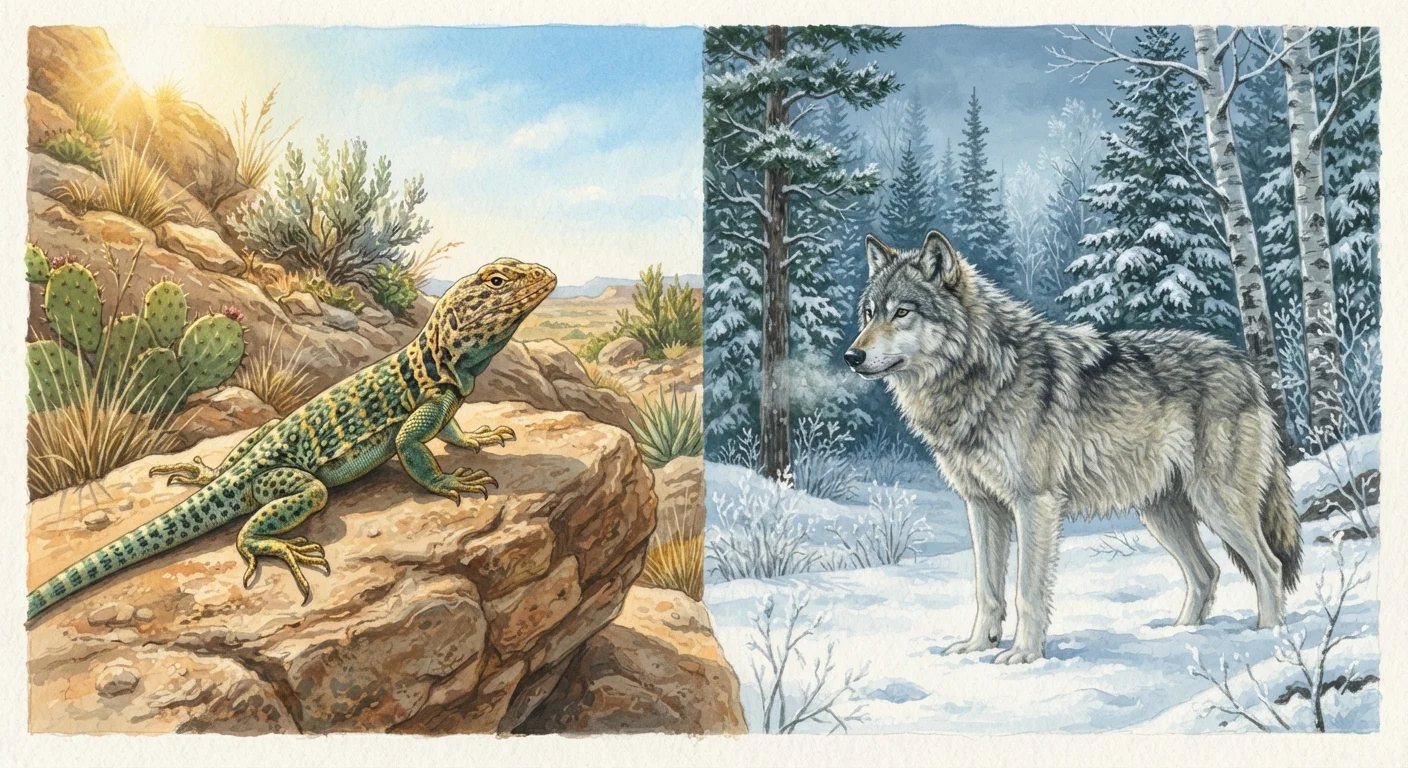
The Core Difference: Where the Heat Comes From
The terms "warm-blooded" and "cold-blooded" are common shorthand, but they're a little misleading. A lizard sitting on a sun-baked rock in summer can have blood just as warm as yours. The real distinction isn't about actual blood temperature — it's about where the heat originates.
Endotherms (warm-blooded animals) produce heat through their own metabolism. Chemical reactions inside their cells generate warmth continuously, keeping core body temperature stable regardless of outdoor conditions. All mammals and birds fall into this category.
Ectotherms (cold-blooded animals) rely primarily on external heat sources — sunlight, warm surfaces, or ambient air temperature — to regulate body temperature. Their internal metabolic processes generate relatively little heat. Reptiles, amphibians, fish, and most invertebrates are ectotherms.
Scientists increasingly prefer the terms endotherm and ectotherm because they describe the mechanism accurately, rather than implying these animals are always hot or cold to the touch. For a broader look at how these groups fit into animal classification, see our plain-language field guide to vertebrate classes.
| Criterion | Endotherms (Warm-Blooded) | Ectotherms (Cold-Blooded) |
|---|---|---|
| Heat source | Internal metabolism | External environment |
| Body temperature | Stable and self-regulated | Varies with surroundings |
| Main animal groups | Mammals, birds | Reptiles, amphibians, fish, most invertebrates |
| Energy requirement | High — frequent feeding needed | Low — infrequent feeding possible |
| Cold-weather activity | Maintained | Reduced or halted |
| Geographic range | Polar to tropical | Primarily temperate to tropical |
| Typical resting behavior | No basking required | Basking common to warm muscles |
How Each Strategy Shapes Daily Life
Temperature regulation strategy has sweeping consequences for how an animal eats, moves, and survives.
Energy Costs
Maintaining a constant internal temperature is expensive. Endotherms can burn through calories roughly five to ten times faster than comparably sized ectotherms. A small bird may need to eat almost continuously during daylight hours in winter, while a snake of similar body mass might survive on a single meal every few weeks.
5–10×
More calories burned by endotherms vs. ectotherms
Comparative physiology research consistently shows endotherms have substantially higher mass-specific metabolic rates than similarly sized ectotherms at equivalent temperatures.
~90%
Proportion of animal species that are ectotherms
The vast majority of Earth's animal diversity — including all invertebrates — relies on external heat sources, making ectothermy by far the more common biological strategy.
98.6°F
Typical human core body temperature
Average adult human core temperature is approximately 98.6°F (37°C), maintained within a narrow range by endothermic heat production regardless of ambient temperature.
Activity Patterns
Because ectotherms depend on environmental warmth, their activity levels track closely with ambient temperature. A cold morning can leave a lizard temporarily immobile — its muscles simply don't function efficiently at low temperatures. Endotherms, by contrast, can sprint, fly, or hunt at dawn in near-freezing conditions.
Geographic Range
Endothermy opens up habitats that ectotherms simply can't colonize year-round. Polar bears and penguins occupy environments where a reptile would become fatally cold. Ectotherms, on the other hand, tend to thrive in warmer, more stable climates where environmental heat is reliably available. This connection between temperature regulation and dormancy behaviors — including hibernation — is explored further in our article on hibernation, torpor, and estivation.
The Animals That Blur the Line
Biology rarely deals in perfect categories. A handful of animals complicate the endotherm/ectotherm divide in fascinating ways.
Tuna and some sharks, including the great white, are capable of retaining metabolic heat in their muscles and core — a phenomenon called regional endothermy. This allows their muscles to work faster, making them more powerful swimmers, without the full cost of whole-body endothermy.
Bumblebees can warm their flight muscles by shivering before takeoff, generating enough internal heat to fly in surprisingly cool temperatures — a trait unusual among insects.
Echidnas and platypuses are mammals (and therefore endotherms), yet they maintain a lower, more variable body temperature than most mammals — an interesting middle ground within the endotherm category.
These exceptions highlight that endothermy and ectothermy exist on a spectrum rather than as a strict binary. For more examples of animals that challenge biological expectations, take a look at our piece on creatures that defy basic biology.
A Note on Terminology
You may encounter the terms "poikilotherm" (variable body temperature) and "homeotherm" (stable body temperature) in biology texts. These describe the outcome of temperature regulation rather than the mechanism. Most ectotherms are poikilotherms and most endotherms are homeotherms, but the terms aren't perfectly interchangeable — some ectotherms maintain relatively stable temperatures in consistently warm environments.
Why Neither Strategy Is "Better"
It can be tempting to view endothermy as the more advanced solution, but evolution doesn't work that way. Each strategy is a finely tuned response to environmental pressures.
Ectothermy is extraordinarily efficient. A Komodo dragon can survive on relatively few calories for its size, devoting energy to growth and reproduction rather than heat production. In stable tropical environments, this is a highly successful formula — ectotherms make up a large share of Earth's animal diversity.
Endothermy trades efficiency for flexibility. The ability to stay active in cold, dark, or variable conditions opened up new ecological niches and enabled the global spread of mammals and birds. Humans benefit from this directly — our own stable body temperature is what allows us to function in a wide range of climates. Interestingly, even within endotherms, body temperature isn't perfectly fixed; you can learn more about normal fluctuations in our article on why your body temperature changes throughout the day.
Understanding these two strategies makes a wide range of animal behaviors click into place — from why a crocodile needs the sun to why a husky thrives in Arctic conditions.