
When Biology Breaks Its Own Rules
Most of us learn early that animals are born, grow, reproduce, and die — that limbs, once lost, are gone forever, and that blood is always red. The animal kingdom, however, is full of species that flatly ignore those assumptions. From microscopic survivors that can endure the vacuum of space to crabs with medically indispensable blue blood, biological outliers are everywhere once you know where to look.
Understanding these traits isn't just fascinating trivia — it reveals how evolution can produce radically different solutions to the same challenges of survival. As our overview of the world's major species groups shows, the diversity of animal biology runs far deeper than most people expect.
Axolotls: Masters of Regeneration
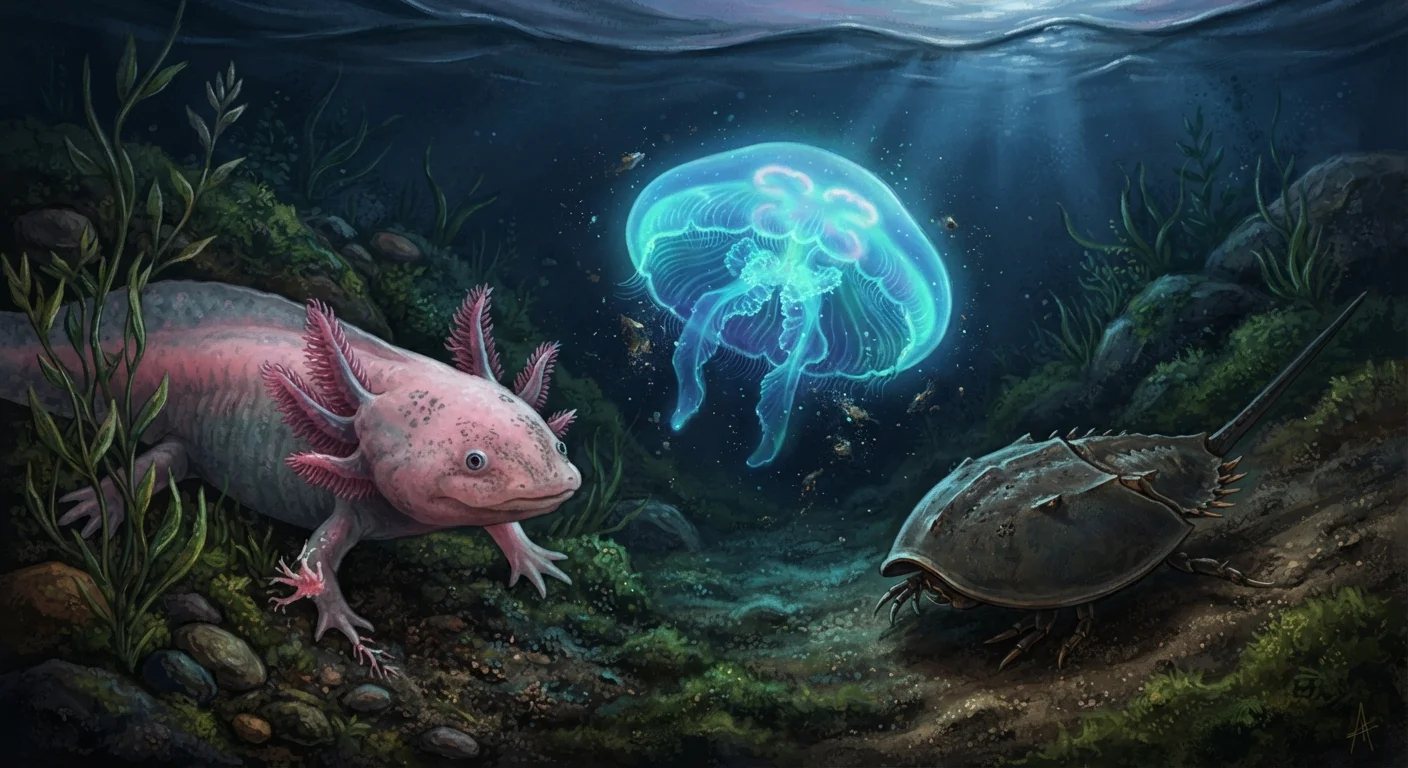
The axolotl (Ambystoma mexicanum), a freshwater salamander native to Mexico, can regrow lost limbs, portions of its heart, sections of its spinal cord, and even parts of its brain — with functional tissue, not just scar replacement. This ability is driven by clusters of cells called blastemas that form at the wound site and can differentiate into whatever tissue type is needed.
Axolotls also exhibit neoteny — they retain larval features, including external gills, throughout their adult lives, never fully metamorphosing as most amphibians do. Wild axolotls are critically endangered, making their biology both scientifically urgent and ecologically precarious.
Axolotls can regrow limbs, heart tissue, and even parts of the brain with fully functional replacement cells.
Tardigrades: Virtually Indestructible Microscopic Animals
Tardigrades — often called water bears — are microscopic eight-legged invertebrates found in nearly every habitat on Earth, from deep ocean sediment to Antarctic ice. When conditions become hostile, they enter a state called cryptobiosis, expelling nearly all body water and suspending metabolism almost entirely.
In this state, tardigrades have survived temperatures approaching absolute zero, pressures six times greater than the deepest ocean trench, intense ionizing radiation, and confirmed exposure to the vacuum of outer space during research missions. They do not technically "live" through these conditions — they pause life itself — but resume normal activity once conditions improve.
Tardigrades survive extreme cold, radiation, and the vacuum of space by suspending their metabolism almost entirely.
Horseshoe Crabs: Ancient Animals with Blue Blood
Horseshoe crabs (Limulus polyphemus) are not true crabs — they're more closely related to spiders and scorpions. What makes them genuinely extraordinary is their blood: it's blue. Instead of iron-based hemoglobin, horseshoe crabs use hemocyanin, a copper-containing protein that turns blue when oxygenated.
Their blood also contains amebocytes — cells that clot almost instantly when exposed to bacterial toxins. This property has made horseshoe crab blood lysate a standard tool in pharmaceutical safety testing, used to detect contamination in injectable drugs and medical devices. Their biology, largely unchanged for roughly 450 million years, directly supports modern medicine.
Horseshoe crab blood turns blue when oxygenated and clots in the presence of bacterial toxins used in medical testing.
The Immortal Jellyfish: A Life Cycle That Reverses
Turritopsis dohrnii, a small jellyfish found in warm ocean waters, is notable for an ability found in virtually no other multicellular animal: under stress or after reaching sexual maturity, it can revert to its earlier polyp stage through a process called transdifferentiation — where mature cells transform into different cell types entirely.
This does not make the species truly immortal in the wild, where disease, predation, and injury remain constant threats. But in controlled conditions, the reversal process has been observed to repeat. Researchers study T. dohrnii for potential insights into cellular aging and reprogramming, though practical applications remain speculative.
Turritopsis dohrnii can reverse its own aging process by transforming mature cells back into an earlier life stage.
Mantis Shrimp: Seeing Colors Humans Can't Imagine
Human eyes contain three types of color-detecting photoreceptors (cones), allowing us to perceive millions of color combinations. The mantis shrimp has up to 16 types of photoreceptors, including receptors sensitive to ultraviolet and infrared light — wavelengths completely invisible to us.
Interestingly, research suggests mantis shrimp may not process color with the same nuance as humans despite this receptor count — their visual system appears optimized for rapid color identification rather than fine discrimination. Beyond vision, mantis shrimp can strike prey with the force of a bullet and accelerate their appendages faster than almost any other animal movement recorded. Their entire biology challenges expectations at every level. For more on how sensory biology varies across animal groups, see our guide to warm- and cold-blooded animal differences.
Mantis shrimp have up to 16 types of photoreceptors, detecting ultraviolet and infrared light far beyond human vision.
Mimic Octopuses: Shape-Shifters of the Sea
The mimic octopus (Thaumoctopus mimicus), discovered off the coast of Indonesia in 1998, takes camouflage to a remarkable extreme. Unlike other octopuses that blend into backgrounds, this species actively impersonates other animals — including lionfish, flatfish, and sea snakes — by rearranging its body shape, color, and movement patterns.
What makes this especially striking is the apparent context-sensitivity: the octopus appears to select which animal to mimic based on the type of predator nearby. Whether this reflects genuine decision-making or a more reflexive response remains an area of active research. Either way, it represents one of the most sophisticated behavioral disguises observed in invertebrates. See also our deeper look at how camouflage works across different species.
The mimic octopus impersonates multiple dangerous animals, apparently selecting its disguise based on the threat present.
What These Traits Tell Us About Life Itself
Each of these extraordinary adaptations evolved in response to real environmental pressures — predation, extreme habitats, scarcity of resources. They aren't accidents or anomalies so much as elegant, if surprising, biological strategies refined over millions of years.
Curiosity Is a Good Starting Point
If an animal trait sounds impossible, it's worth investigating rather than dismissing. Many of biology's most important discoveries — from penicillin to cancer treatments — began with scientists paying close attention to organisms that did something unexpected. The natural world consistently rewards curiosity with useful surprises.
These animals also open genuine doors in science. Axolotl regeneration research informs wound-healing studies. Tardigrade resilience mechanisms are studied in the context of preservation biology. Horseshoe crab blood has been used in medical safety testing for decades. The "weird" in nature, it turns out, often points toward the useful. For more on how animal biology challenges common assumptions, explore our look at animal intelligence myths science has overturned and the surprising science behind why animal lifespans vary so dramatically.