
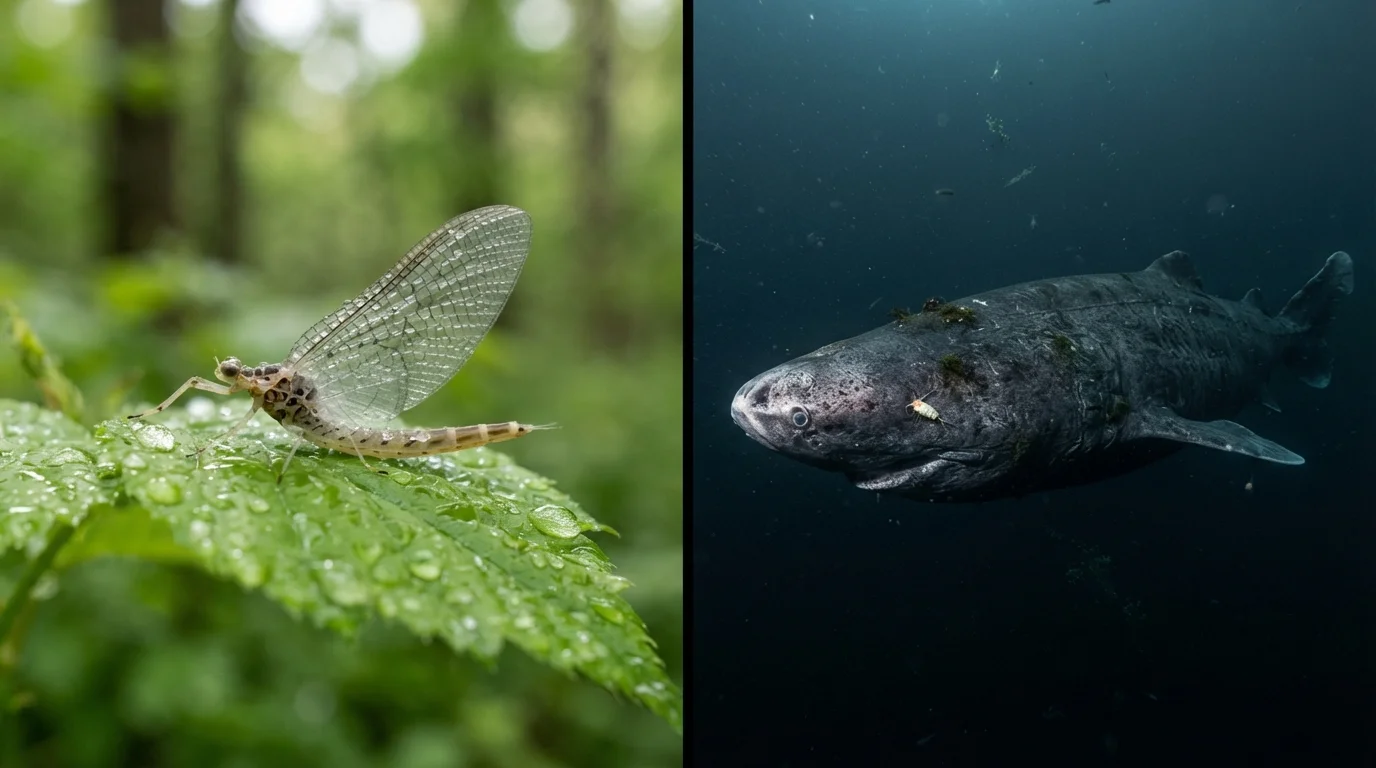
The Mayfly and the Shark: Two Extremes of Animal Life
A mayfly emerges from a river, mates, lays eggs, and dies — sometimes within 24 hours. Meanwhile, somewhere in the frigid waters of the North Atlantic, a Greenland shark cruises slowly through the dark, possibly born before the American Revolution. These two animals share a planet but almost nothing else about their biological clocks.
The science of why animals age and die at such different rates — a field called biogerontology — has uncovered several overlapping forces that determine how long a creature lives. No single factor explains everything, but together they paint a fascinating picture of life's many strategies.
Metabolism: The Engine That Burns Out
One of the most consistent patterns in longevity research is the link between metabolic rate and lifespan. Metabolism is the rate at which an animal converts food into energy. Animals with fast metabolisms — like small rodents — tend to burn through their biological resources quickly and live briefly. A mouse's heart may beat 600 times per minute; it lives roughly two years.
Larger, slower-metabolism animals tend to live much longer. An elephant's resting heart rate is around 30 beats per minute — and elephants can live 60 to 70 years in the wild. The Greenland shark, one of the slowest-moving vertebrates known to science, has an extremely sluggish metabolism suited to near-freezing water. Researchers believe this slow pace of living is a key contributor to its extraordinary longevity.
“The rate of living theory has intuitive appeal, but biology keeps finding animals that simply don't follow the rules — bats, mole rats, naked mole rats. Lifespan is a trait shaped by many forces acting together.”
— Joao Pedro de Magalhaes, Professor of Molecular Biogerontology, University of Birmingham
Bats are a striking exception to simple size-metabolism rules. Despite being small with high metabolic demands during flight, many bat species live 20 to 40 years — far longer than land mammals of similar size. Their ability to enter torpor (a deep energy-saving rest) and unusually efficient DNA repair mechanisms likely contribute to this outlier status. See also: animals with genuinely surprising biological traits.
Reproduction Strategy: Live Fast or Take It Slow
Evolution doesn't care about individual longevity — it cares about successful reproduction. Species that reproduce in enormous numbers, very early in life, and with minimal parental investment tend to be short-lived. There's little evolutionary pressure to maintain the body beyond the point of peak reproduction.
Mayflies epitomize this strategy. Their adult stage exists solely to mate. Investing energy in a long adult life would offer no reproductive advantage. Contrast this with large tortoises or whales, which invest heavily in fewer offspring and require many years of development before reproducing at all. Longevity becomes advantageous when it allows more reproductive opportunities over a lifetime.
24 hrs
Maximum adult lifespan of a mayfly
Adult mayflies (order Ephemeroptera) exist solely to reproduce, with some species living only a few hours after emerging from water.
400+
Estimated years a Greenland shark can live
Carbon-14 dating of Greenland shark eye lenses, published in Science (2016), suggested lifespans exceeding 400 years for the largest individuals studied.
507 yrs
Age of the oldest recorded ocean quahog clam
Researchers at Bangor University determined the clam's age by counting growth rings in its shell, making it one of the oldest individual animals ever documented.
~30 yrs
Maximum lifespan of naked mole rats
Naked mole rats live up to ten times longer than similarly sized rodents, according to research into their unusually robust cellular repair systems.
Cellular Repair, Telomeres, and the Biology of Aging
At the cellular level, aging is partly a story of accumulated damage. Every time a cell divides, the protective caps on chromosomes — called telomeres — shorten slightly. When telomeres become too short, the cell can no longer divide properly and begins to malfunction. Animals with more efficient DNA repair mechanisms and slower telomere shortening tend to live longer.
Some species have evolved remarkable countermeasures. The naked mole rat, a small African rodent, lives up to 30 years — roughly ten times longer than comparably sized mice — and shows almost no increase in cancer risk with age. Researchers have identified unusually stable protein production and highly effective cellular quality control as likely contributors.
DNA Repair Is a Key Longevity Factor
Species with particularly efficient DNA repair mechanisms — including certain species of sharks, mole rats, and bats — consistently outperform lifespan predictions based on body size alone. Researchers studying human aging often look to these animals for clues about extending healthy cellular function.
The immortal jellyfish (Turritopsis dohrnii) takes cellular strategy even further, able to revert its cells to an earlier developmental stage — essentially hitting a biological reset button. It's one of the most extraordinary examples in a kingdom full of outliers, including those explored in our article on animals that defy basic biology.
Environment and Predation: Outside Pressures on Lifespan
Biology isn't the only driver. An animal's environment shapes how natural selection molds lifespan over generations. Animals facing heavy predation pressure — like small rodents in open fields — benefit from reproducing quickly and early, since surviving to old age is unlikely anyway. Over evolutionary time, this selects for shorter natural lifespans.
Animals with few predators, like large tortoises on isolated islands or deep-ocean sharks, face less pressure to reproduce fast, allowing evolution to favor longer-lived individuals. Protected environments, whether literal islands or the ocean's depths, consistently correlate with exceptional longevity. Ocean creatures, in general, show some of the most dramatic lifespans on Earth, a pattern researchers continue to investigate. Understanding how animals navigate their environments over lifetimes also connects to extraordinary abilities like those described in our piece on how animals navigate thousands of miles without a map.