
Why Our Ideas About Animal Minds Keep Changing
For most of human history, animals were assumed to operate on instinct alone — biological machines with no real inner life or capacity for complex thought. Science has spent decades dismantling that assumption, one carefully designed study at a time. The picture that has emerged is far more interesting: animal cognition is genuinely diverse, surprisingly deep in some species, and almost impossible to evaluate fairly using human-centric standards.
Understanding what animals can and cannot do matters beyond trivia. It shapes how we care for pets, how we treat farm animals, and how we understand our own evolutionary history. If you've repeated any of the myths below, you're in good company — but the evidence has moved on. For a broader look at why animals behave the way they do, see our introduction to ethology.
Myth
Goldfish have a memory span of just three seconds.
Fact
Goldfish can retain learned information for months, not seconds.
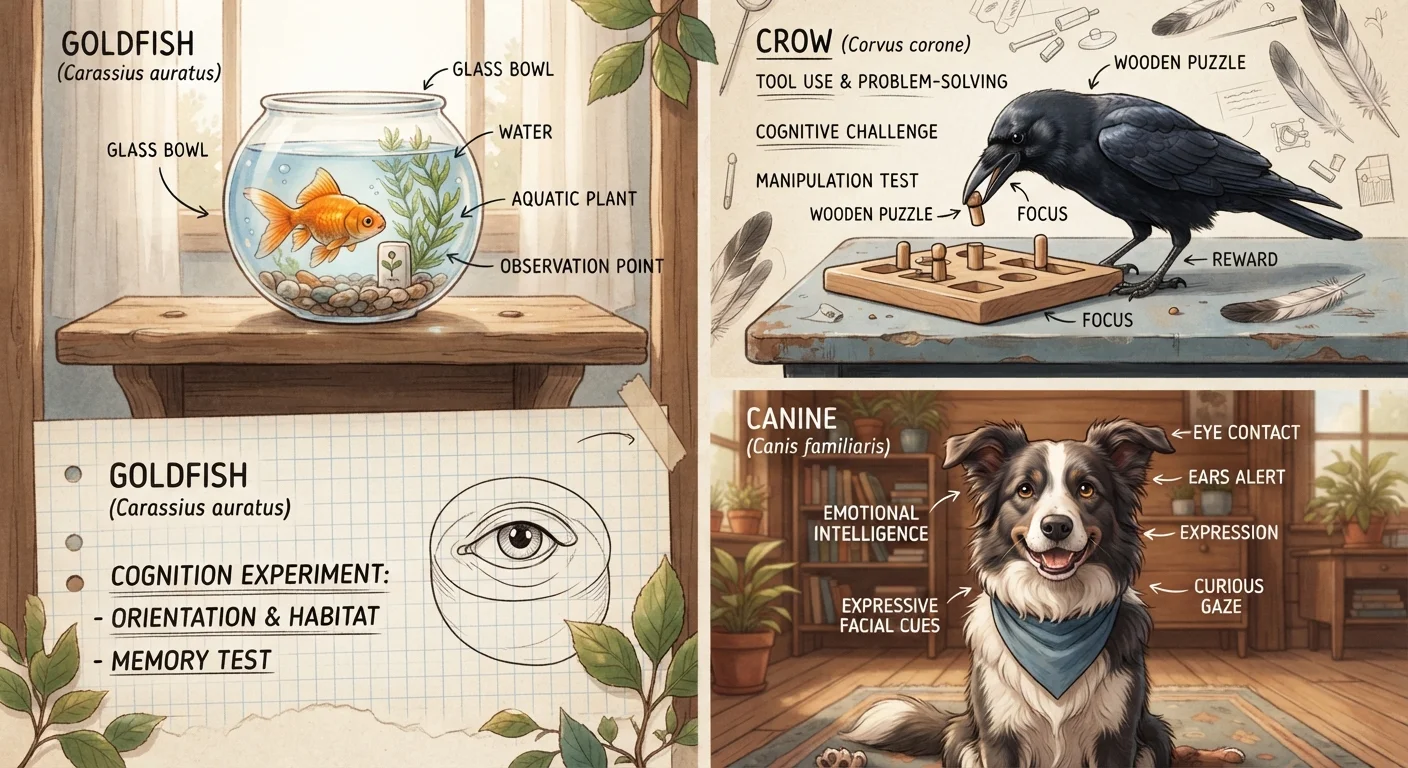
This claim is one of the most persistent in popular culture, but it has no scientific basis. Controlled experiments have demonstrated that goldfish can be trained to navigate mazes, recognize feeding times, and respond to signals — retaining that learning for weeks or months. Their memory architecture is genuinely different from a mammal's, but it is far from non-existent. The three-second myth likely persists because it is a satisfying, memorable idea rather than because anyone measured it.
Myth
Birds are unintelligent — 'bird-brained' is a fair insult.
Fact
Many bird species display problem-solving, tool use, and planning abilities comparable to great apes.
Corvids — the family including crows, jays, and ravens — have repeatedly surprised researchers. They craft and modify tools, cache food while accounting for observers who might steal it, and pass some versions of future-planning tests. African grey parrots have demonstrated numerical understanding and context-sensitive communication. The 'bird-brained' insult reflects the outdated assumption that brain size relative to body mass determines intelligence. Birds evolved a different neural architecture that achieves comparable results through distinct pathways.
Myth
When a dog looks 'guilty,' it knows it did something wrong.
Fact
The 'guilty look' in dogs is a response to owner behavior, not evidence of moral self-awareness.
Psychologist Alexandra Horowitz conducted a now widely cited study in which dogs displayed the classic guilty expression — lowered head, averted gaze, tucked tail — regardless of whether they had actually misbehaved. What triggered the look was the owner's body language and tone, not the dog's own actions. Dogs are extraordinarily good at reading human emotional cues, and the guilty look is appeasement behavior aimed at de-escalating a tense interaction. This doesn't mean dogs lack emotional lives; it means guilt as humans experience it has not been demonstrated in dogs. See our full breakdown of pet behaviour myths for related examples.
Myth
Only humans and great apes can recognize themselves in a mirror.
Fact
Elephants, dolphins, magpies, and some fish have also passed or come close to passing the mirror self-recognition test.
The mirror test — placing a mark on an animal's body and observing whether it investigates the mark in its own reflection — is considered one indicator of self-awareness. Asian elephants have passed it. Bottlenose dolphins and orca have passed it. European magpies, a corvid, have shown self-directed behavior toward marks on their own feathers. A 2019 study even reported that cleaner wrasse fish engaged in mark-directed behavior, though scientists continue to debate what that result means for the test itself. The point is not that all these species share human-like self-consciousness, but that self-recognition is not the exclusive province of primates.
Myth
Cats are asocial loners with no real attachment to their owners.
Fact
Research shows cats form genuine social bonds and display attachment behaviors similar to those seen in dogs and human infants.
A 2019 study published in Current Biology used an attachment protocol adapted from infant psychology and found that the majority of cats tested used their owner as a secure base for exploration — a hallmark of attachment bonding. Cats are more selective about when they display affiliation than dogs, which may have contributed to the 'aloof' reputation, but selectivity is not the same as indifference. Their social behavior evolved differently from dogs, but attachment to specific humans has been documented across multiple studies.
What the Evidence Actually Shows
Cognitive research on animals has accelerated dramatically since the 1990s, using standardized tests, brain imaging, and long-term behavioral observation. The findings consistently reveal that species once dismissed as simple — fish, birds, even insects — possess cognitive tools that serve their ecological needs remarkably well.
77%
Cats showing secure attachment to owners
A 2019 study in Current Biology found roughly 65–77% of cats tested displayed secure attachment behaviors toward their caregivers.
Months
Goldfish memory retention in lab studies
Multiple controlled experiments have demonstrated goldfish retaining learned tasks — such as lever pressing for food — for several months.
The broader lesson isn't that animals are "almost human" — that framing still centers the wrong species. It's that intelligence itself takes many forms, and evaluating a crow by primate standards misses the point entirely. For a companion look at how similar myths persist about pet behavior specifically, see pet behaviour myths that even experienced owners still believe.
Misreading Animal Behavior Can Affect Welfare
Assuming a dog 'knows it was bad' can lead to punishment after the fact, which dogs cannot connect to a past action — creating confusion and anxiety rather than learning. Similarly, assuming fish or birds feel nothing can lead to inadequate housing and enrichment. Accurate knowledge of animal cognition directly improves the quality of care we provide.
When we correctly understand what animals are capable of, we become better caregivers and more informed advocates. Curiosity about animal minds is one of the most productive instincts a pet owner — or a curious person — can have. You might also find our article on whether fish feel pain illuminating, as it explores another area where popular assumptions are giving way to more nuanced science.