
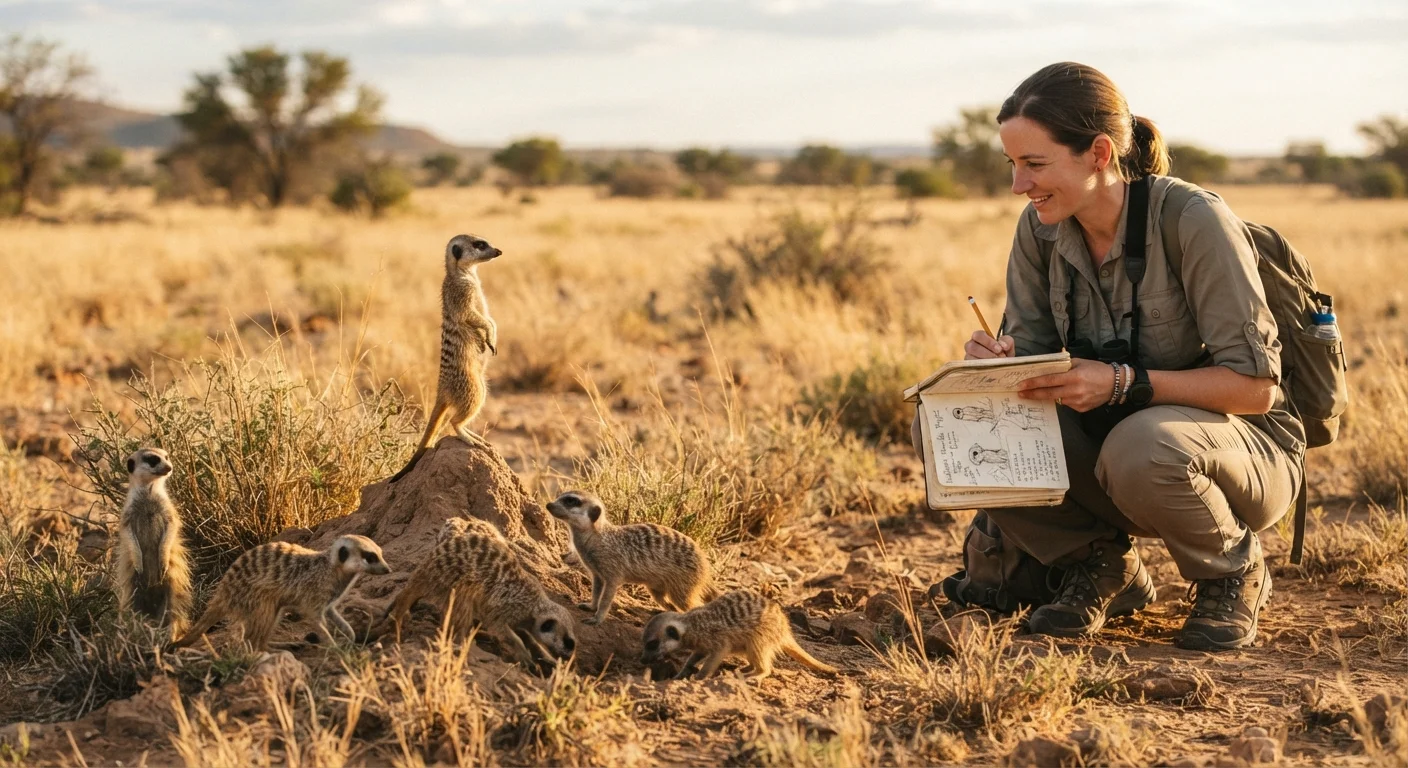
What Is Ethology?
Ethology is the scientific study of animal behaviour, with a particular emphasis on behaviour as it occurs in natural environments and as shaped by evolution. The word comes from the Greek ethos (character) and logos (study). Rather than simply cataloguing what animals do, ethologists ask why — what function does a behaviour serve, how did it develop in the individual, and how did it evolve in the species?
The field was formalised in the mid-twentieth century, largely through the work of researchers studying animals in the field rather than in controlled lab conditions. A central insight is that behaviour, like anatomy, is shaped by natural selection — meaning that the actions animals perform have, over generations, tended to increase survival or reproductive success.
Ethology
The scientific study of animal behaviour, focusing on behaviour in natural settings and its evolutionary origins.
Fixed action pattern
An innate, stereotyped sequence of behaviours that is triggered by a specific stimulus and runs to completion automatically.
Sign stimulus
A specific cue in the environment — often a simple feature like a colour or shape — that triggers an instinctive behavioural response.
Social learning
Acquiring new behaviours or information by observing and copying others, rather than through direct personal trial and error.
Pheromone
A chemical signal released by an animal that influences the behaviour or physiology of other members of the same species.
Stereotypy
A repetitive, invariant behaviour pattern with no obvious function, often seen in captive animals and used as an indicator of welfare problems.
Ethology sits at the crossroads of biology, ecology, and psychology. It complements related work on animal intelligence, challenging assumptions and replacing guesswork with observation-based evidence.
Instinct vs. Learned Behaviour
One of ethology's foundational questions is how much of an animal's behaviour is innate (built in from birth) and how much is learned through experience. The honest answer is: almost always both, interacting with each other.
Instinctive behaviours — sometimes called fixed action patterns — are triggered by specific stimuli and run to completion without prior learning. A newly hatched duckling following the first moving object it sees is a classic example of this kind of hardwired response.
Learned behaviours range from simple habituation (stop responding to a stimulus that proves harmless) to complex problem-solving and social learning. Many birds, for instance, learn the specific songs of their species during a sensitive period early in life — the capacity to learn is innate, but the content is acquired.
Watch First, Then React
When a pet does something unexpected, pause before correcting. Observe what preceded the behaviour — the trigger often reveals the real cause. This small habit shift, borrowed directly from field ethology, leads to far more effective responses than punishment or redirection alone.
This instinct-learning continuum matters enormously for pet owners. A dog that digs or a cat that hunts is not misbehaving — it is expressing behaviours with deep evolutionary roots. Recognising this is the first step toward responding constructively rather than punitively.
How Animals Communicate
Animals exchange information constantly, and ethologists classify signals by the sense channel they use. The main channels are:
- Visual: postures, facial expressions, colour displays, and movement patterns. A dog's lowered tail signals a very different emotional state than a raised, stiff one.
- Acoustic: calls, songs, ultrasonic squeaks, and even substrate vibrations. Birdsong can simultaneously attract mates and warn rivals.
- Chemical: pheromones and scent marks convey identity, reproductive status, and territorial claims — often long after the signalling animal has left.
- Tactile: grooming, nuzzling, and physical contact reinforce social bonds in many species.
Crucially, many signals carry meaning only in context. The same vocalisation from a cat can indicate contentment, hunger, or distress depending on posture, situation, and audience. Misreading signals is one of the most common sources of human–animal miscommunication.
Visual signals in nature go well beyond body language. Colour patterns in the wild — from the bold stripes of a poison dart frog to a peacock's iridescent tail — are a rich form of communication in their own right.
Social Behaviour and Group Dynamics
Many animals live in groups, and ethologists study how those groups are structured and maintained. Social behaviour emerges from individual-level rules: who defers to whom, who grooms whom, who investigates threats first.
The concept of a linear dominance hierarchy — a strict pecking order — is well-documented in some species but oversimplified when applied universally. In many animals, relationships are more nuanced: alliances shift, context matters, and subordinates regularly access resources without conflict.
Avoid Oversimplifying Dominance
Applying strict dominance hierarchies to all social animals — especially dogs and cats — can lead to training approaches that are counterproductive or damaging to trust. Current behavioural science suggests that most pet behaviour labelled as 'dominance' is better explained by anxiety, resource guarding, or inconsistent boundaries. Consult a qualified animal behaviourist if you're dealing with persistent behaviour concerns.
Cooperative behaviour is another major area of study. Meerkats take turns acting as sentinels, alarm-calling at the approach of predators even at risk to themselves. Dolphins cooperate to herd fish. Understanding these dynamics requires observing individuals over time — not just single interactions.
For pet owners, this research is directly relevant. A cat's environment shapes how it expresses social tendencies, copes with isolation, and interacts with humans — all rooted in the social ecology of its wild ancestors.
Why Ethology Matters for Pet Owners
You don't need a research background to benefit from ethological thinking. At its core, it encourages one habit: observe before you interpret. What is the animal actually doing? What might have triggered it? What does the animal gain from the behaviour?
This approach directly challenges common misconceptions. Many widely held ideas about pet behaviour myths — that dogs feel guilt, that cats are purely solitary, that dominance explains most problems — don't survive contact with the evidence.
Applying ethological principles can improve how you train, house, and relate to your pet. It also forms the foundation of the broader field of pet behaviour study that informs modern, reward-based training and welfare assessment.
For a practical next step, explore how behavioural understanding builds stronger bonds — translating what you now know about ethology into everyday interactions with the animals in your life.
Animal Behaviour Society
A professional organisation dedicated to the scientific study of animal behaviour. Their public resources provide an accessible entry point into current research and careers in ethology.
ASPCA Animal Behavior Resources
The ASPCA publishes practical, evidence-based guides on understanding and managing common pet behaviour patterns — a useful bridge between ethological science and everyday pet ownership.