
Why Colour Is a Form of Communication
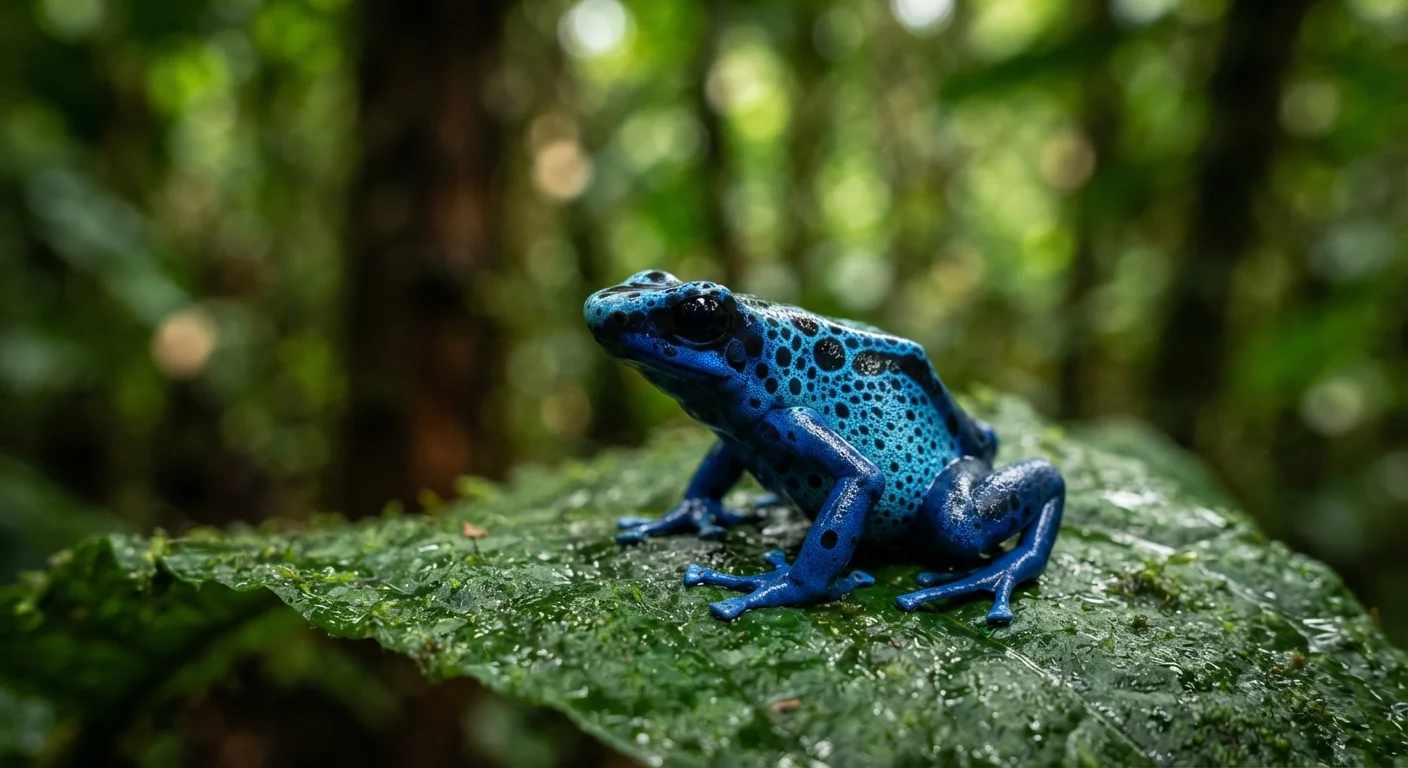
When we spot a brilliantly coloured animal in the wild — a jewel-like frog, a striped caterpillar, a shimmering fish — our first instinct is often to admire it. But for other animals sharing that environment, vivid colouration carries urgency: it is a signal, not decoration.
Animal colour patterns communicate across species lines without sound or movement. They can say I am toxic, I am healthy and worth mating with, or even I am something I'm not. Evolution has refined these signals over millions of years because they work — they change the behaviour of receivers reliably enough to provide a survival advantage.
This kind of biological messaging fits within the broader science of animal behaviour. Ethology — the study of animal behaviour — examines exactly these patterns: why animals do what they do, and how signals like colour evolved to serve specific functions.
~180
Species of poison dart frogs identified
According to herpetological classifications, the family Dendrobatidae contains roughly 180 described species, many exhibiting distinct aposematic colour forms even within a single species.
700+
Heliconius butterfly species and subspecies studied
Heliconius butterflies have been a primary research model for Müllerian mimicry, with researchers documenting hundreds of distinct populations across Central and South America.
1 trial
Often enough for a bird to learn a warning pattern
Behavioural studies on avian predators have shown that a single aversive encounter with an aposematic prey item can be sufficient to establish long-term avoidance of that colour pattern.
Warning Colours: The Honest Signal
The most studied use of bright colour in nature is aposematism — using conspicuous patterns to warn predators of genuine danger. Poison dart frogs of Central and South America are a textbook example. Their brilliant reds, blues, and yellows honestly advertise potent skin toxins. A naive predator that ignores the signal may survive but will rarely make the same mistake twice.
What makes warning colouration particularly effective is the learning mechanism it exploits. Predators with strong memory — birds being a prime example — rapidly form associations between a pattern and an unpleasant or harmful experience. The brighter and more distinctive the pattern, the faster that association forms and the longer it is retained.
This is why aposematic species across different continents and taxonomic groups have independently evolved strikingly similar colour combinations: black and yellow (wasps, certain salamanders), red and black (ladybugs, coral snakes), orange and black (monarch butterflies, fire salamanders). Evolution keeps arriving at the same solutions because those specific contrasts are particularly easy for vertebrate visual systems to detect and remember.
A Useful Rule of Thumb in Nature
As a general principle in wildlife observation, conspicuously coloured wild animals — especially small ones — are more likely to carry a genuine defence mechanism than dull-coloured ones. That said, colour alone is never a reliable identification tool. Always observe wild animals from a respectful distance and consult regional field guides or qualified naturalists if you need to identify a species safely.
Mimicry: Deception Built on Honest Signals
Once a genuine warning colour becomes widely recognised in an ecosystem, it creates an opportunity for cheaters. Batesian mimicry describes harmless species that have evolved to resemble dangerous ones — borrowing the reputation of a toxic neighbour without the metabolic cost of producing toxins.
Many hoverfly species, for instance, bear yellow and black banding that closely resembles stinging wasps or bees, yet are completely harmless. The deception works because predators cannot afford to test every yellow-and-black insect they encounter.
A related but distinct strategy is Müllerian mimicry, where multiple genuinely toxic species converge on the same colour pattern. This is a mutually beneficial arrangement: each species contributes individuals to the predator-learning process, so each species loses fewer members before the warning is established in the local predator population. Many species of Heliconius butterflies across South America display this strategy, with geographically distinct populations converging on shared local warning patterns.
It is worth noting that identifying venomous or dangerous wild animals should always be left to trained wildlife professionals. Colour-based identification, while biologically meaningful, is not a reliable safety method for people in the field.
For a deeper look at how concealment strategies contrast with these conspicuous signals, see how animal camouflage works across different species.
Colour for Mate Choice and Social Status
Not all vivid colour is about predator deterrence. In many species, bright colouration functions as a reliable indicator of genetic quality or physical health during mate selection.
The red plumage of a male house finch, for example, is derived from carotenoid pigments in the diet. Brighter red honestly signals that the male has been able to find carotenoid-rich food — an indicator of foraging skill and overall health. Females across many bird species prefer more intensely coloured males because the colour honestly reflects something they cannot fake easily.
Colour also communicates social rank within species. Many fish, lizards, and primates display colour changes that signal dominance or submission, allowing hierarchies to be maintained without constant physical conflict. The throat fans (dewlaps) of male anole lizards, for instance, vary in colour and display pattern and carry information about species identity and individual status simultaneously.
When Colour Signals Break Down
Animal colour signals are not infallible, and understanding their limits matters. Signals can be disrupted when non-native species are introduced to ecosystems where local predators have no experience with the warning patterns. A predator that has never encountered a poison dart frog may not recognise its warning colours — the signal only works within a shared ecological context where the relevant learning has occurred.
Colour signals can also be misread across species lines in ways that have real consequences. Some domestic animals retain colour-response instincts from wild ancestors that may not apply to their current environment. Similarly, understanding that animal signals are context-dependent is a useful lens for reading pet behaviour correctly — signals that seem obvious can mean something quite different in practice.
Colour signalling is one of the most elegant demonstrations of how evolution shapes communication systems. Each bright pattern is, in effect, a message refined across generations until it reliably changes behaviour in the animals that perceive it.
“The diversity of warning colours across the animal kingdom is a testament to how powerful learning-based predator avoidance can be as a selective force. Once a signal becomes established in a community, it can persist and spread for thousands of generations.”
— John Skelhorn, Researcher in animal cognition and aposematism, Newcastle University