
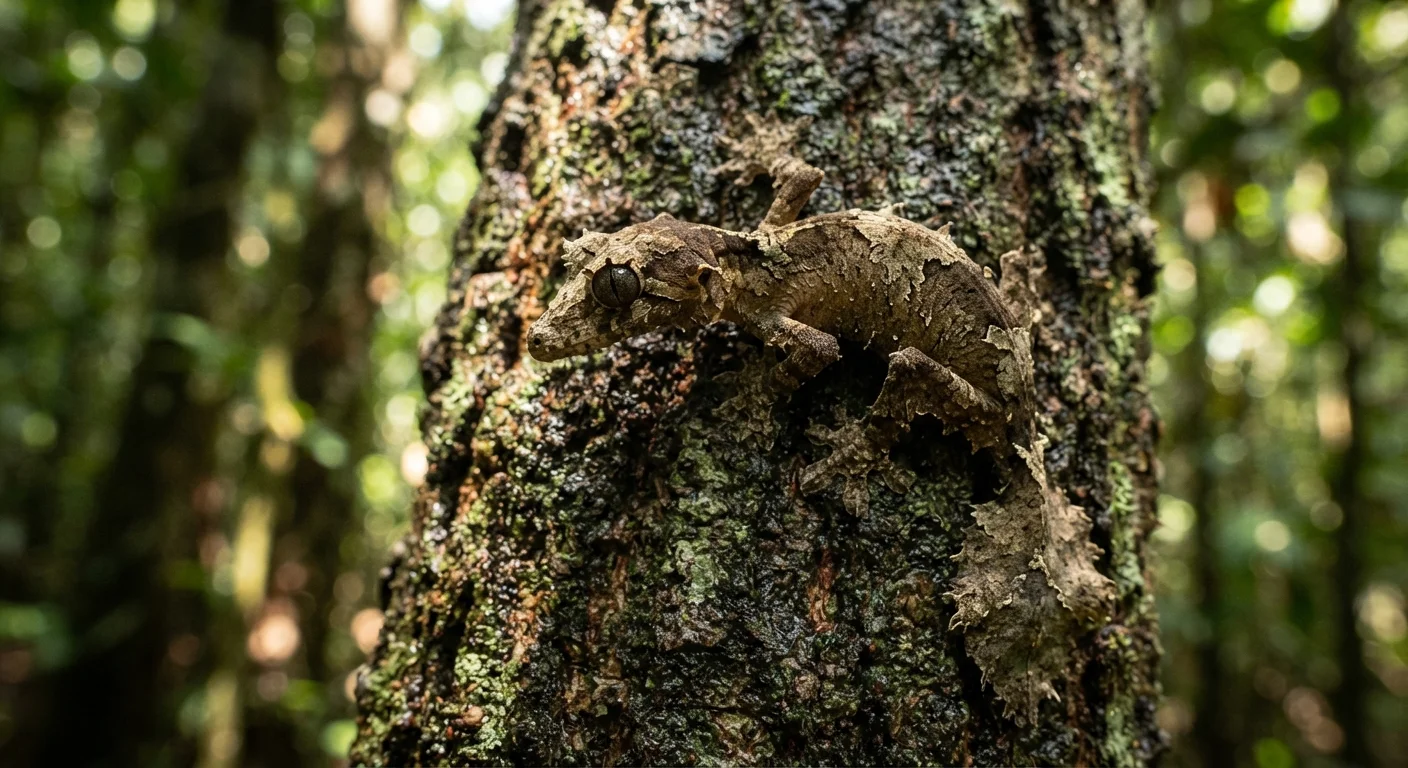
The Core Mechanisms of Camouflage
Camouflage is not a single trick — it is a collection of distinct biological strategies, each working differently to reduce an animal's visibility. Understanding these mechanisms reveals just how sophisticated and varied concealment in nature can be.
Background matching is the most familiar form: an animal's colours and patterns closely resemble the surface it typically rests on. The peppered moth's speckled wings against lichen-covered bark is a textbook example. Disruptive coloration works differently — bold, contrasting patches like those on a zebra or a tiger break up the outline of the body, making it harder for a viewer to recognise the animal's shape at a glance.
Countershading is a more subtle technique used by many fish, sharks, and deer. The animal is darker on top and lighter on the bottom, counteracting the natural shading caused by overhead light and making the body appear flatter and less three-dimensional. Mimicry goes further still, with some animals resembling specific objects — dead leaves, bird droppings, or even flower petals — with striking precision.
Camouflage vs. Warning Coloration
Camouflage and warning coloration (aposematism) are opposite strategies that can sometimes exist in the same species at different life stages. A caterpillar may be cryptically coloured, while the adult butterfly it becomes displays vivid warning patterns. The contrast between these strategies is explored in our article on what bright animal colours actually signal.
Masters of Active Camouflage
Most camouflage is fixed — an animal is born with particular colours or patterns suited to its habitat. But a remarkable group of animals can actively change their appearance in seconds. Cephalopods — octopuses, squid, and cuttlefish — are the most celebrated examples. They use networks of chromatophores (pigment-filled cells), iridophores (light-reflecting cells), and papillae (skin bumps that change texture) to replicate almost any surface in their environment.
Chameleons are often cited as colour-changers, though their ability is frequently misunderstood. Research suggests chameleons primarily shift colour for communication and temperature regulation, with camouflage being a secondary benefit in many species. Their colour changes rely on structural manipulation of light-reflecting nanocrystals rather than pigment alone.
“Camouflage is not simply about matching colour — it is about defeating the perceptual system of a specific observer. Understanding that requires us to study vision as much as pigmentation.”
— Roger Hanlon, Senior Scientist, Marine Biological Laboratory; leading researcher in animal camouflage and cephalopod biology
The Arctic fox and snowshoe hare demonstrate a slower form of active adaptation: seasonal colour change. Both species grow white coats in winter and brown or grey coats in summer, cycling with the landscape through hormonal triggers tied to day length.
Camouflage Across Animal Groups
Camouflage has evolved independently across wildly different branches of the animal kingdom, a striking example of convergent evolution — where unrelated species arrive at similar solutions to similar problems.
~700
Stick insect species using plant mimicry
Approximately 700 species of stick insects (order Phasmatodea) have been identified, the vast majority of which use body shape and colour to mimic twigs, bark, or leaves.
200 ms
Time for an octopus to change colour
Research on cephalopod camouflage has documented colour and pattern changes in octopuses occurring in under 200 milliseconds — faster than a human eye blink.
30+
Independent evolutions of countershading
Countershading has evolved independently in over 30 vertebrate lineages, according to comparative biology analyses, underscoring its broad adaptive value.
Insects are perhaps the most diverse group of camouflage artists. Stick insects and leaf insects replicate plant material so precisely that they include vein-like markings and even simulate bite damage. The orchid mantis mimics flower petals and uses this disguise both to hide from predators and to ambush visiting pollinators.
Reptiles beyond chameleons also excel at concealment. The leaf-tailed gecko of Madagascar matches bark with uncanny accuracy, while some flatfish like the flounder can alter both colour and pattern to match sand and gravel substrates beneath them, demonstrating that active camouflage isn't exclusive to cephalopods.
Mammals generally rely on fixed coloration, but it is often highly effective. The spotted coats of fawns break up their outlines in dappled woodland light — a form of disruptive coloration that complements the deer's instinct to lie still when threatened. For more on how environment shapes animal strategy, see our piece on why some species live alone and others in groups.
Why Camouflage Matters Beyond Survival
Camouflage is often framed purely as a defence against predators, but its roles are broader. Predators use it offensively — leopards' rosette patterns help them remain hidden in dappled forest shade while stalking. The stonefish, one of the world's most venomous fish, sits motionless on the seafloor resembling a rock, waiting for prey to drift within range.
Some animals use camouflage during specific life stages. Many caterpillars are camouflaged while vulnerable, then metamorphose into brightly coloured adults that rely on warning coloration instead. This contrast — between concealment and conspicuousness — highlights that there is no single best strategy. Natural selection favours whatever works in each animal's specific ecological context.
Watch for Behavioural Camouflage
Physical appearance is only part of the picture. Many camouflaged animals pair their colouring with specific postures — a bittern stretches its neck skyward to mimic reeds, and a moth holds its wings flat to maximize contact with bark. When observing wildlife, look for stillness and posture as clues that an animal may be relying on concealment.
It is also worth noting that camouflage is always relative to an observer's visual system. Some animals that appear well-camouflaged to human eyes may be visible to predators with ultraviolet vision, and vice versa. The effectiveness of concealment depends entirely on the eyes doing the looking — a nuance that researchers continue to investigate. For a deeper look at extraordinary animal adaptations, explore our article on animals with genuinely surprising biological traits.