
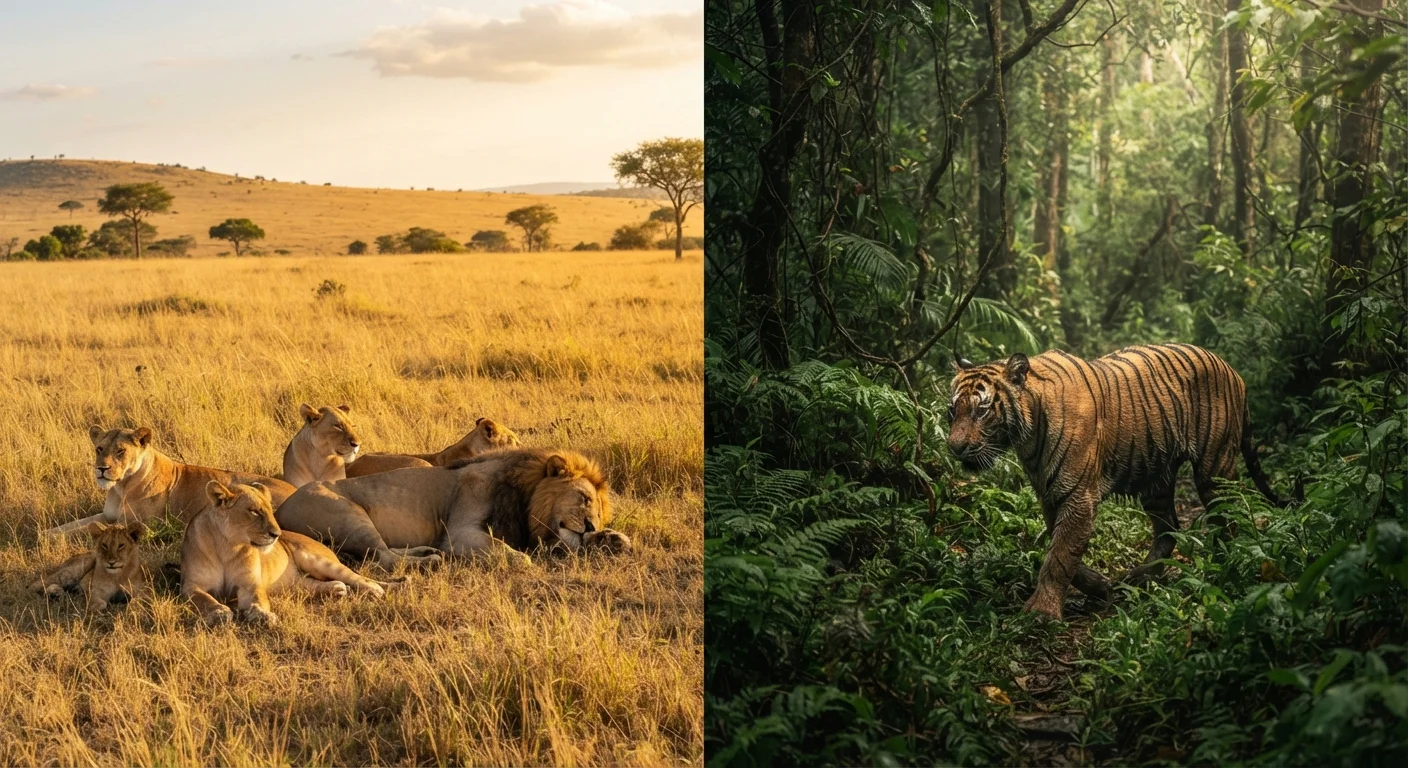
The Core Trade-Off: Sharing Resources vs. Pooling Strength
At its heart, the divide between social and solitary animals comes down to a single trade-off: is it more advantageous to share resources with group members, or to keep them all for yourself? Evolution doesn't favor one answer — it favors whichever answer works best for a given species in a given environment.
Social animals — from wolves to meerkats to honeybees — live in groups because the collective benefit outweighs the cost of sharing. Solitary animals — such as tigers, polar bears, and most spider species — find that going it alone maximizes their individual fitness. Understanding why requires looking at the specific pressures each lifestyle solves. For a broader overview of how animal groups are classified, see Animal Kingdom at a Glance.
| Social Animals | Solitary Animals | |
|---|---|---|
| Examples | Lions, wolves, meerkats, elephants | Tigers, leopards, polar bears, giant pandas |
| Hunting strategy | Cooperative; can tackle large prey | Ambush or stealth; relies on individual skill |
| Predator defense | Group vigilance and collective defense | Camouflage, speed, or intimidation alone |
| Territory size | Shared; group patrols and defends together | Large individual range; minimal overlap tolerated |
| Disease risk | Higher; proximity accelerates pathogen spread | Lower; limited contact reduces transmission |
| Offspring care | Often cooperative; helpers assist parents | Typically maternal only; no group support |
| Food competition | Internal hierarchy determines access | No competition within species at feeding site |
Why Some Animals Thrive in Groups
Group living typically evolves when the benefits of cooperation exceed the costs of competition. The most well-documented benefits include:
- Cooperative hunting: African wild dogs and lions can bring down prey far larger than any individual could manage alone, improving caloric return per animal.
- Predator defense: Many eyes spot danger sooner. Animals like meerkats rotate sentinel duty, allowing others to feed safely.
- Shared care of young: In species like wolves and elephants, older group members help raise offspring, improving juvenile survival rates.
- Thermoregulation: Huddling reduces heat loss in cold climates — a critical advantage for small mammals and birds in winter.
Social living also comes with real costs: disease spreads more easily, dominant individuals may monopolize food, and stress from social hierarchy can suppress reproduction in lower-ranking members. Apex predators in particular show how group strategy can determine ecological dominance.
Watch for Context Before Labeling
Calling a species "social" or "solitary" based on a single observation can be misleading. Many animals shift their social behavior by season, life stage, or resource availability. Observing a species across multiple contexts gives a much more accurate picture of its true social strategy.
Why Solitary Living Works Just as Well
Solitary animals are not simply antisocial — they are adapted to conditions where group living would be a liability rather than an asset. Several factors push species toward independence:
- Low prey density: When food is widely scattered, a group would deplete a patch quickly and leave everyone hungry. A solitary animal can survive on what a group cannot efficiently share.
- Ambush hunting: Species like leopards and many snakes rely on stealth. Extra bodies mean extra noise and scent — both of which alert prey and ruin hunts.
- Large home range requirements: Some carnivores need vast territories to meet their caloric needs. Sharing that range with conspecifics (members of the same species) is simply unsustainable.
It's also worth noting that "solitary" rarely means zero social contact. Most solitary species interact for mating, and some — like orangutans — maintain loose social networks through overlapping ranges and occasional contact. How environment shapes cat behaviour offers a relatable example of how habitat influences social tendencies even within domesticated species.
~30%
Mammal species considered truly social
Zoological estimates suggest the majority of mammal species lead predominantly solitary lives outside of mating and maternal care periods.
2x
Hunt success rate for cooperative vs. solo hunters
Studies of African wild dogs show pack hunts succeed at roughly twice the rate of solo attempts for equivalent prey sizes.
When the Line Blurs: Flexible Social Strategies
Many species don't fit neatly into either camp. Brown bears are generally solitary but congregate at salmon-rich streams during runs. Cougars live alone but mothers raise cubs in close proximity for up to two years. These flexible strategies — called "facultative" social behavior — reveal that group living isn't binary. It's a dial that evolution can turn up or down depending on resource conditions.
Ecology also matters at the population level. Spotted hyenas, for instance, can hunt alone or in large clans depending on prey size and competition from lions. This behavioral plasticity is often what allows a species to persist across diverse environments.
Just as animals balance independence against community based on circumstance, the same tension surfaces in human behavior — from solo versus group travel to how we approach learning. The underlying logic of costs and benefits translates remarkably well across contexts.
Ultimately, the social or solitary classification of a species is less a personality trait and more a survival blueprint — one written over millions of years of evolutionary pressure, predator-prey dynamics, and ecological opportunity.