
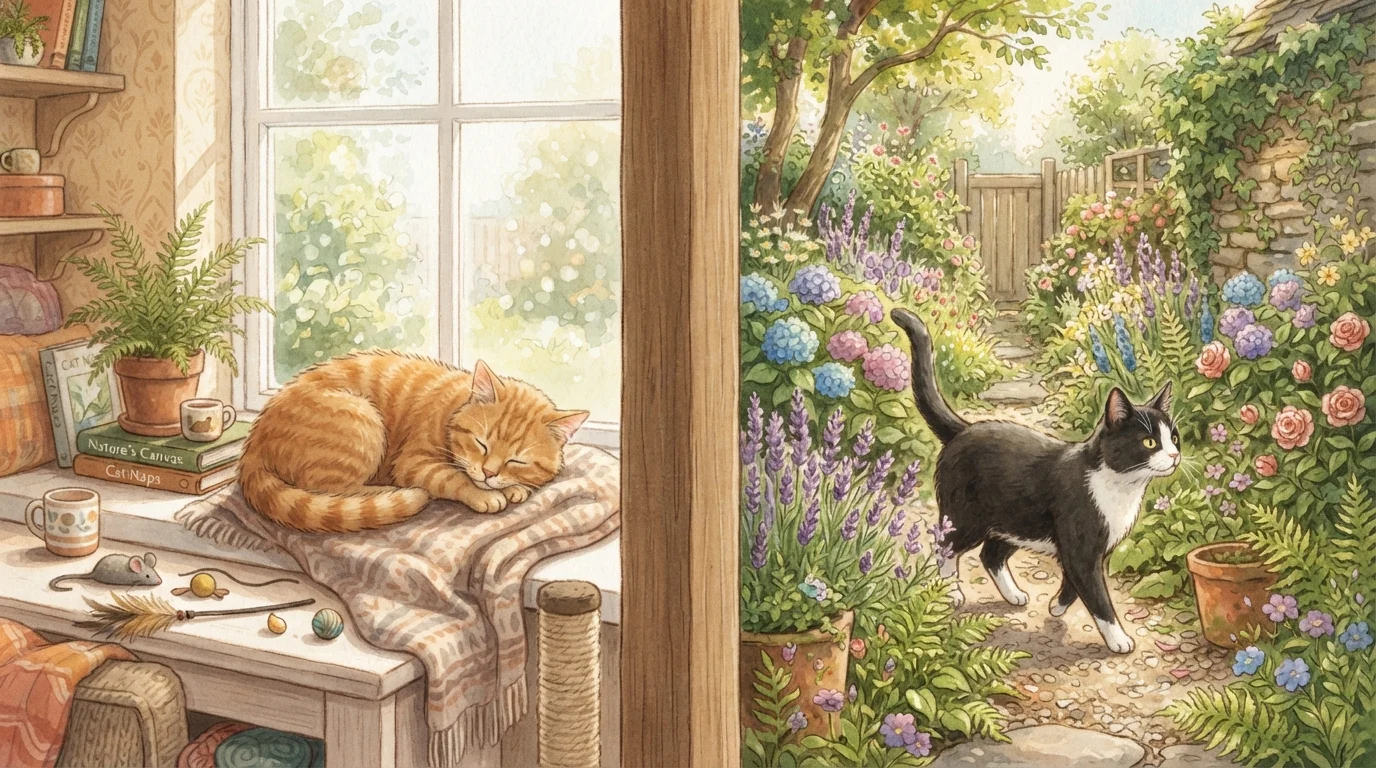
How Environment Becomes Behaviour
Cats are highly adaptable animals, but their living environment leaves a clear imprint on how they behave day to day. Whether a cat spends its life indoors, roams freely outside, or moves between both worlds, that context shapes everything from hunting behaviour and territorial expression to stress levels and social bonding with humans.
Understanding these differences helps owners recognise what's normal for their cat's situation — and where behavioural problems might actually be environmental signals in disguise. For a broader look at feline body language and stress cues, see how to spot stress signals in cats before they escalate.
Behavioural Patterns in Indoor Cats
Indoor cats live in a controlled, predictable environment — which has both advantages and trade-offs. Without the natural stimulation of territory patrolling, prey encounters, and outdoor sensory variety, indoor cats must get those needs met another way. When they can't, the results often show up as unwanted behaviour.
Common signs include excessive vocalisation, destructive scratching, over-grooming, and attention-seeking. These aren't personality flaws — they're responses to under-stimulation. Boredom is one of the biggest threats to a pet's wellbeing, and cats are no exception.
On the positive side, indoor cats often develop stronger bonds with their human companions. They also tend to have lower baseline stress from unpredictable environmental threats — provided their space is sufficiently enriched with climbing structures, hiding spots, and interactive play.
Rotate Toys to Sustain Interest
Indoor cats habituate quickly to the same toys left out permanently. Keeping a rotation of toys and introducing novel objects periodically can sustain exploratory interest and reduce boredom. Even a paper bag or cardboard box can serve as effective, low-cost enrichment when introduced fresh.
Behavioural Patterns in Outdoor Cats
Cats with outdoor access have opportunities to express a much wider range of instinctive behaviours: hunting, territory marking, scent investigation, and social navigation with other animals. This self-directed stimulation often means outdoor cats are less likely to develop the repetitive or attention-seeking behaviours seen in under-enriched indoor cats.
However, the outdoor environment introduces unpredictable stressors — confrontations with other cats, noise, traffic, and unfamiliar people. These can contribute to heightened anxiety or redirected aggression when the cat returns indoors. To understand how territorial marking behaviour differs between cats and dogs, context matters enormously.
Outdoor cats also tend to be more independent in their interaction style with humans, partly because their social and sensory needs are already partially met by their environment.
| Indoor Cats | Outdoor / Mixed-Access Cats | |
|---|---|---|
| Sensory stimulation | Relies on owner-provided enrichment | Naturally high from environment |
| Hunting behaviour | Expressed through play if provided | Actively practised on real prey |
| Territorial expression | Focused within home space | Patrolled across broader range |
| Boredom risk | Higher without structured enrichment | Lower due to self-directed activity |
| Bond with humans | Often stronger, more dependent | Typically more independent |
| Stress sources | Under-stimulation, lack of escape routes | Other animals, traffic, unpredictability |
| Aggression risk | Play or frustration-based if understimulated | Redirected from outdoor encounters |
The Role of Enrichment for Indoor Cats
For cats living primarily indoors, purposeful enrichment isn't optional — it's essential for behavioural health. Environmental complexity can compensate meaningfully for the absence of outdoor stimulation. This includes vertical space (cat trees, shelves), puzzle feeders, rotating toys, window perches with bird feeders outside, and regular interactive play sessions with a wand or feather toy.
Play is especially important because it mirrors the hunt cycle — stalk, pounce, catch — which cats are neurologically wired to complete. Interrupting or never providing that cycle is a reliable path to frustration and play-related aggression.
For owners unsure whether their cat's behaviour signals boredom, check out signs your pet may be bored for a useful breakdown of what under-stimulation looks like in practice.
2–3x
Higher lifespan estimate for indoor cats
Veterinary organisations generally note indoor cats tend to live longer on average, largely due to reduced exposure to injury, disease, and predation.
~30%
Indoor cats showing repetitive behaviours
Behavioural research suggests a significant proportion of indoor cats develop repetitive or compulsive behaviours when environmental enrichment is inadequate.
Finding the Right Balance
Many owners are exploring middle-ground options that offer sensory variety without full free-roaming risk. Enclosed outdoor spaces (sometimes called catios), leash training with a harness, and supervised garden time can provide meaningful environmental enrichment while limiting exposure to hazards.
The right approach depends on the individual cat. A shy, anxious cat may find outdoor access overwhelming rather than enriching. A bold, high-energy cat confined indoors without enrichment may develop chronic stress. For a deeper look at the practical trade-offs of each lifestyle, indoor cat vs. outdoor cat: understanding the trade-offs covers the health and safety dimensions in detail.
What matters most is matching the environment to the cat's temperament — and committing to meeting whichever unmet needs that environment creates. See our pet care basics hub for more guidance on keeping cats healthy and behaviourally well.