
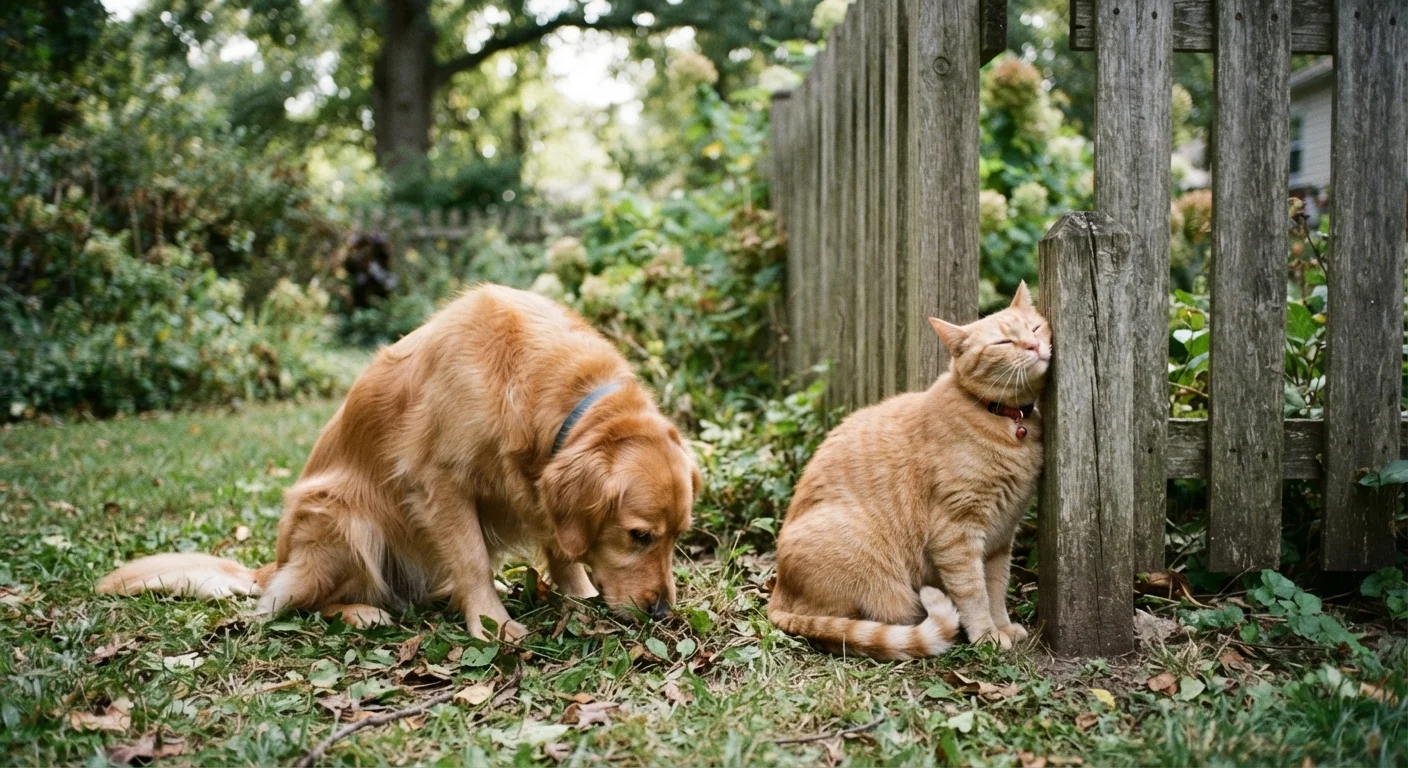
Why Animals Mark Territory at All
Territorial marking is a form of chemical communication — one of the oldest signalling systems in the animal kingdom. Both dogs and cats possess scent glands that deposit complex chemical messages called pheromones, which carry information about identity, reproductive status, and presence over time. Unlike barking or hissing, a scent mark keeps working long after the animal has moved on.
This behaviour is rooted in survival instincts: marking establishes resource ownership, warns rivals, and attracts mates. In domestic pets, those instincts persist even when the original pressures — predation, competition for food, mate selection — are largely absent. Understanding the evolutionary purpose helps owners interpret the behaviour rather than simply reacting to it. For a broader look at how misunderstood this kind of instinct-driven conduct can be, see our guide to common pet behaviour myths.
How Dogs Mark: Social Signals on Every Surface
Dogs mark primarily through urine deposition, and the deliberate, leg-raised posture many owners recognise is distinct from regular elimination. Male dogs mark far more frequently than females, though intact females also mark — particularly during oestrus. The raised-leg posture places scent at nose height for other dogs, maximising the signal's reach.
Scent glands between a dog's paw pads also deposit chemical information when they scratch the ground after marking, combining visual disruption with olfactory messaging. Dogs are essentially posting public notices for any passing dog to read — broadcasting age, sex, health status, and reproductive availability.
Marking frequency spikes in the presence of unfamiliar dogs, new environments, or recent changes to the household. Neutering typically reduces (though rarely eliminates) marking in males, particularly when performed before the behaviour becomes habitual. Dogs with separation anxiety may also mark indoors as a stress response rather than a social signal.
| Criterion | Dogs | Cats |
|---|---|---|
| Primary marking method | Urine on vertical/horizontal surfaces | Urine spray, scratching, facial rub |
| Typical target location | Outdoor boundaries, paths, posts | Indoor furniture, doorways, walls |
| Main social purpose | Broadcasting identity to other dogs | Reassuring self; warning rivals |
| Effect of neutering/spaying | Significantly reduces marking frequency | Reduces spraying; other marking persists |
| Stress-driven indoor marking | Less common; linked to anxiety | More common; triggered by many stressors |
| Pheromone delivery sites | Urine, paw pad glands | Urine, paws, cheeks, chin, tail base |
How Cats Mark: A Multi-Channel System
Cats employ a more varied territorial toolkit than dogs. Their marking behaviours fall into three main categories:
- Urine spraying: Cats back up to a vertical surface and deposit a small amount of urine at nose height. This is distinct from squatting to urinate. Spraying is more common in intact males but occurs in females and neutered cats under stress.
- Scratching: Physical scratch marks on surfaces serve a dual purpose — they leave both a visual mark and a scent deposit from glands in the paw pads. Cats reliably scratch the same locations, creating durable territorial boundaries.
- Facial and body rubbing: Scent glands around a cat's cheeks, chin, and the base of the tail produce pheromones that communicate familiarity and ownership. When a cat rubs against your leg or a doorframe, it is depositing a calming, ownership-associated scent — a reassuring form of marking rather than a warning.
How much a cat marks indoors is strongly influenced by its living environment. Our article on how environment shapes cat behaviour explains how access to outdoor space affects the frequency and intensity of territorial signalling.
90%
Reduction in spraying after neutering
Veterinary behavioural research consistently shows that neutering intact male cats reduces urine spraying in approximately 90% of cases, according to guidance from the American Association of Feline Practitioners.
3x
More marks left by intact vs. neutered dogs
Studies on canine scent-marking behaviour have found that intact male dogs mark at roughly three times the rate of neutered males during a standard walk.
Key Differences at a Glance
Although both species share the underlying drive to mark, the purpose, triggers, and typical locations differ meaningfully. Dogs orient their marking outward — at boundaries, along paths, and toward other dogs' marks. Cats are more concerned with the interior of their own space, using marking to reassure themselves as much as to warn rivals.
One important overlap: both species mark significantly more when they sense a threat to their claimed space. A new pet, a visiting animal, or even the smell of an unfamiliar animal on an owner's clothing can trigger increased marking in either species. This context-sensitivity is worth noting when diagnosing a sudden change in behaviour.
Cats and dogs also respond differently to the marks of other species. Dogs are typically curious about cat scent but rarely react with counter-marking; cats, however, may spray in response to a dog's presence in their home — a stress-driven territorial assertion. See our comparison of commonly misread pet signals for more on how owners often mistake stress marking for spite or disobedience.
Marking vs. Inappropriate Elimination
It is important to distinguish territorial marking from incomplete house-training or a medical elimination problem. Marking typically involves small amounts of urine deposited on specific, repeated spots — often vertical surfaces. Full bladder voidings in unusual locations are more likely to indicate a health issue or anxiety disorder. A veterinarian can help differentiate the two based on history, volume, and location patterns.
When to Be Concerned — and What to Do
Occasional marking is normal. Persistent or escalating indoor marking in either species warrants attention. The first step is always a veterinary check to rule out urinary tract infections, hormonal conditions, or pain — all of which can increase inappropriate elimination or spraying.
If medical causes are ruled out, the approach differs by species. For dogs, consistent training, reliable outdoor marking opportunities, and — in persistent cases — neutering (if not already done) are the most effective tools. For cats, identifying and reducing stressors is central: adding vertical space, providing one litter tray per cat plus one extra, and using synthetic pheromone diffusers can meaningfully reduce spraying frequency.
Multi-pet households require particular care. Gradual, managed introductions and ensuring each animal has exclusive access to its own resources prevents the territorial competition that drives the most disruptive marking. For owners weighing whether to add a second species to their home, our dog vs. cat lifestyle comparison covers temperament and space considerations that directly affect territorial harmony.
Building a deeper understanding of why your pet marks — rather than simply stopping the behaviour — creates a foundation for a calmer household. The connection between behavioural understanding and the human-pet bond is well-established in animal behaviour research.
This article is for general informational purposes only and is not a substitute for professional veterinary advice. If your pet's marking behaviour changes suddenly or significantly, consult a licensed veterinarian.