
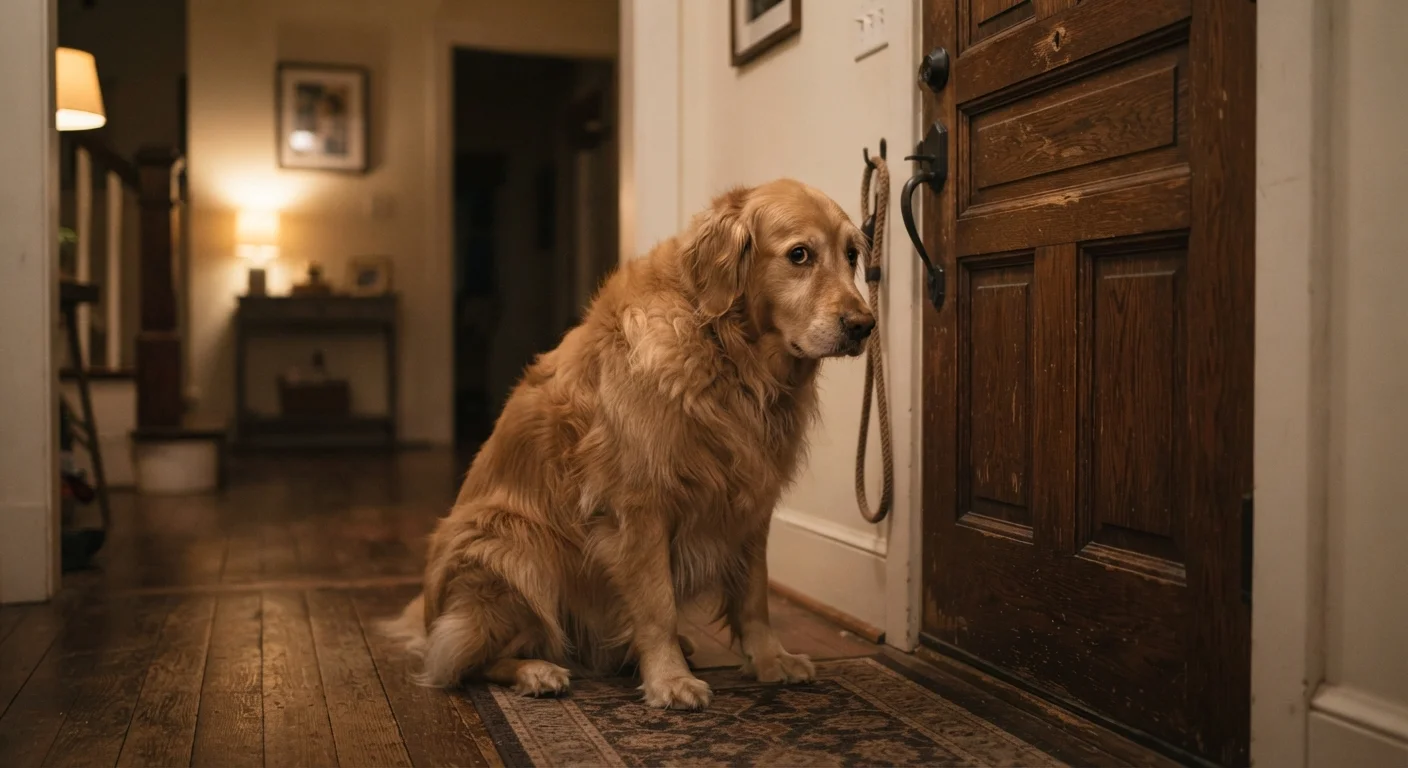
What Separation Anxiety Actually Looks Like
Many owners first notice the signs after a neighbor complains about noise, or they come home to find furniture chewed and items scattered across the floor. The key clue is timing: behaviours linked to separation anxiety occur when the dog is alone or anticipates being alone — not randomly throughout the day.
Common signs include:
- Vocalization — sustained howling, barking, or whimpering shortly after the owner leaves
- Destructive chewing — often focused near exit points like doors and windows
- House soiling — accidents from a dog that is otherwise reliably housetrained
- Pacing or restlessness — repetitive movement patterns that signal agitation
- Escape attempts — which can result in broken nails, injured paws, or damaged crates
- Excessive greeting — frantic, prolonged excitement when the owner returns
Pre-departure anxiety is also telling. Some dogs begin showing stress signals — trembling, salivating, or shadowing their owner — as soon as they notice cues like keys being picked up or a bag being packed. This anticipatory distress is itself a diagnostic indicator. It's worth noting that not all destructive behaviour signals anxiety; boredom can produce very similar-looking behaviours with a different underlying cause.
Video Monitoring Can Be Revealing
Setting up a phone or pet camera to record your dog while you're away is one of the most useful diagnostic steps you can take. What owners imagine is happening is often very different from what the footage shows. A dog that seems fine when the owner returns may have spent hours in distress — or a dog assumed to be anxious may simply be sleeping. Objective observation removes guesswork and helps any professional you consult give better guidance.
Why Separation Anxiety Happens: The Science Behind the Distress
Dogs are highly social animals that have co-evolved with humans over thousands of years. Unlike wolves, who maintain strong intraspecies bonds, domesticated dogs have shifted much of their social attachment toward people. This makes the bond between a dog and its human genuinely comparable to an attachment relationship — and separation from an attachment figure is inherently stressful for social species.
Research in veterinary behaviour points to several contributing factors:
- Genetics and temperament: Some dogs are simply more reactive to stress by disposition. Fearful or highly sensitive temperaments carry a higher baseline risk.
- Early socialization: Puppies that were not gradually exposed to periods of alone-time during their critical development window may be less equipped to cope with solitude later.
- Major life changes: Rehoming, the loss of a companion (human or animal), a move to a new home, or an abrupt change in a daily routine are frequent triggers.
- Over-attachment patterns: Dogs that rarely experience any time apart from their owners — particularly if the owner works from home and then returns to an office — may struggle more acutely when routines shift.
It's also important to understand that separation anxiety is not the dog acting out of spite or seeking revenge. That framing is a myth the evidence does not support. Dogs lack the cognitive architecture for that kind of premeditated retaliation. For a broader look at misconceptions like this, see common pet behaviour myths that even experienced owners still believe.
“Separation anxiety in dogs is best understood as a panic response, not a behaviour problem. The dog is not choosing to misbehave — it is genuinely overwhelmed by fear.”
— Karen Overall, Board-certified veterinary behaviourist and author of clinical behaviour texts
How Separation Anxiety Is Diagnosed and Approached
There is no single test for separation anxiety. Diagnosis is typically based on a thorough behavioural history and, ideally, video footage of the dog's behaviour while alone. A veterinarian will also want to rule out medical causes — urinary tract infections, gastrointestinal issues, or pain can all contribute to house soiling and restlessness that might otherwise look like anxiety.
Once identified, separation anxiety is generally managed through a combination of approaches:
- Graduated desensitization: This involves very slowly increasing the duration of alone time, starting from seconds, so the dog learns that departures are safe and temporary. The process requires patience and consistency over weeks or months.
- Environmental enrichment: Puzzle feeders, long-lasting chews, and other activities can reduce arousal before and during alone time — though these tools typically help more with mild cases or as a complement to behaviour modification.
- Medication: For moderate to severe cases, veterinarians may prescribe anti-anxiety medications alongside behaviour modification. These are not a substitute for training, but they can lower the emotional baseline enough for the dog to learn.
Separation anxiety can resemble other conditions, including compulsive repetitive behaviours such as pacing or spinning, which warrants professional evaluation to distinguish between them. Building a strong, trusting relationship overall also plays a foundational role — understanding your dog's behaviour is central to that bond.
Start With Very Short Departures
If you suspect your dog is struggling with alone time, begin practicing departures that last only a few seconds. Step outside, come back in calmly, and gradually extend the duration over many sessions across days or weeks. Keeping arrivals and departures low-key — without drawn-out goodbyes or exuberant greetings — can also help reduce the emotional intensity around these transitions.
This article is for general informational and educational purposes only and is not a substitute for professional veterinary or behavioural advice. If your dog is showing signs of significant distress, consult a licensed veterinarian or certified veterinary behaviourist for guidance tailored to your pet's situation.