
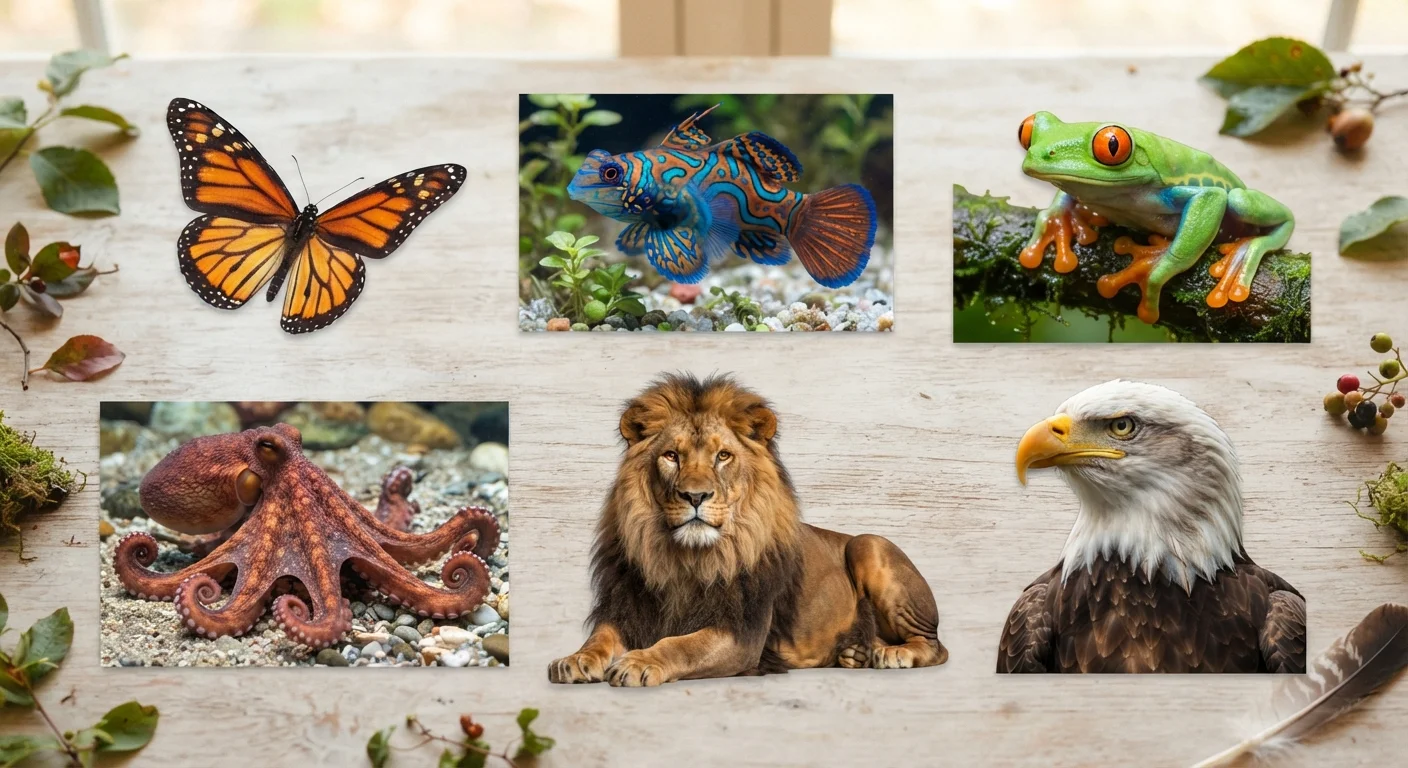
What Is the Animal Kingdom?
The animal kingdom — formally called Animalia — includes all multicellular organisms that consume other organisms for energy, can move at some point in their life cycle, and reproduce sexually (though some also reproduce asexually). Scientists estimate there are more than 8 million animal species on Earth, though only about 1 million have been formally described and named.
Animals are organized into major groups called phyla (singular: phylum), and within those into classes, orders, families, genera, and species. Understanding these groupings is one of the core concepts in biology class. This reference guide covers the most commonly discussed major groups, with key facts for each.
| Total known animal species | ~1 million described (IUCN and taxonomic databases) |
| Estimated undescribed species | ~7 million more (PLoS Biology, 2011 estimate) |
| Largest animal phylum | Arthropoda (insects, crustaceans, spiders) |
| Smallest known vertebrate | Paedophryne amauensis (frog, ~7.7 mm) (Described in PLOS ONE, 2012) |
| Largest living animal | Blue whale (up to 100 feet long) |
| Vertebrates as % of animals | ~3% of all animal species |
Invertebrates: The Largest Category
Invertebrates are animals without a backbone. They make up roughly 97% of all known animal species, making them by far the most diverse group on Earth. Major invertebrate phyla include:
- Arthropoda (insects, spiders, crustaceans): The largest phylum, with over 1 million described species. Arthropods have segmented bodies and exoskeletons.
- Mollusca (snails, octopuses, clams): About 85,000 known species. Many have a soft body protected by a hard shell, though cephalopods like octopuses do not.
- Annelida (earthworms, leeches): Segmented worms found in soil and aquatic environments. Key decomposers in many ecosystems.
- Echinodermata (sea stars, sea urchins): Marine animals with a water-vascular system used for movement and feeding.
Phylum
A major taxonomic rank grouping animals that share a fundamental body plan. For example, all animals with a backbone belong to the phylum Chordata.
Ectotherm
An animal that regulates its body temperature using external heat sources, commonly called 'cold-blooded.' Fish, reptiles, and amphibians are ectotherms.
Endotherm
An animal that generates body heat internally through metabolism, commonly called 'warm-blooded.' Birds and mammals are endotherms.
Invertebrate
Any animal lacking a vertebral column (backbone). Invertebrates include insects, worms, mollusks, and crustaceans, and account for the vast majority of animal species.
Exoskeleton
A hard external shell or covering that provides structural support and protection for an animal's body. Arthropods, including insects and crabs, have exoskeletons.
Vertebrates: Backbone Animals
Vertebrates belong to the subphylum Vertebrata within the phylum Chordata. Despite being far fewer in total species than invertebrates, vertebrates include the largest and most behaviorally complex animals on Earth. The five main vertebrate classes are:
- Fish: The most species-rich vertebrate group (~34,000 species), including jawless fish (lampreys), cartilaginous fish (sharks, rays), and bony fish. They breathe via gills and are ectothermic (cold-blooded).
- Amphibians: Roughly 8,000 species of frogs, salamanders, and caecilians. They typically begin life in water (as larvae with gills) and transition to land as adults. Highly sensitive to environmental change.
- Reptiles: Around 10,000 species, including lizards, snakes, turtles, and crocodilians. Reptiles have scales and are largely ectothermic, though some larger species can retain body heat.
- Birds: Approximately 10,000 species. Birds are endothermic (warm-blooded), feathered, and descended from theropod dinosaurs. All birds lay eggs.
- Mammals: About 5,500 species. Mammals are endothermic, have hair or fur, and most give birth to live young. Females produce milk to nurse offspring. This class includes humans, whales, bats, and rodents.
97%
Animal species that are invertebrates
Invertebrates overwhelmingly dominate the animal kingdom in species count, with arthropods alone accounting for the majority.
~10,000
Known bird species worldwide
According to the International Ornithological Committee's World Bird List, birds are one of the most species-rich vertebrate groups.
~34,000
Known fish species
Fish are the most species-diverse group among vertebrates, spanning freshwater and marine environments globally.
Useful Distinctions and Common Misconceptions
Several common confusions arise when people learn about animal classification:
- Insects vs. spiders: Both are arthropods, but insects have six legs and three body segments, while spiders (arachnids) have eight legs and two body segments.
- Whales are mammals: Despite living fully in water, whales breathe air, are warm-blooded, and nurse their young — all defining mammal traits.
- Not all cold-blooded animals are sluggish: Ectothermic does not mean slow. Many fish and reptiles are fast and highly active at optimal temperatures.
Understanding how organ systems differ across these groups also sheds light on broader biology. For instance, comparing the respiratory systems of fish (gills) and mammals (lungs) is a classic example covered in our organ systems reference guide.
Classification Systems Evolve
Animal classification is not fixed — scientists regularly revise groupings as new species are discovered and DNA analysis reveals unexpected relationships. For example, birds are now classified scientifically as a group within reptiles based on their evolutionary lineage. What counts as a 'class' or 'phylum' can shift as understanding deepens. Always check current scientific literature for the most up-to-date taxonomy.