
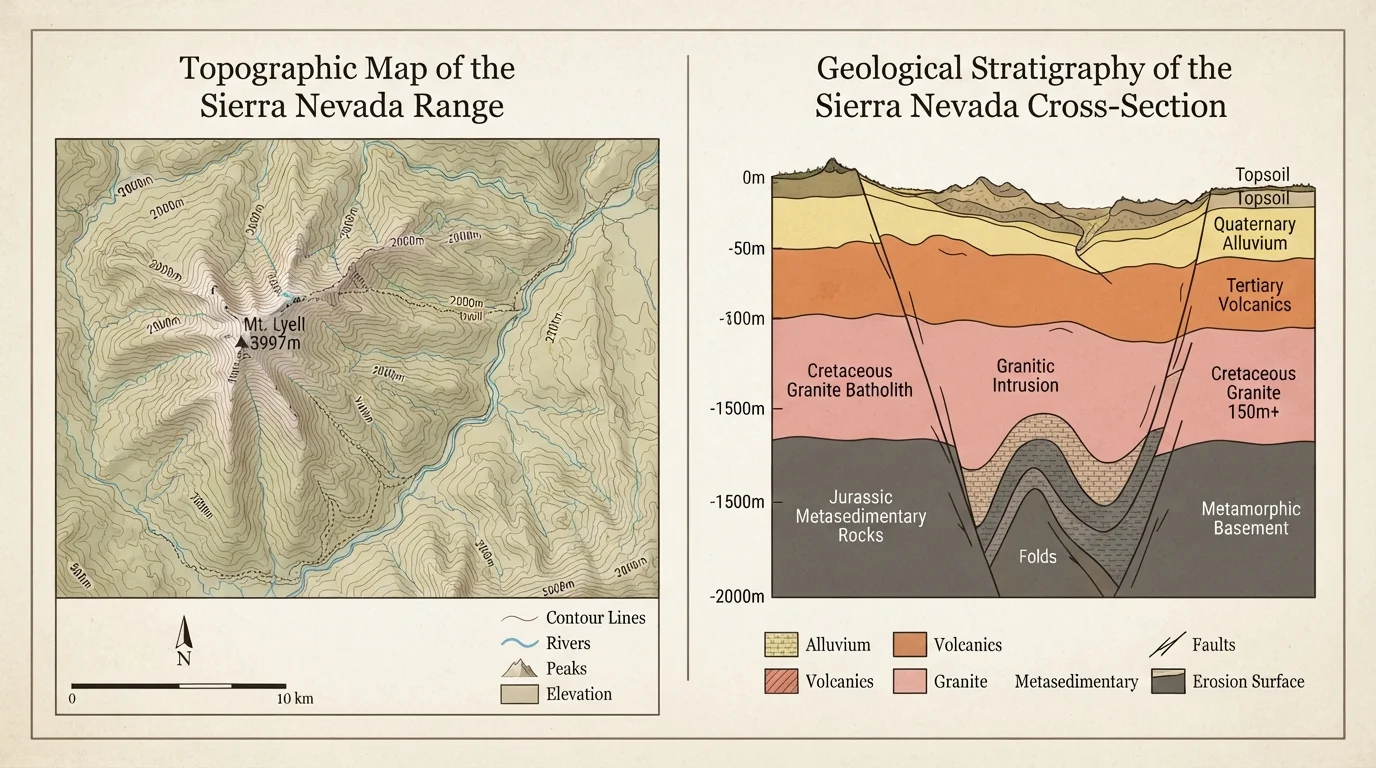
Two Subjects, One Planet - Different Questions
Both geography and Earth science point at the same object - the planet Earth - but they ask fundamentally different questions about it. Geography asks where and why there: Where do people live? Why does this region experience drought? How does a river shape the community beside it? Earth science asks what and how at a physical level: What is this rock made of? How did that mountain range rise? What drives the water cycle?
This distinction matters in school because the two subjects live in different parts of the curriculum. Geography typically appears under social studies alongside history, civics, and economics - as explained in our social studies breakdown. Earth science, by contrast, counts as a lab science credit, sitting alongside biology, chemistry, and physics.
| Criterion | Geography | Earth Science |
|---|---|---|
| Core question | Where, and why there? | What is it, and how does it work? |
| Curriculum home | Social studies | Science |
| Main branches | Physical & human geography | Geology, meteorology, oceanography |
| Key tools | Maps, GIS, spatial data | Rock samples, lab experiments, field data |
| Time scale focus | Present patterns and trends | Deep geological time to present |
| Human element | Central to the subject | Secondary; mostly physical focus |
| Overlapping topic | Natural hazards, climate zones | Natural hazards, atmospheric science |
What Each Subject Actually Covers
Geography divides into two broad branches. Physical geography looks at natural features - landforms, climates, soils, and ecosystems - but always with attention to how those features affect human activity. Human geography investigates populations, migration, cultural patterns, economic systems, and political boundaries. The common thread is spatial thinking: using location and place as tools for understanding patterns.
Earth science is an umbrella term for several overlapping disciplines: geology (rocks and the solid Earth), meteorology (atmosphere and weather), oceanography (oceans), and astronomy (Earth's place in space) are all components. The focus is on understanding physical systems, materials, and the processes - erosion, plate tectonics, precipitation cycles - that operate largely independent of human decisions.
There is genuine overlap. A geography student studying flooding will draw on Earth science concepts. An Earth science student studying the water cycle will encounter ideas that geography treats from a human angle. Subjects that blend disciplines are common in STEM, as explored in our guide to overlapping school subjects.
4
Core disciplines within Earth science
Geology, meteorology, oceanography, and astronomy are generally recognized as the four main branches under the Earth science umbrella in U.S. secondary education.
2
Major branches of geography taught in school
Physical geography and human geography represent the two primary divisions introduced in most U.S. middle and high school geography curricula.
Methods and Tools: How Each Subject Builds Knowledge
The methods each field uses reflect their different goals. Geography relies heavily on maps and spatial data. Students learn to read topographic maps, interpret population density charts, analyze satellite imagery, and - increasingly - work with Geographic Information Systems (GIS), software that layers multiple types of location data for analysis.
Earth science is more laboratory-oriented. Students examine rock and mineral samples, conduct experiments on erosion or chemical weathering, analyze weather data, and study stratigraphic layers (the stacked rock formations that record geological time). Fieldwork is central: measuring stream flow, identifying local rock formations, or recording weather observations connects classroom concepts to the physical world.
Both subjects value observation and evidence, but geography tends toward pattern recognition across space while Earth science tends toward process explanation across time - often very deep time, measuring events in millions of years.
When Subjects Share a Classroom
Some schools combine elements of geography and Earth science into a single course, often titled "Earth and Space Science" or "Environmental Science." These hybrid courses can make it harder to see where one subject ends and another begins. If your school offers separate geography and Earth science courses, checking the credit category (social studies vs. science) is usually the clearest way to distinguish them.
Careers and Connections Beyond School
Understanding the boundary between these subjects also illuminates career paths. Geographers work in urban planning, international development, cartography, environmental policy, and intelligence analysis. Earth scientists pursue careers in geology, hydrology, climate research, petroleum engineering, volcanology, and environmental consulting.
Some careers draw on both. Environmental scientists routinely blend physical Earth processes with geographic analysis of human impact. Climate scientists study atmospheric chemistry (Earth science) while also modeling how changes will affect human settlements across regions (geography).
For students building a science foundation, Earth science connects naturally to biology - ecosystems depend on soils, water, and climate. Core biology concepts like nutrient cycles and habitats are deeply embedded in both Earth science and geographic frameworks, showing how scientific disciplines reinforce each other.