
What Social Studies Actually Is
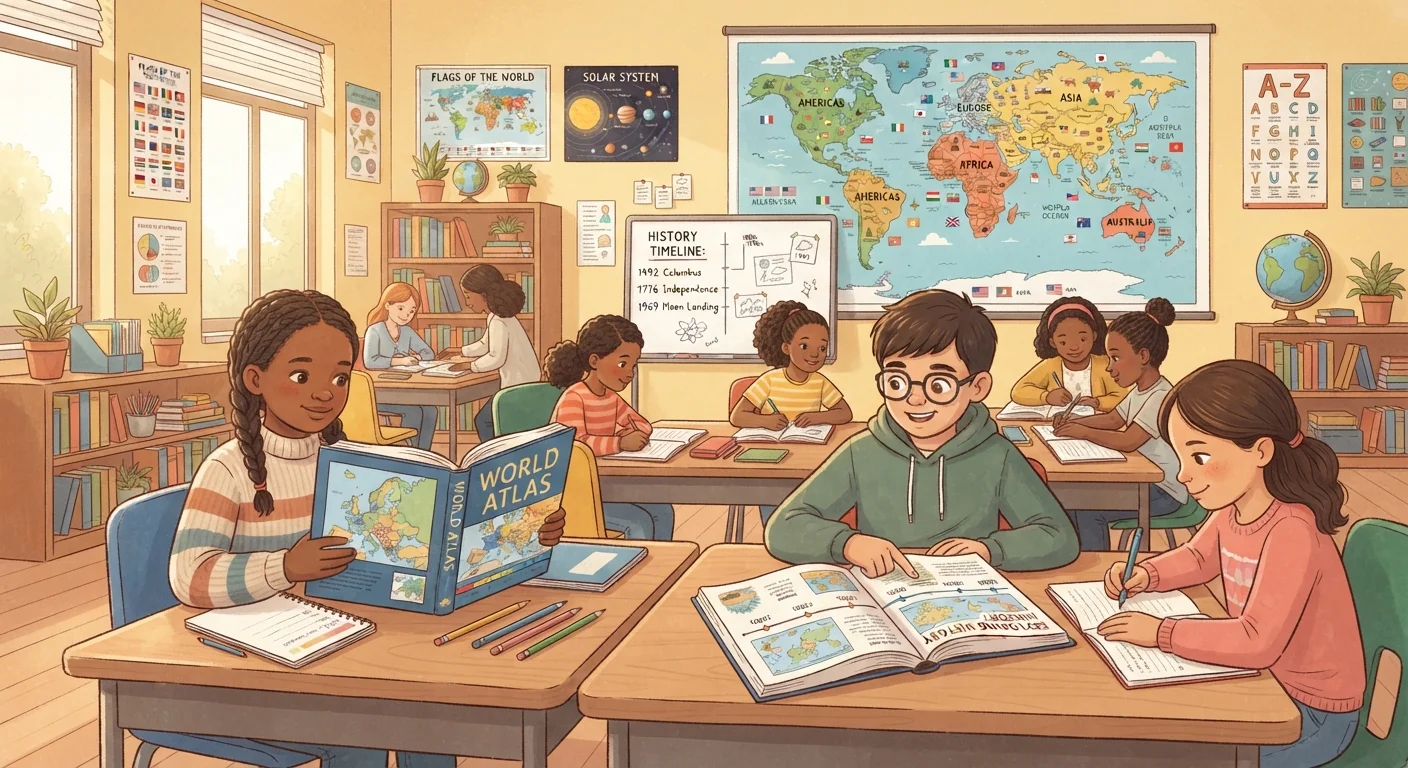
Ask a student what they learn in social studies and you'll often get a vague answer like "history stuff" or "maps and things." The subject is genuinely broad - and intentionally so. Social studies is an umbrella discipline that draws from several academic fields to help students understand one central question: how do human societies work?
In most U.S. schools, social studies weaves together four core strands: history, civics and government, geography, and economics. Each strand looks at human society through a different lens. Depending on the grade level, a class might focus heavily on one area or blend all four in a single unit. State standards shape exactly what gets taught when, so the content can vary - but the four strands are the reliable backbone.
Primary source
An original document, artifact, or record created at the time of an event - such as a letter, photograph, or government record. Historians use these as direct evidence.
Civics
The study of how government works and what citizens' rights and responsibilities are within a democratic society.
Scarcity
The economic concept that resources - like time, money, or materials - are limited, so people and communities must make choices about how to use them.
Human geography
The branch of geography that studies how people interact with and are shaped by their physical environment, including settlement patterns, culture, and land use.
Opportunity cost
What you give up when you choose one option over another. If you spend time studying history, the opportunity cost might be the time you could have spent on math.
History: Understanding How the Past Shapes Today
History is often the most recognizable part of social studies. In early grades, students might explore community history or Indigenous peoples. By middle school, the scope typically expands to U.S. history - from colonization through the Civil Rights Movement. High schoolers often study world history, looking at civilizations, revolutions, and global conflicts across centuries.
But school history isn't just about memorizing dates. Students are taught to analyze primary sources (original documents, letters, and photographs from the time) and secondary sources (historians' interpretations). They learn to ask: What caused this event? Who benefited? Whose perspective is missing? These are thinking skills, not just content.
Civics and Government: How Society Makes Decisions
Civics is the strand that answers the question: who's in charge, and how did they get there? Students learn how the three branches of the U.S. federal government work, how a bill becomes a law, and what the Constitution and Bill of Rights actually say. They also explore state and local government, since many decisions affecting daily life - schools, roads, taxes - happen at those levels.
Beyond structure, civics covers citizenship: what it means, what rights it includes, and what responsibilities come with it. Voting, jury duty, and civic participation are common topics. This strand is designed to give students the knowledge to take part in democratic life rather than just observe it.
Make Civics Real for Yourself
One of the best ways to understand civics is to follow a current local issue - a school board vote, a city council proposal, or a state bill. Tracking how it moves through the system makes abstract concepts like "committee hearings" and "public comment" immediately concrete and memorable.
Geography: More Than Memorizing Capitals
Geography in social studies is far richer than filling in a blank map. Students explore physical geography - landforms, climate zones, and natural resources - alongside human geography, which examines how people use and adapt to their environments. Why do cities form near rivers? How does climate affect what crops a region grows? Why do borders look the way they do? These are geography questions.
Geographic thinking also connects closely to economics and history. Trade routes, migration patterns, and resource distribution are all geographic stories. For a deeper look at how geography overlaps with and differs from Earth science, see our article on geography vs. Earth science.
Economics: The Basics of How Resources Are Used
Economics might seem out of place in a social studies class, but it fits naturally. At its core, economics asks: how do people and communities decide what to produce, trade, and consume? School economics introduces concepts like scarcity (resources are limited), supply and demand, opportunity cost (choosing one thing means giving up another), and the difference between needs and wants.
In upper grades, students explore how markets work, what governments do to manage economies, and how international trade connects nations. These aren't abstract concepts - they connect directly to decisions students and families make every day. Understanding economics helps students read the news, understand tax policy debates, and think critically about financial choices.
Economics Appears in Other Subjects Too
Economic reasoning doesn't stay inside social studies class. History lessons often turn on economic causes - wars fought over trade routes, revolutions triggered by taxation. Geography explores how resource distribution shapes wealth and power. Recognizing economics across subjects helps students see how the strands of social studies truly connect.
Why Social Studies Matters Beyond the Classroom
Social studies is one of those subjects that quietly shapes how students think for life. The skills it builds - analyzing evidence, understanding multiple perspectives, connecting cause and effect - transfer into almost every domain. Whether someone is evaluating a news story, voting in an election, or thinking about a community issue, they're drawing on social studies reasoning.
Unlike subjects with a single correct answer, social studies often involves interpreting complex, contested material. That makes it excellent practice for the kind of nuanced thinking adults use constantly. Students who engage seriously with social studies are better equipped to participate in civic life and to understand the world they're inheriting.
If you're juggling social studies alongside other demanding subjects, practical strategies for balancing multiple subjects can help you plan your study time effectively. And if you're just starting to build strong study habits more broadly, our complete guide to study skills for new learners is a solid place to begin.
Study Skills Hub
A collection of practical techniques to help students learn, retain, and recall information effectively - useful when tackling the reading and analysis demands of social studies.
U.S. Census Bureau Education Resources
The Census Bureau offers freely accessible data and educational materials on geography, demographics, and economics - all core social studies topics - useful for student projects and deeper exploration.