
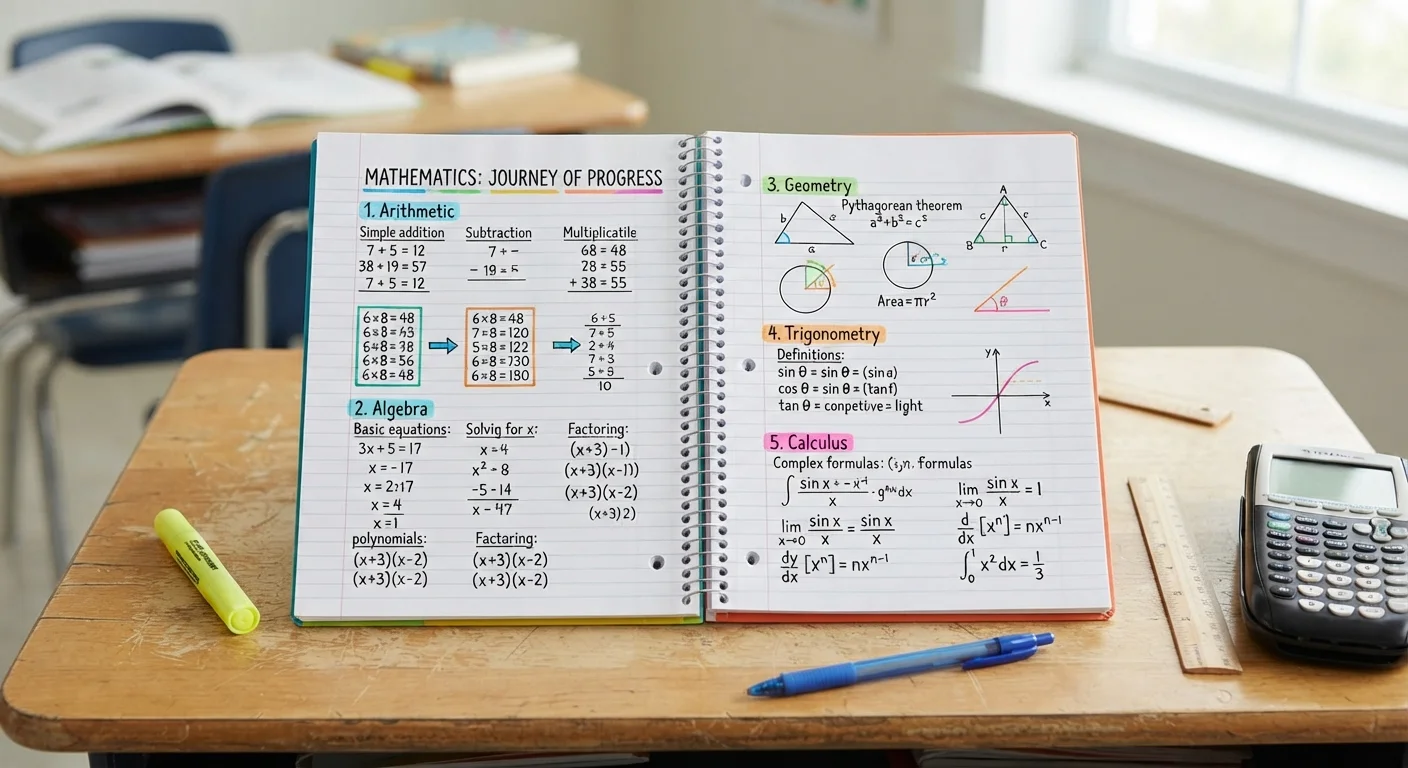
Why Maths Is a Cumulative Subject
Unlike some subjects where topics can be studied in relative isolation, school maths is built as a vertical stack. Each layer depends structurally on the layer below it. A student who skips understanding fractions will find algebra confusing; one who struggles with algebra will hit a wall in pre-calculus. This isn't a design flaw - it reflects the nature of mathematics itself.
Understanding this progression helps students (and parents) see gaps not as permanent obstacles but as specific points to return to and repair. See our complete starting point for effective study skills for strategies that work especially well in cumulative subjects like maths.
12+
Years of connected maths learning in K-12
The U.S. K-12 curriculum spans over twelve years of mathematics instruction, each grade level building directly on the previous one.
~50%
College students needing remedial maths
Research from the National Center for Education Statistics has found that roughly half of entering college students require some form of remedial or developmental maths coursework.
The Foundation: Arithmetic and Number Sense
The journey begins with arithmetic - the study of numbers and the four basic operations: addition, subtraction, multiplication, and division. But beneath the computations lies something more important: number sense, an intuitive feel for how quantities relate to one another.
Early primary school develops this through counting, place value, and simple operations. By upper primary, students work with fractions, decimals, and percentages - concepts that will resurface constantly in every stage ahead. A student who understands why ½ + ¼ = ¾ (not ²⁄₈) has internalized something conceptual, not just procedural, and that understanding carries forward.
When a student struggles with a new maths topic, trace the difficulty back one level. Nine times out of ten, the gap lives in a prerequisite concept, not the current one.
Because maths is cumulative, apparent confusion about new material often signals an unresolved understanding from an earlier stage - addressing the root cause is far more effective than re-teaching the surface topic.
Practice fraction operations until they feel automatic before moving into algebra. Fluency with fractions is the single strongest predictor of algebra readiness.
Longitudinal research, including studies cited by the National Mathematics Advisory Panel, identifies fraction proficiency as one of the most important precursors to algebraic success.
Building Upward: Pre-Algebra and Algebra
Around middle school, the curriculum introduces variables - letters that stand in for unknown numbers. This is the defining conceptual leap of algebra. Instead of solving 3 + ? = 7, students solve 3 + x = 7. It seems like a small notational change, but it represents a shift from arithmetic thinking to symbolic reasoning.
Pre-algebra bridges the two worlds, reinforcing concepts like ratios, proportions, and the order of operations before variables are introduced. Algebra I then formalizes equations, inequalities, and linear functions. Algebra II extends this to quadratic and polynomial expressions, exponential functions, and systems of equations - all of which are tools calculus will use directly.
Strengthen Algebra by Reading Equations Aloud
Encourage students to read equations as sentences - for example, '2x + 3 equals 11' means 'two times some number, plus three, gives eleven.' This verbal habit builds the conceptual understanding that symbolic manipulation alone can obscure. It also makes it easier to catch errors before they become habits.
Expanding the Picture: Geometry and Trigonometry
Geometry develops a different kind of mathematical thinking: spatial and logical reasoning. Students learn to prove statements using deductive logic - a skill that sharpens precise thinking across all mathematics. Core topics include angles, triangles, circles, area, volume, and the Pythagorean theorem.
Trigonometry extends geometry into the study of relationships between angles and side lengths in triangles. The sine, cosine, and tangent functions introduced here become essential in calculus - particularly when modeling periodic phenomena like waves. Maths rarely stays in one lane, a point explored further in our article on where maths, science, and technology overlap.
“Mathematics is not about numbers, equations, computations, or algorithms: it is about understanding.”
— William Paul Thurston, Fields Medal-winning mathematician and professor
The Gateway to Higher Maths: Pre-Calculus
Pre-calculus is less a single topic and more a consolidation course - it brings together functions, logarithms, trigonometric identities, sequences, and series into a unified picture. The central concept students must grasp here is the function: a rule that assigns exactly one output to each input.
Pre-calculus also introduces the idea of limits informally - what happens to the value of a function as its input approaches a particular number. This question is the seed from which all of calculus grows. Students who understand functions deeply and can manipulate them fluently are genuinely ready for the conceptual demands ahead.
Gaps in Pre-Calculus Compound in Calculus
Students who move into calculus without a solid grasp of functions, algebraic manipulation, and trigonometric identities often struggle - not because calculus is beyond them, but because they're solving two problems at once. If pre-calculus material feels shaky, it is worth pausing to consolidate it before advancing. This is a strategic choice, not a setback.
The Summit: What Calculus Actually Is
Calculus is the mathematical study of change and accumulation. It has two main branches that are mirror images of each other:
- Differential calculus asks: how fast is something changing at a given instant? This is answered by the derivative - a function that gives the rate of change of another function at any point.
- Integral calculus asks: how much has accumulated over an interval? The integral sums infinitely many infinitely small pieces to find totals like area under a curve or distance traveled.
The remarkable result connecting these two ideas - that differentiation and integration are inverse operations - is known as the Fundamental Theorem of Calculus. Every concept in this final stage traces back to arithmetic, algebra, geometry, and trigonometry. Students ready to explore what comes next can see how these ideas branch in our article on pure versus applied mathematics.
Khan Academy - Math by Grade and Subject
A free, self-paced platform organized by grade level and subject area, covering every stage from basic arithmetic through AP Calculus. Useful for both filling gaps and previewing upcoming material.
Desmos Graphing Calculator
A free, browser-based graphing tool that makes abstract functions visible and interactive. Particularly helpful for understanding algebra, pre-calculus functions, and the graphical meaning of derivatives.
National Council of Teachers of Mathematics (NCTM)
The NCTM publishes standards, research summaries, and classroom resources that explain what mathematical understanding looks like at each developmental stage.