
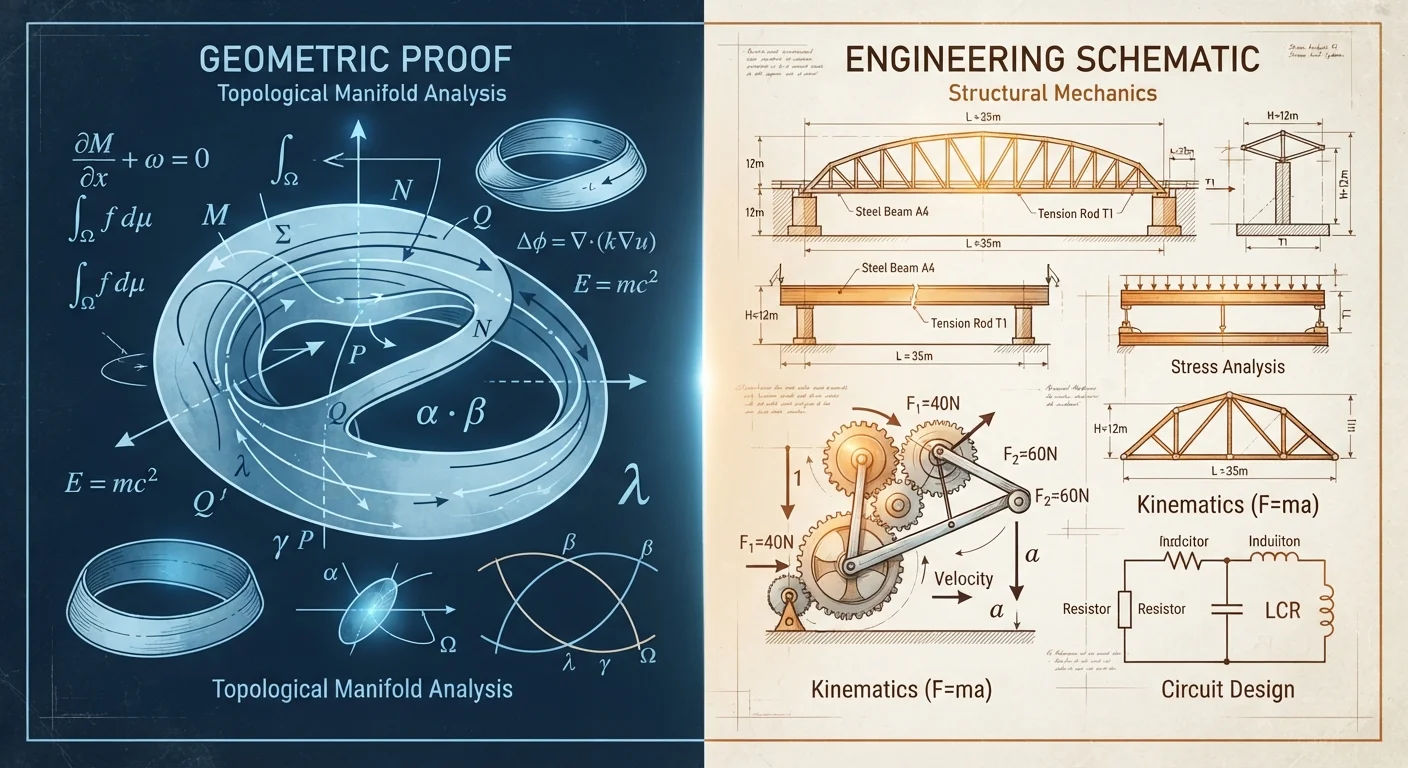
What Is Pure Mathematics?
Pure mathematics is the study of mathematical concepts entirely on their own terms. A pure mathematician asks: Is this statement true, and can I prove it? The answer doesn't need to fix a bridge or predict a stock price - the value lies in the logical structure itself.
Core areas of pure maths include number theory (the study of integers and their properties), abstract algebra (exploring structures like groups and rings), real and complex analysis (the rigorous foundations of calculus), and topology (studying properties preserved through continuous deformations). What unites them is the emphasis on proof - a watertight argument that something must be true.
This doesn't mean pure maths is useless. Many ideas explored purely for intellectual beauty later turn out to have profound practical applications. Number theory, once considered the most abstract branch of all, now underpins modern encryption and internet security.
See how school maths builds toward these ideas year by year for context on the progression students follow before reaching pure specialization.
What Is Applied Mathematics?
Applied mathematics starts with a real-world question and asks: What mathematical tools can help me answer this? Rather than building abstract theory, applied mathematicians use existing mathematical structures as instruments for modeling, prediction, and problem-solving.
Common areas include statistics and probability (analyzing uncertainty and data), differential equations (modeling how systems change over time), numerical analysis (finding approximate solutions when exact ones aren't possible), optimization (finding the best outcome under given constraints), and mathematical physics. These tools appear across disciplines - in climate modeling, epidemiology, aeronautical engineering, and machine learning.
Applied maths doesn't abandon rigor. The mathematics used still needs to be correct. The distinction is in motivation: the goal is a useful answer, not a complete theory.
| Criterion | Pure Mathematics | Applied Mathematics |
|---|---|---|
| Primary goal | Establish abstract mathematical truth | Solve real-world problems |
| Core method | Logical proof and theorem-building | Modeling, computation, and analysis |
| Relationship to applications | Not required; may emerge later | Central to the work |
| Key example areas | Number theory, topology, abstract algebra | Statistics, differential equations, optimization |
| Typical university tracks | Mathematics (BSc/BA), Logic | Engineering, Physics, Data Science, Economics |
| Emphasis at school level | Proof-based geometry, number patterns | Word problems, modeling, statistics |
Where the Two Branches Overlap
The boundary between pure and applied maths is blurrier than it first appears. Most mathematicians draw on both traditions, and many sub-fields - such as mathematical statistics, computational mathematics, and mathematical biology - sit firmly in between.
Consider calculus: at school it often feels applied (calculating rates of change in physics problems), but at university level it is rebuilt from rigorous first principles - firmly in pure territory. Similarly, the geometry studied abstractly by pure mathematicians in the 19th century became the language Einstein needed for general relativity.
~350 years
Gap between pure discovery and application
Fermat's work on number theory in the 17th century became foundational to modern cryptography only in the 20th century, illustrating how pure maths findings can take centuries to find applied use.
2 branches
Major divisions recognized by most universities
Most mathematics departments formally organize degree programs around pure and applied tracks, though many courses and research areas overlap substantially.
This crossover is exactly why most schools teach a mixed curriculum before students specialize. Understanding both the why (pure) and the how (applied) makes for a more versatile mathematical thinker. Our article on subjects that blur the lines between maths, science, and technology explores how this overlap extends beyond maths into broader STEM subjects.
A Note on School-Level Labels
Most high school maths curricula don't use the terms 'pure' or 'applied' explicitly. Students encounter both styles of thinking within a single course - proof-style reasoning in geometry, applied modeling in statistics units. The labels become more meaningful when choosing between university programs or academic specializations.
Choosing a Direction: Practical Guidance for Students
At school level, most students study both without labeling them. Word problems and modeling tasks lean applied; proof-based geometry and number work lean pure. Awareness of the distinction matters most when students begin choosing electives, university courses, or career pathways.
Ask yourself a few questions: Do you find more satisfaction in proving something is true, or in using it to get an answer? Are you drawn to abstract puzzles or to measurable outcomes? Do you want to work primarily with ideas or with real-world data and systems?
Neither answer is better - both branches are intellectually demanding and professionally valuable. Many students find that a foundation in pure maths gives them flexibility, because the abstract skills transfer readily into applied contexts. But students with a clear vocational direction (engineering, economics, data science) often benefit from an applied emphasis that makes their mathematical toolkit immediately usable.
Whatever your inclination, the most important thing is to build solid fundamentals. Algebra, calculus, logic, and proof are the shared backbone of both paths - and mastering them opens doors in either direction.