
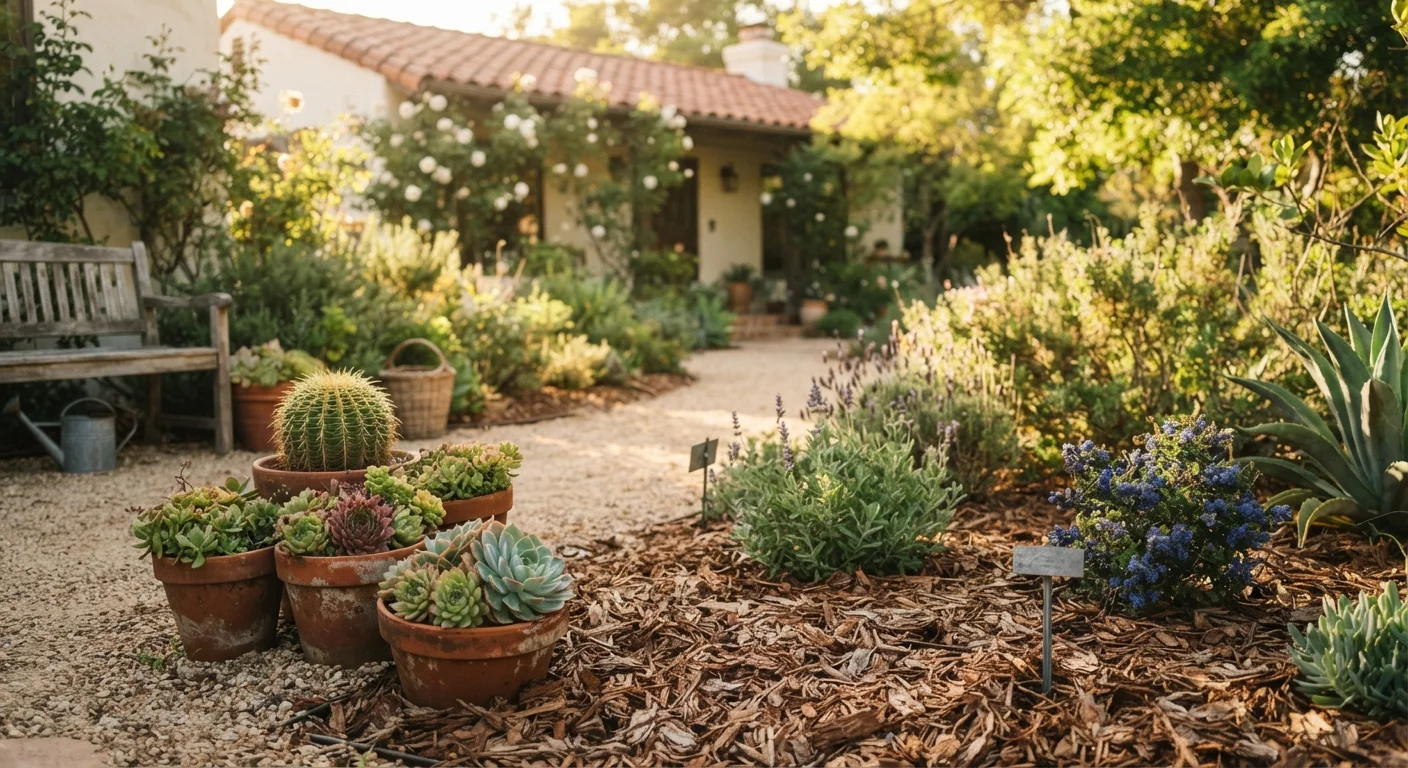
Why Drought Resilience Matters for Everyday Gardeners
Dry spells are a normal part of gardening in most parts of the US, but they don't have to mean wilting plants and emergency watering runs. Building drought resilience into your garden is less about surviving an extreme event and more about reducing stress - both for your plants and for yourself.
The good news is that most of the strategies involved are simple, low-cost, and well within reach for beginner gardeners. Whether you're starting your garden from scratch or refining an established yard, small adjustments made early pay off every summer.
Lay a 2-3 inch layer of mulch over exposed soil around plants.
Mulch dramatically slows evaporation from the soil surface, keeping roots cooler and moisture available longer. It also suppresses weeds that compete with your plants for water.
Choose plants that are naturally adapted to low-water conditions in your region.
Plants native to your local climate or to dry climates elsewhere have evolved to survive with less water. They establish more quickly, require fewer interventions, and tend to bounce back faster after dry spells. Check your hardiness zone when selecting - our article on what hardiness zones mean is a useful starting point.
Water deeply and infrequently rather than a little every day.
Frequent shallow watering trains roots to stay near the surface, making plants more dependent on regular irrigation. Deep watering encourages roots to follow moisture downward, where the soil stays damp longer during dry periods.
Add compost to improve soil's water-holding capacity.
Organic matter binds soil particles in a way that creates small spaces to hold water while still allowing drainage. Both sandy and clay-heavy soils benefit, in different ways.
Group plants with similar water needs together.
When thirsty plants grow alongside drought-tolerant ones, you end up either overwatering the hardy plants or underwatering the needy ones. Zoning by water need makes watering more efficient and reduces plant stress.
Core Practices for a Drought-Tough Garden
The following approaches are well-established among gardeners and horticulturalists. Together they address the three key drivers of drought damage: soil moisture loss, shallow roots, and poorly matched plant choices.
For a broader look at how moisture and watering frequency interact, our guide on how much water your garden actually needs walks through common mistakes and how to avoid them.
Drought Resilience Isn't the Same as Zero Watering
Even drought-tolerant plants need regular watering during their first growing season while they establish root systems. Once established - typically after one to two full growing seasons - they can handle longer dry spells with little or no supplemental watering. Don't skip watering for new transplants just because the plant is labeled drought-tolerant.
Building Better Soil for Dry Conditions
Soil structure is the foundation of drought resistance. Sandy soils drain too fast; heavy clay soils can crack and repel water. Both benefit from added organic matter - compost, aged bark, or leaf mould - worked into the top several inches of soil. Organic matter improves a soil's ability to hold onto moisture without becoming waterlogged.
To understand what your soil is actually made of and why it behaves the way it does, see our overview of what garden soil is actually made of. Testing your soil's texture doesn't require a kit - a simple squeeze test (moist soil that crumbles rather than holds a ribbon) can tell you a lot.
2-3 inches
Recommended mulch depth for moisture retention
Horticultural guidance consistently points to this range as sufficient to meaningfully reduce soil evaporation without causing stem rot at the plant base.
~50%
Estimated reduction in outdoor water use with drought-adapted planting
The US Environmental Protection Agency has noted that landscape watering accounts for a large portion of household water use, and switching to climate-adapted plants can substantially reduce that demand.
Gardeners using raised beds often find it easier to control soil quality directly, which can be an advantage when managing water retention in dry regions.
Compost Doesn't Have to Be Store-Bought
Kitchen scraps like vegetable peels, coffee grounds, and eggshells, combined with dry garden waste like leaves and small twigs, break down into excellent compost at no cost. A simple compost bin in a corner of your yard can produce usable material in a few months. Even imperfect, partially-broken-down compost improves soil texture and moisture retention when dug in.
Smarter Watering Habits That Support Resilience
Even with the best soil and plant selection, watering technique makes a real difference. Deep, infrequent watering - soaking the soil to a depth of several inches rather than sprinkling the surface - encourages roots to grow downward where moisture is more stable. Surface-only watering keeps roots shallow and plants more vulnerable to short dry spells.
Timing also matters. Watering in the early morning reduces evaporation and gives foliage time to dry before evening, which helps reduce disease. If you're weighing options for how to deliver water consistently, our comparison of watering by hand versus using an irrigation system covers the practical trade-offs for different garden sizes.
“The goal of a resilient garden isn't to eliminate watering - it's to create conditions where plants can go longer between drinks without suffering.”
— Home & Garden Editorial Team, Garden care writers and researchers