
Two Directions, One System
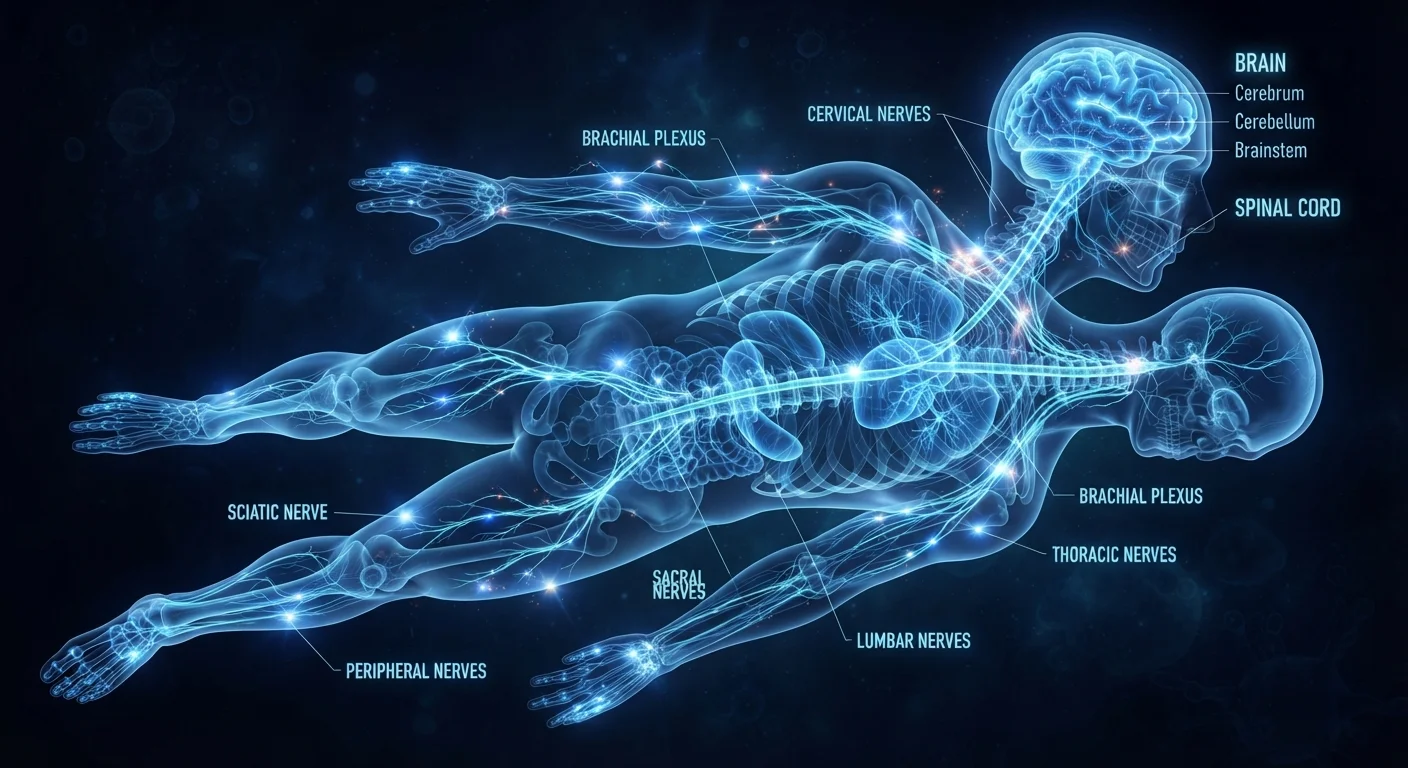
Think of the nervous system as a two-lane highway running through every part of your body. Traffic flows in both directions simultaneously: afferent signals (sensory information) travel inward toward the brain and spinal cord, while efferent signals (motor commands) travel outward to muscles and organs. This continuous, bidirectional exchange is what lets you feel a hot surface and pull your hand away - often faster than conscious thought can form.
This signal architecture underlies everything from a blink reflex to the complex coordination involved in catching a ball. The nervous system doesn't just react to the world; it also regulates internal conditions like blood pressure and body temperature without any conscious effort on your part.
To understand how these signals are organized, it helps to know the system's two major structural divisions - covered in depth in our guide to the central and peripheral nervous systems.
The Cell Behind the Signal: Neurons
Every signal in the nervous system depends on neurons - specialized cells built for rapid communication. A typical neuron has three main parts: dendrites that receive incoming signals, a cell body that processes them, and an axon that transmits the output signal onward. Many axons are wrapped in a fatty insulating layer called the myelin sheath, which dramatically increases transmission speed.
When a neuron fires, an electrical impulse called an action potential travels the length of the axon. At the end of the axon, the signal converts to a chemical message: neurotransmitters are released into the synapse - the tiny gap between neurons - and bind to receptors on the next cell, continuing the relay.
86 billion
Estimated neurons in the adult human brain
A widely cited estimate from neuroscience research, though exact counts vary by method and individual.
~270 mph
Top speed of nerve signal transmission
Applies to large, heavily myelinated motor and sensory fibers; unmyelinated fibers are far slower.
~0.1 sec
Typical spinal reflex response time
Spinal reflex arcs bypass the brain, allowing protective responses in roughly a tenth of a second.
Neurons don't work alone. Supporting cells called glial cells maintain the environment around neurons, provide structural support, assist with myelin formation, and help manage communication efficiency. They vastly outnumber neurons in the brain and are essential to healthy neural function.
Voluntary vs. Involuntary Control
Not all nervous system activity is under your conscious control. Neurologists broadly distinguish two functional subdivisions of the peripheral nervous system based on whether the response is voluntary or automatic.
- Somatic nervous system: Governs voluntary movement - the commands you consciously send to skeletal muscles when you walk, write, or speak.
- Autonomic nervous system: Governs involuntary functions - heartbeat, digestion, gland secretion, and respiratory rate. It operates continuously in the background, maintaining stability without requiring your attention.
The autonomic system itself has two counterbalancing branches. The sympathetic branch mobilizes the body in response to stress or perceived danger - increasing heart rate and redirecting blood flow to muscles. The parasympathetic branch reverses this, promoting rest, digestion, and recovery. These branches constantly modulate each other to maintain physiological balance.
Chronic Stress Strains the Autonomic Balance
When the sympathetic nervous system is repeatedly activated by ongoing psychological stress, the parasympathetic system has less opportunity to restore equilibrium. Over time, this sustained activation is associated with physical effects on the heart, immune function, and sleep. Practices that support parasympathetic activity - such as slow, controlled breathing - are well-documented in stress physiology research. Speak with a healthcare provider if stress-related symptoms are persistent.
The nervous system coordinates closely with the endocrine system through this same balancing act. How body systems use feedback loops explains how these two networks interact to keep physiology steady.
Reflex Arcs: Bypassing the Brain
One of the most elegant features of nervous system design is the reflex arc - a neural pathway that allows the spinal cord to coordinate a rapid response without waiting for the brain to weigh in. When you step on something sharp, sensory neurons send an alert to the spinal cord, which immediately signals motor neurons to withdraw the foot. The brain registers pain a fraction of a second later, after the protective movement has already begun.
Reflex arcs exist because speed matters in protective responses. Routing every signal through the brain would introduce a critical delay. Instead, the spinal cord handles the emergency; the brain receives the report.
Disruptions to reflex responses can sometimes signal nervous system changes worth discussing with a healthcare professional. For a broader look at how nervous system symptoms present, our symptom overview across body systems offers useful context.
The Nervous System in Context
No body system operates in isolation. The nervous system shares regulatory responsibilities with the endocrine system - which uses hormones rather than electrical impulses to communicate. While nervous signals are fast and precise, hormonal signals are slower and more diffuse, affecting broad groups of cells over longer timeframes. The endocrine system's role as the body's chemical messenger complements the picture of how neural control fits into the whole.
The gut offers a particularly vivid example of this integration. The enteric nervous system - an extensive nerve network lining the gastrointestinal tract - communicates bidirectionally with the brain. The gut-brain connection illustrates how this cross-system dialogue influences mood, stress responses, and digestive health.
“The brain is the most complex object in the known universe, and yet its fundamental logic - sensing the world and responding to it - is elegantly simple.”
— David Eagleman, Neuroscientist and author specializing in brain science and perception
This article is for general informational and educational purposes only and is not a substitute for professional medical advice, diagnosis, or treatment. Always consult a qualified healthcare provider with questions about your health or any symptoms you may be experiencing.