
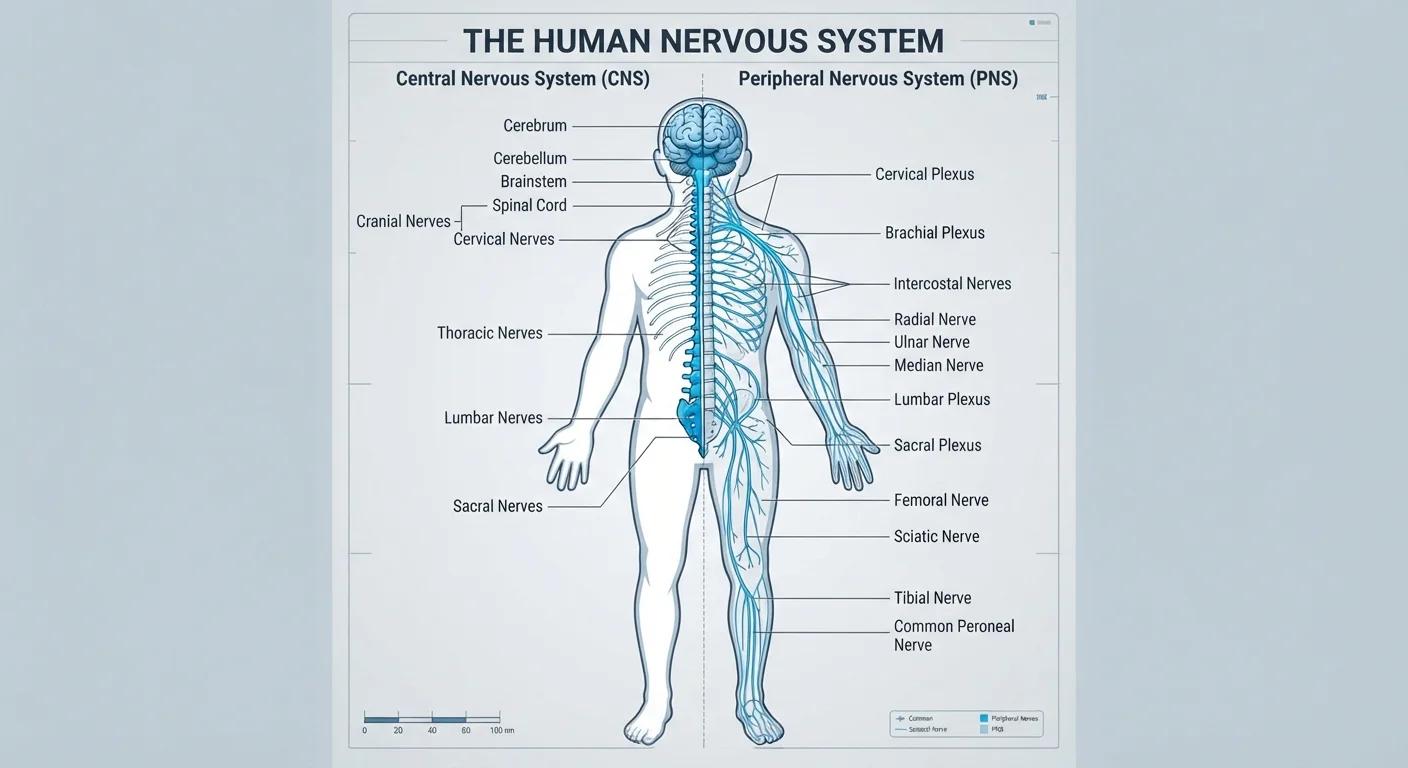
One System, Two Divisions
The nervous system is the body's master communication network, responsible for everything from a heartbeat to a thought. Despite its complexity, it is organized into just two major structural divisions: the central nervous system (CNS) and the peripheral nervous system (PNS). Understanding what separates them - and how they cooperate - is foundational to making sense of nearly every bodily function.
As part of the broader picture of the human body's organization, the nervous system sits alongside other major organ systems described in our quick-reference guide to organ systems. Here, we focus specifically on what makes each nervous system division unique.
| Criterion | Central Nervous System (CNS) | Peripheral Nervous System (PNS) |
|---|---|---|
| Main structures | Brain and spinal cord | Nerves, ganglia, and sensory receptors |
| Primary role | Processes and integrates information | Transmits signals to and from the CNS |
| Signal direction | Receives and sends commands | Both afferent (in) and efferent (out) |
| Voluntary vs. involuntary | Manages both, initiates voluntary action | Handles both via somatic and autonomic branches |
| Physical protection | Skull, vertebrae, meninges, CSF | Less protected; embedded in tissues |
| Regeneration after injury | Limited regenerative capacity | Greater capacity for nerve regrowth |
The Central Nervous System: Processing Headquarters
The CNS consists of exactly two structures: the brain and the spinal cord. Together, they form the body's processing hub - receiving incoming information, making sense of it, and sending out appropriate responses.
The brain handles higher functions: perception, language, memory, emotional regulation, and voluntary movement. Different regions specialize in different tasks - the cerebral cortex manages conscious thought, while the cerebellum coordinates balance and fine motor control. The brainstem, connecting the brain to the spinal cord, regulates automatic functions like breathing and heart rate.
The spinal cord acts as a relay highway, transmitting signals between the brain and the rest of the body. It also independently manages certain reflexes - the spinal reflex arc can trigger a response, such as pulling a hand away from heat, before signals even reach the brain.
Crucially, CNS tissue is surrounded by protective structures: the bony skull and vertebral column, and three membrane layers called the meninges. Cerebrospinal fluid cushions both organs from mechanical shock. Because of the CNS's complexity and limited regenerative capacity, damage to brain or spinal cord tissue is generally more difficult to recover from than injuries to peripheral nerves.
86 billion
Estimated neurons in the human brain
Neuroscience research estimates the adult human brain contains roughly 86 billion neurons, each capable of forming thousands of connections.
~45 m
Length of peripheral nerves in the human body
The total length of peripheral nerves in an adult human body is estimated at around 45 meters (approximately 150 feet).
The Peripheral Nervous System: The Relay Network
Everything outside the brain and spinal cord belongs to the PNS - an expansive network of nerves, ganglia (nerve cell clusters), and sensory receptors that reaches every corner of the body. The PNS carries signals in both directions: sensory (afferent) signals travel toward the CNS, and motor (efferent) signals travel away from it to muscles and glands.
The PNS divides into two functional branches:
- Somatic nervous system: Controls voluntary skeletal muscle movement and relays sensory information such as touch, pain, and temperature from the skin and muscles to the brain.
- Autonomic nervous system (ANS): Governs involuntary internal processes - heart rate, digestion, glandular secretion, and more. The ANS itself splits into the sympathetic division (activating the "fight-or-flight" response) and the parasympathetic division (promoting "rest-and-digest" states).
To understand how the autonomic system works alongside hormones in maintaining body balance, see our article on how body systems communicate through nerves and feedback loops.
How They Work Together - and What Happens When Something Goes Wrong
The CNS and PNS are not independent systems - they are two halves of a single, seamlessly integrated whole. When you touch a hot surface, PNS sensory receptors detect the heat, peripheral nerves transmit the signal to the spinal cord (CNS), and the brain registers pain while simultaneously issuing a motor command through the PNS to withdraw your hand.
Disruption to either division produces recognizable effects. Neurological symptoms - tingling, weakness, coordination problems - often reflect where in the system an issue has occurred. Our overview of common symptoms across body systems maps many of these presentations to the systems they involve.
PNS nerves have some capacity to regrow after injury, which is why conditions affecting peripheral nerves sometimes improve over time. CNS damage - such as that from stroke or spinal cord injury - tends to be more lasting, though the brain retains a degree of adaptability (neuroplasticity) throughout life.
Neuroplasticity: The Brain's Adaptability
The CNS has limited ability to regenerate damaged neurons, but it is not entirely static. Neuroplasticity refers to the brain's capacity to reorganize neural pathways in response to learning, experience, or injury. This adaptability underlies rehabilitation strategies used after strokes or traumatic brain injuries. The extent of recovery varies considerably depending on factors such as the nature and severity of the injury.
For a deeper look at how the brain itself is often misunderstood, our article on common myths about how the brain works addresses popular misconceptions with what neuroscience actually shows.
This article is for general informational and educational purposes only and is not a substitute for professional medical advice. If you have concerns about neurological symptoms or your nervous system health, consult a qualified healthcare provider.