
Where the 3-1-1 Rule Comes From
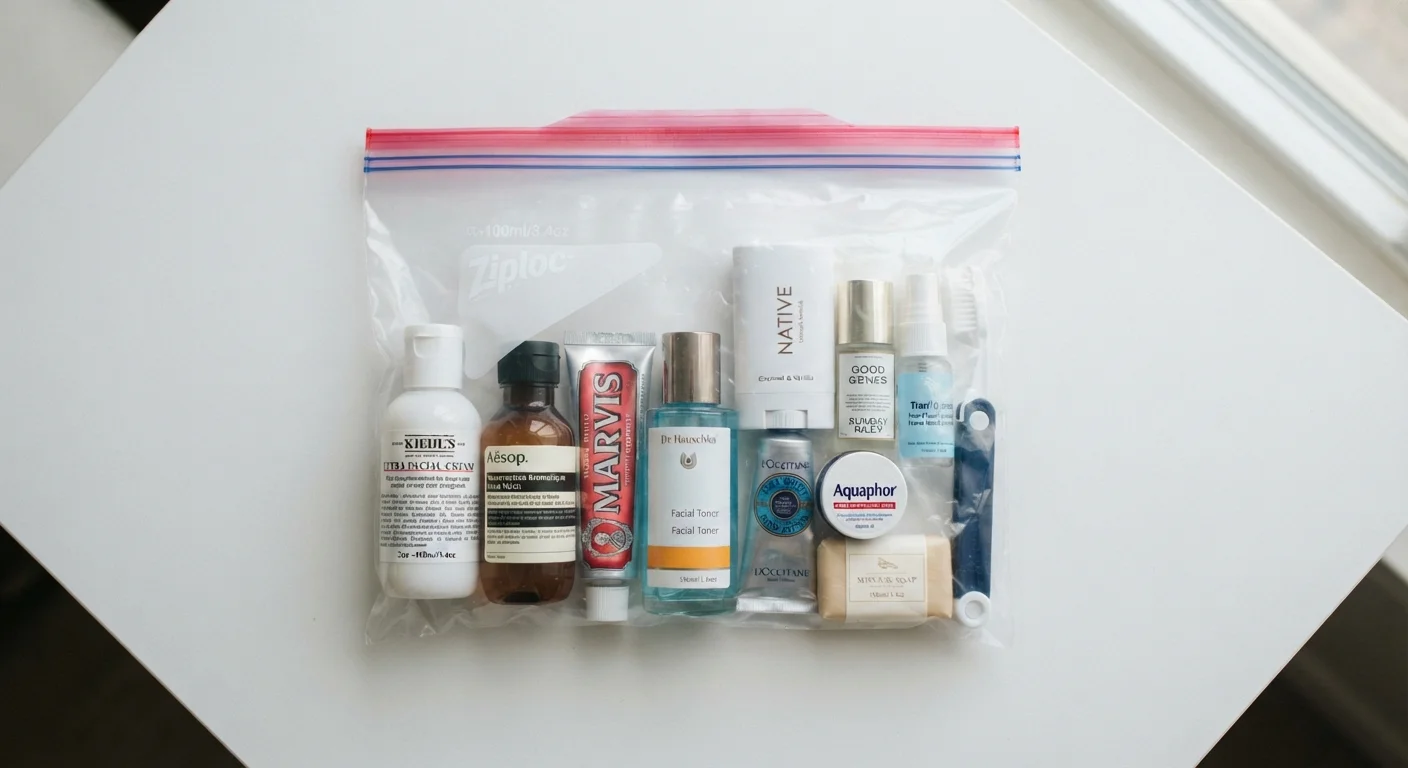
The Transportation Security Administration (TSA) introduced the liquids rule in 2006 following a foiled bomb plot that involved liquid explosives. The policy — commonly called the 3-1-1 rule — requires that carry-on liquids, gels, aerosols, creams, and pastes each be in containers of 3.4 ounces (100 milliliters) or less, all placed inside one clear, quart-sized zip-top bag, with one bag allowed per passenger. That bag must be removed from your carry-on and placed in a bin for separate screening.
The rule applies to anything with a flowing or spreadable consistency: shampoo, toothpaste, lotion, liquid foundation, peanut butter, yogurt, and even snow globes. If it pours, smears, or sprays, it falls under the policy. For a complete picture of what to expect at the checkpoint, see our plain-language security walkthrough.
Myth
As long as each container is 3.4 oz or less, you can bring as many as you want in your carry-on.
Fact
All compliant containers must fit together inside a single, quart-sized clear zip-top bag — unlimited containers is not permitted.
The quart-sized bag is the hard outer limit. TSA officers assess whether your liquids collectively fit inside one quart bag that zips closed. Bringing a dozen 1 oz bottles still violates the rule if they don't all fit. One bag, per person — that's the constraint that most travelers overlook.
Myth
The 100ml limit refers to how much liquid is inside the container, not the container's labeled capacity.
Fact
The limit applies to the container's total capacity — a 200ml bottle that's only half full is still not permitted.
TSA and most international security authorities assess the labeled size of the container, not its current fill level. A partially used 6 oz shampoo bottle will likely be confiscated regardless of how little is left inside. Transfer the remainder into a container clearly labeled at 3.4 oz or under before you travel.
Myth
Liquids you buy past security — like airport food or duty-free bottles — must follow the 3-1-1 rule.
Fact
Items purchased after the security checkpoint are generally exempt from the carry-on liquids rule for that leg of travel.
Once you're past the checkpoint, beverages, soups, and duty-free alcohol purchased at airport retailers are not subject to the 3-1-1 restriction. However, if you have a connecting flight that requires you to pass through security again — especially at an international airport — those items may be screened under that country's rules. Duty-free liquids should be kept in their original sealed, tamper-evident bags with purchase receipts.
Myth
Peanut butter, yogurt, and similar foods aren't liquids, so the rule doesn't apply to them.
Fact
The TSA treats spreadable, pourable, or gel-like foods as liquids — peanut butter, hummus, jam, and yogurt all fall under the 3-1-1 rule.
It's an easy mistake: if a food item has no defined shape of its own and can be smeared or scooped, security treats it as a liquid or gel. This includes dips, sauces, salad dressings, and soft cheeses. Solid foods — hard cheeses, whole fruit, sandwiches — are fine in your carry-on without restriction. When in doubt, pack it in checked luggage or buy it after security.
Myth
You need to show a prescription for liquid medications to bring them through security.
Fact
TSA does not require a prescription or doctor's note for liquid medications, though having documentation can help speed up additional screening.
Medically necessary liquid medications exceeding 3.4 oz are permitted, but they must be declared to officers and removed from your bag for separate screening. While no documentation is legally required by TSA, a prescription label on the bottle — or a letter from your physician for unusual items — can reduce questions and delays. Rules may differ at international checkpoints, so check the requirements of each country you'll travel through.
Exemptions That Catch Travelers Off Guard
The 3-1-1 rule has real exemptions — and knowing them can save you from discarding legitimate items.
- Medications: Prescription and over-the-counter liquid medications may exceed 3.4 oz when they are medically necessary. Passengers should declare these at the checkpoint and present them separately. Supporting documentation (a prescription label or doctor's note) is not required by TSA but can reduce delays. See our guide to travelling with medications for details.
- Infant and toddler nutrition: Baby formula, breast milk, and juice for young children are permitted in quantities exceeding 3.4 oz. They are subject to additional screening but do not require an infant to be present.
- Ice packs and gel packs: Frozen solid at the checkpoint, these are generally allowed. Partially melted or slushy versions may be treated as liquids.
International Connections Can Change the Rules
If your journey involves connecting through an international airport, liquids purchased after your departure security screening — including duty-free items — may need to pass through another checkpoint. Some countries do not recognize tamper-evident duty-free bags from other airports. Before purchasing large-format liquids duty-free, verify the rules for every security checkpoint on your itinerary with official government or airport sources.
Items purchased in duty-free shops after security are typically allowed in sealed, tamper-evident bags with a receipt showing same-day purchase from that airport. Rules on connecting flights — especially international ones — can complicate this, so verify with your airline and destination country's security authority before travel.
Practical Packing Strategies
Staying compliant isn't complicated once the rules are clear. A standard quart-sized bag holds roughly six to eight travel-sized containers comfortably. Overstuffed bags that won't seal fully can cause delays or require officers to inspect contents by hand.
~2,500
Items confiscated at TSA checkpoints daily
TSA has publicly reported that liquids rule violations are among the most common reasons items are surrendered at U.S. security checkpoints each day.
1 quart
Maximum total bag volume for carry-on liquids
TSA specifies a single clear, quart-sized (approximately 1 liter) zip-top bag as the only container permitted for carry-on liquids per traveler.
Checked luggage has no liquid size restrictions beyond what's standard for hazardous materials (such as flammable aerosols). If you regularly travel with full-size products, packing them in your checked bag eliminates the quart-bag problem entirely. For help deciding what belongs where, our carry-on vs. checked luggage guide walks through the tradeoffs.
Avoid filling containers right to their labeled maximum — liquid expands slightly under cabin pressure, and overfilled soft containers can leak. Solid alternatives (shampoo bars, solid moisturizers, toothpaste tablets) sidestep the rule entirely and are worth considering for frequent travelers.
When traveling internationally, note that while many countries follow similar 100ml rules based on ICAO standards, enforcement details, bag size requirements, and checkpoint procedures can differ. Always check the security authority of each country you'll pass through. For a broader look at checkpoint pitfalls, see what slows travelers down at security.