
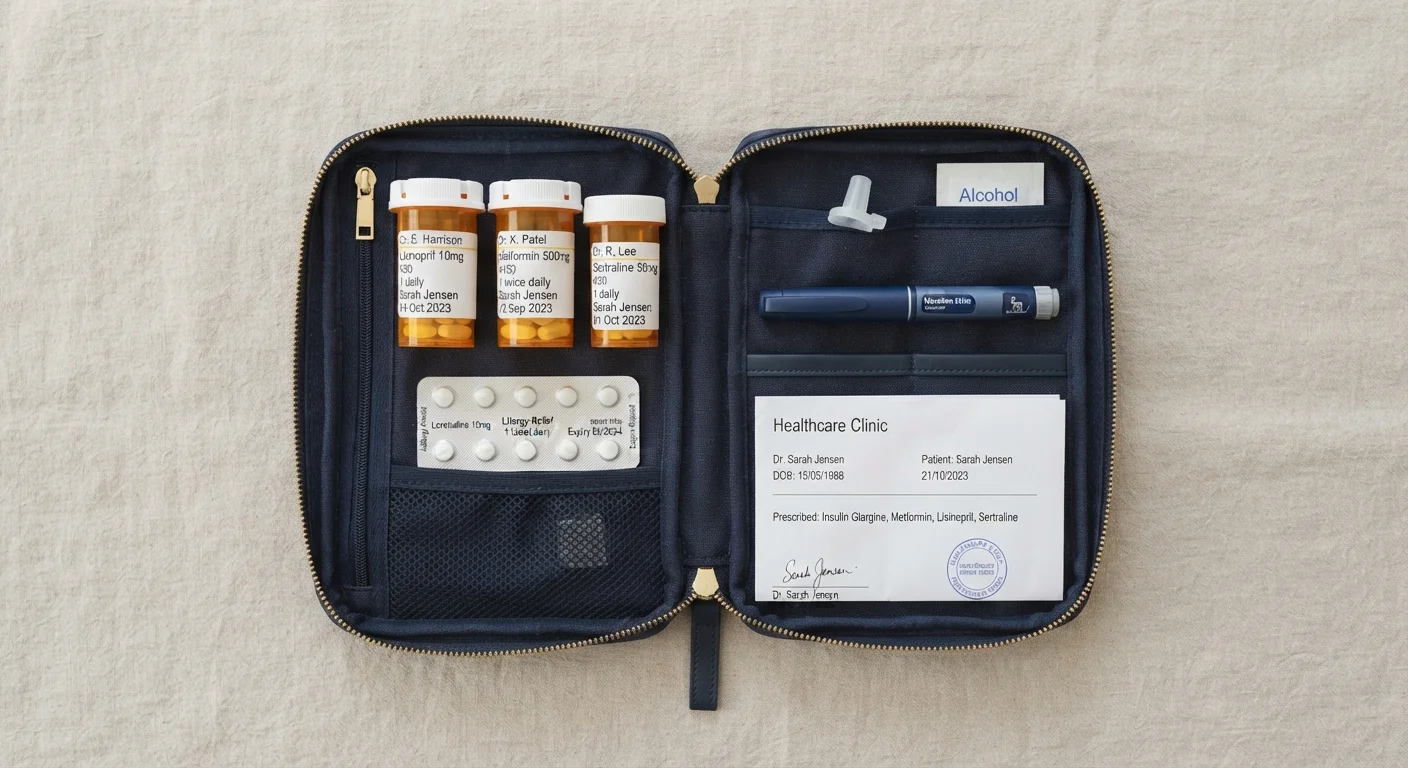
What You Can Carry — and Where
Most medications — prescription and over-the-counter — are permitted through airport security in both carry-on and checked baggage. However, keeping essential medications in your carry-on is strongly recommended. Checked bags can be delayed, misdirected, or lost, and temperature extremes in cargo holds may affect certain drugs like insulin or biologics.
The U.S. Transportation Security Administration (TSA) allows medically necessary liquids, gels, and aerosols in quantities exceeding the standard 3.4 oz (100 ml) limit, as long as they are declared separately for screening. This includes liquid medications, eye drops prescribed for a condition, and liquid nutrition products. You do not need a prescription label to pass security, but having one simplifies any questions an officer might raise. See how the liquid rules apply to exempt medical items for more detail on what qualifies.
Solid-form medications — tablets, capsules, and pills — do not fall under the liquid rule at all and can be packed in any reasonable quantity without triggering the 100 ml restriction.
What to Declare and When
At TSA security in the U.S., you should proactively inform the officer if you are carrying medically necessary liquids, syringes, auto-injectors, or medical devices such as insulin pumps. Separating these items from the rest of your bag before the X-ray belt speeds the process and reduces the chance of a secondary bag check. The TSA does not require a doctor's note, but a pharmacy label linking your name to the medication helps.
International customs declaration is a separate matter. Many countries require travelers to declare prescription medications — particularly controlled substances, large supplies, or injectable drugs — on arrival forms. Some destinations impose quantity limits or require an advance import permit. Always verify entry requirements with the destination country's embassy or official health authority well before travel. Documentation requirements for international travel also covers what supporting paperwork to carry.
How to Prepare Your Medications for Travel
Good preparation avoids delays at the checkpoint and protects you if something goes wrong during the trip.
- Keep medications in original packaging where practical — pharmacy labels confirm the drug name, your name, and dosage.
- Carry a letter from your prescribing physician for controlled substances, injectables, or large supplies. The letter should state the medical necessity, drug name, and expected travel duration.
- Bring enough supply for the full trip plus a buffer — typically a few extra days — in case of delays. Do not rely on being able to refill abroad.
- Research your destination's drug laws. Some medications legal in the U.S. are classified as controlled or prohibited substances in other countries. This is especially important for opioid-based pain medications, certain ADHD treatments, and some sleep aids.
- Store temperature-sensitive medications correctly. If you carry insulin or another refrigerated drug, a TSA-approved insulated case with reusable ice packs is permissible through security.
For a structured pre-departure review, see the pre-flight checklist for travellers, which includes a medications section alongside documents and devices.
Medical Devices and Implants
Devices such as insulin pumps, continuous glucose monitors (CGMs), pacemakers, and CPAP machines require a bit of extra planning at security. The TSA advises that passengers inform officers of any implanted or wearable medical device before screening begins. Some devices — particularly insulin pumps worn on the body — should not pass through a full-body scanner; ask for an alternative screening method if this applies to you.
CPAP and BiPAP machines are permitted as carry-on items and do not count against your personal item or carry-on allowance on most U.S. carriers, though policies vary internationally. Carry the device in its case and bring a copy of the prescription or sleep study documentation to present if questioned.
If you use a medical device that requires liquid accessories — such as distilled water for a CPAP humidifier — those liquids are generally treated as medically necessary and may exceed the 100 ml limit. Declare them at the checkpoint. The airport security screening walkthrough explains the full checkpoint process step by step, which is helpful if you expect a more detailed screening.
This article provides general travel information only and is not medical or legal advice. Drug regulations vary by country and change over time. Always verify current requirements with official government, customs, and healthcare authorities before travelling.