
The Battery's Limits - and Why Another Component Steps In
Most drivers know the car battery is what gets things going. Turn the key (or press the start button), and the battery delivers a strong burst of electricity to the starter motor, which cranks the engine to life. If you want to understand that full sequence, see our walkthrough of what happens when you turn the ignition key.
Here's the part many people don't realize: a standard 12-volt car battery doesn't have enough stored energy to run your headlights, air conditioning, stereo, power windows, fuel injectors, and ignition system for more than a few minutes at the same time. It was never designed to do that job continuously. That's exactly where the alternator takes over.
Think of It Like a Bicycle Dynamo
A bicycle dynamo - the small generator that powers a bike's lights when you pedal - works on exactly the same principle as a car alternator. The faster you pedal (or the faster your engine runs), the more electricity is produced. This analogy makes it easier to understand why headlights sometimes dim at idle: the 'pedaling' slows down, and so does the electrical output.
How the Alternator Actually Generates Electricity
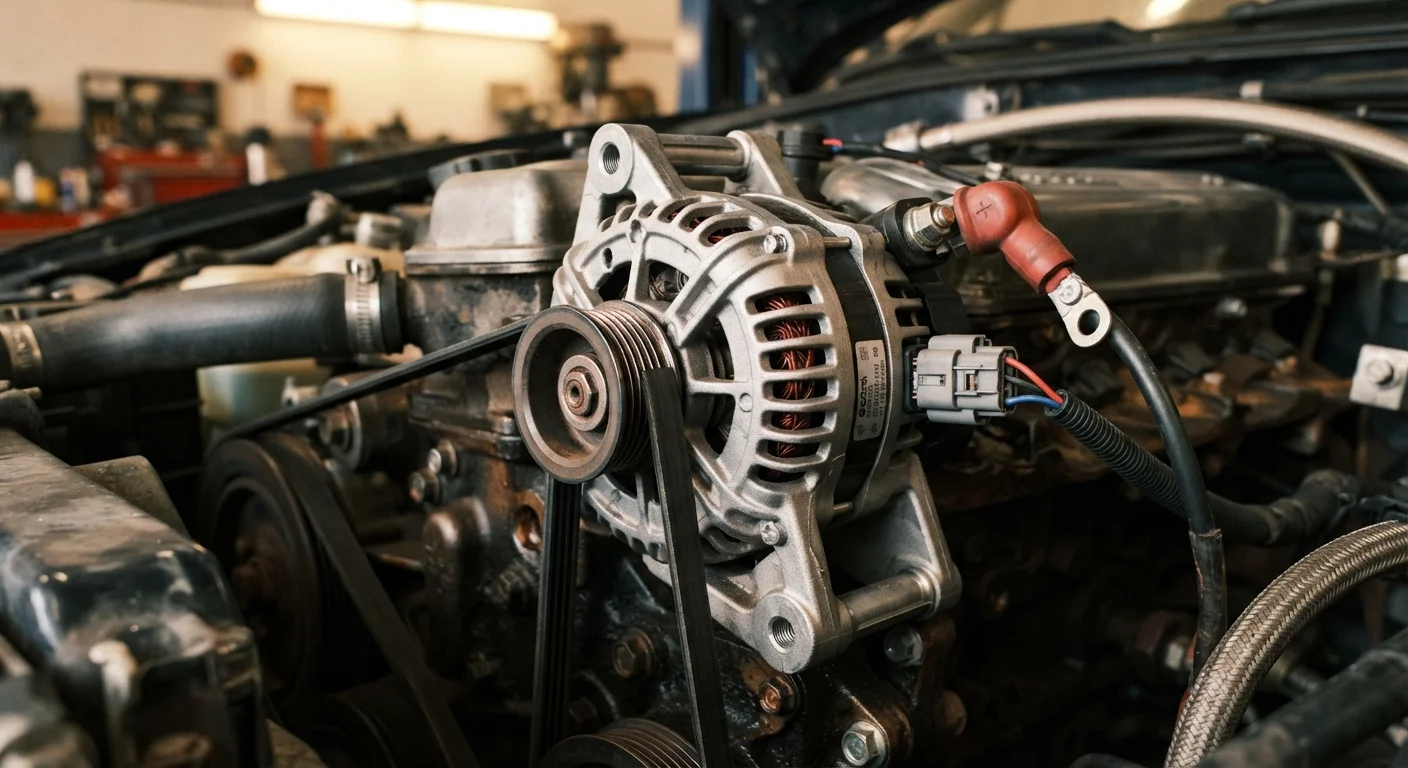
Once your engine is running, it spins a belt - called the serpentine belt - that wraps around several components, including the alternator's pulley. That spinning pulley drives a rotor inside the alternator, which rotates inside a set of wire coils called the stator. This spinning magnetic field induces an electrical current in the coils - a process called electromagnetic induction, first described by physicist Michael Faraday in the 19th century and still the foundation of how virtually all generators work today.
The alternator produces alternating current (AC), but your car's systems run on direct current (DC). A built-in component called a rectifier handles this conversion automatically, so the power that reaches your battery and accessories is always the stable DC voltage your car expects - typically around 13.5 to 14.5 volts while the engine is running.
13.5-14.5V
Normal alternator output voltage while driving
Automotive engineers and mechanic training standards consistently cite this range as the healthy operating voltage for a car's charging system.
80,000-150,000 mi
Typical alternator lifespan
General estimates from automotive maintenance references; actual lifespan varies by vehicle, driving conditions, and electrical load.
~400-1,000W
Electrical power output of a typical alternator
Output capacity varies widely by vehicle type; trucks and vehicles with high accessory loads often use higher-capacity alternators.
What the Alternator Powers - and Why It Matters
While you're driving, the alternator is the primary source of electricity for nearly every system in the vehicle. This includes:
- The ignition and fuel injection systems keeping the engine running
- Headlights, dashboard displays, and interior lights
- The climate control system (blower motors, heated seats, rear defrost)
- Infotainment, navigation, and phone charging via USB
- Power steering (on many modern vehicles, which use electric assist)
The battery, once the engine is running, is largely in a maintenance role - being topped back up by the alternator after each start. Think of the battery as a reserve tank, and the alternator as the live supply line. For a deeper look at how the battery fits in, our guide on caring for your car battery explains what drains it and how to make it last.
Recognising a Failing Alternator
Alternator problems tend to reveal themselves gradually before failing completely. The most common warning signs include:
- Battery warning light - this dashboard indicator can signal alternator trouble, not just a weak battery
- Dimming or flickering headlights, especially at idle when the engine isn't spinning the alternator as fast
- Electrical gremlins - power windows moving slowly, the radio cutting out, or the clock resetting
- Whining or grinding noise from the engine bay, which may indicate worn alternator bearings
- A battery that keeps going flat even after being replaced
If you notice these symptoms, have your vehicle inspected by a qualified mechanic promptly. A technician can test the alternator's output voltage with a multimeter - a quick, non-invasive check that quickly distinguishes a battery problem from an alternator problem. This matters before considering a jump-start, since jump-starting won't fix a charging system that can't sustain power.
Testing Is Always the First Step
Many auto parts stores offer free battery and charging system tests. However, interpretations of results can vary, and a definitive diagnosis - especially if multiple symptoms are present - is best made by a qualified mechanic using calibrated diagnostic equipment. Don't replace components based on guesswork alone.
Where the Alternator Fits in the Bigger Picture
The alternator is one piece of a larger web of interconnected car systems. It depends on the engine running (for belt-driven rotation), the battery (to provide initial field excitation), and functional wiring to distribute power. If you're curious how all these systems relate, our introduction to how cars work maps the full picture, and our car systems glossary defines the terminology you'll encounter along the way.
For most drivers, the practical takeaway is simple: if your car is behaving strangely electrically - especially if the battery warning light is on - don't assume the battery is the only suspect. Have both the battery and the alternator tested. Replacing just one when the other is also failing is a common and avoidable mistake.