
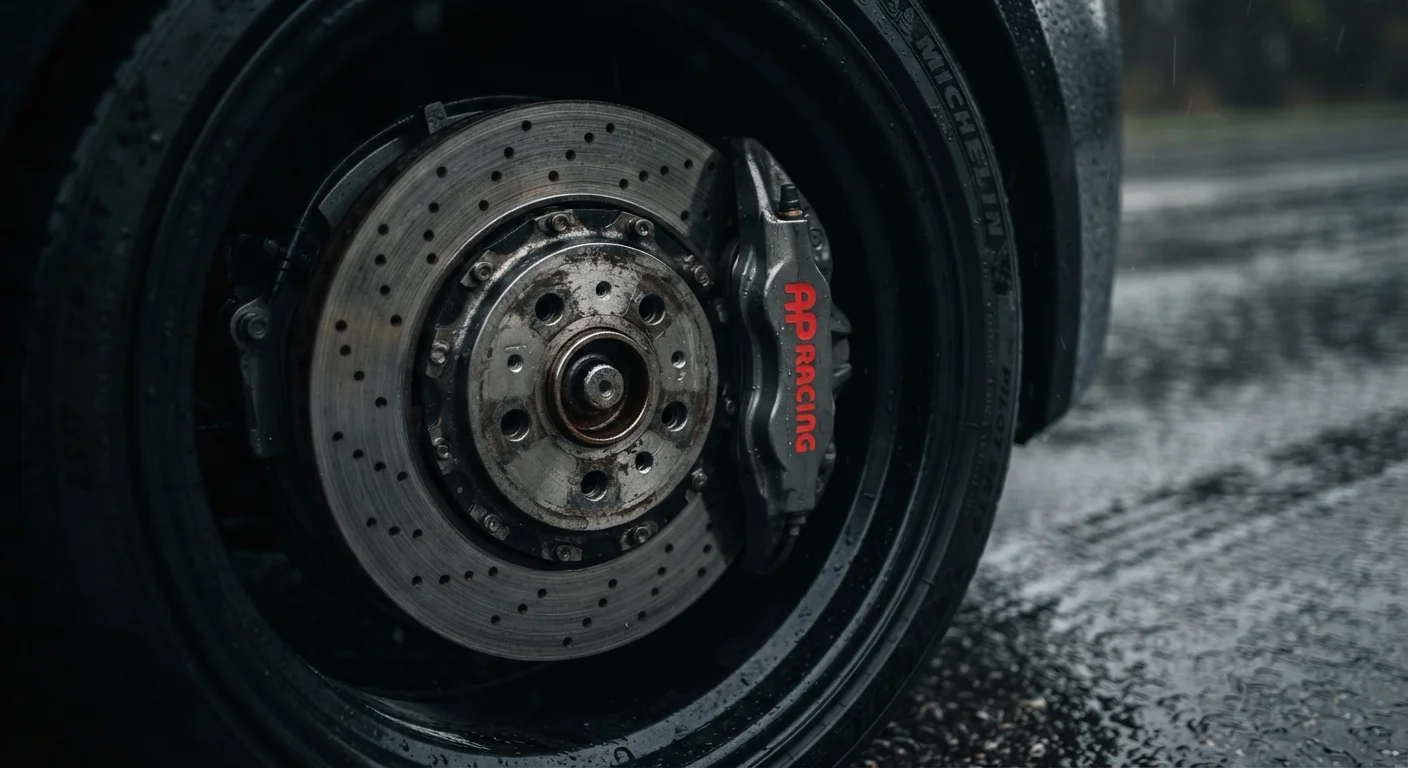
What Happens When You Brake Hard
In any emergency stop, your brakes are doing one fundamental job: converting the vehicle's kinetic energy (the energy of motion) into heat through friction. How quickly and safely that happens depends on whether the wheels keep rotating - or lock up completely.
When a wheel locks, it stops spinning and skids across the pavement. A skidding tire has significantly less grip than a rolling one, which does two things: it often increases stopping distance, and it robs the driver of steering control entirely. You can't steer a car with locked wheels - the front tires simply push forward rather than responding to the steering wheel's direction. This is the core problem that anti-lock braking systems were designed to solve.
For a deeper look at how wet pavement amplifies these risks, see our article on stopping distance in rain.
How Each System Responds
Standard brakes rely entirely on the driver's foot pressure. Press too hard and the wheels lock. On dry pavement with a skilled driver applying careful, graduated pressure - sometimes called threshold braking - a non-ABS system can stop effectively. But under panic conditions, most drivers apply far too much force, causing lockup almost immediately.
ABS brakes use wheel-speed sensors on each wheel that communicate with a control module dozens of times per second. The moment a sensor detects a wheel decelerating faster than the others - a sign of imminent lockup - the system automatically modulates hydraulic pressure at that wheel, releasing and reapplying it rapidly (typically 10-15 times per second). The driver feels this as a pulsing vibration through the brake pedal, which is normal and expected.
| Criterion | ABS Brakes | Standard Brakes |
|---|---|---|
| Wheel lockup prevention | Automatic, electronic modulation | Driver-controlled only |
| Steering control during hard stop | Maintained | Lost if wheels lock |
| Pedal feel in emergency | Pulsing vibration - normal | Firm, no feedback pulse |
| Correct driver technique | Firm, steady pressure | Threshold braking or pumping |
| Performance on dry pavement | Excellent | Good with skilled driver |
| Performance on wet or icy roads | Strong advantage | Significantly reduced |
| Performance on loose gravel/deep snow | Good; may be slightly longer stop | Lockup may shorten distance |
| Required on new US vehicles | Yes, since 2012 | No longer standard on new cars |
The key instruction for ABS is counterintuitive for drivers trained on older cars: do not pump the brakes. Apply firm, continuous pressure and let the system do the modulation automatically. Pumping the pedal interrupts the system's cycle and reduces effectiveness.
Understanding braking is also connected to the type of brake hardware your car uses. Our guide to disc brakes vs drum brakes explains how different brake designs interact with these systems.
When ABS Has a Disadvantage
ABS is highly effective on hard, consistent surfaces - asphalt, concrete, and even wet pavement. However, on very loose surfaces like deep gravel, sand, or heavy snow, the picture changes. On these surfaces, a locked wheel can plow into the material and build up a small wedge in front of it, which can actually contribute to deceleration. ABS, by preventing lockup, may allow the wheel to roll over that loose material rather than digging in.
2012
Year ABS became federally required in the US
The National Highway Traffic Safety Administration (NHTSA) mandated ABS on all new passenger cars sold in the United States starting with model year 2012.
10-15x
Times per second ABS modulates brake pressure
ABS control modules can cycle brake pressure on individual wheels far faster than any driver could manually pump the pedal, maintaining the wheel near the edge of lockup.
~18%
Estimated reduction in fatal crash risk with ABS
Research published by NHTSA has estimated that ABS is associated with a meaningful reduction in certain types of fatal crashes, particularly run-off-road and rollover events.
This doesn't mean ABS is unsafe on loose surfaces - the steering control benefit still applies - but drivers in regions with frequent loose-surface driving should be aware of this nuance. It's also worth noting that modern vehicles often pair ABS with additional systems like electronic stability control (ESC) and traction control, which work together as a broader safety network. Our related article on passive safety systems covers how multiple vehicle safety features coordinate during a crash event.
Regardless of which braking system your vehicle has, maintaining your brakes is essential. If you notice unusual sounds during braking, our guide on why brakes squeal explains when noise signals a maintenance need that shouldn't wait.