
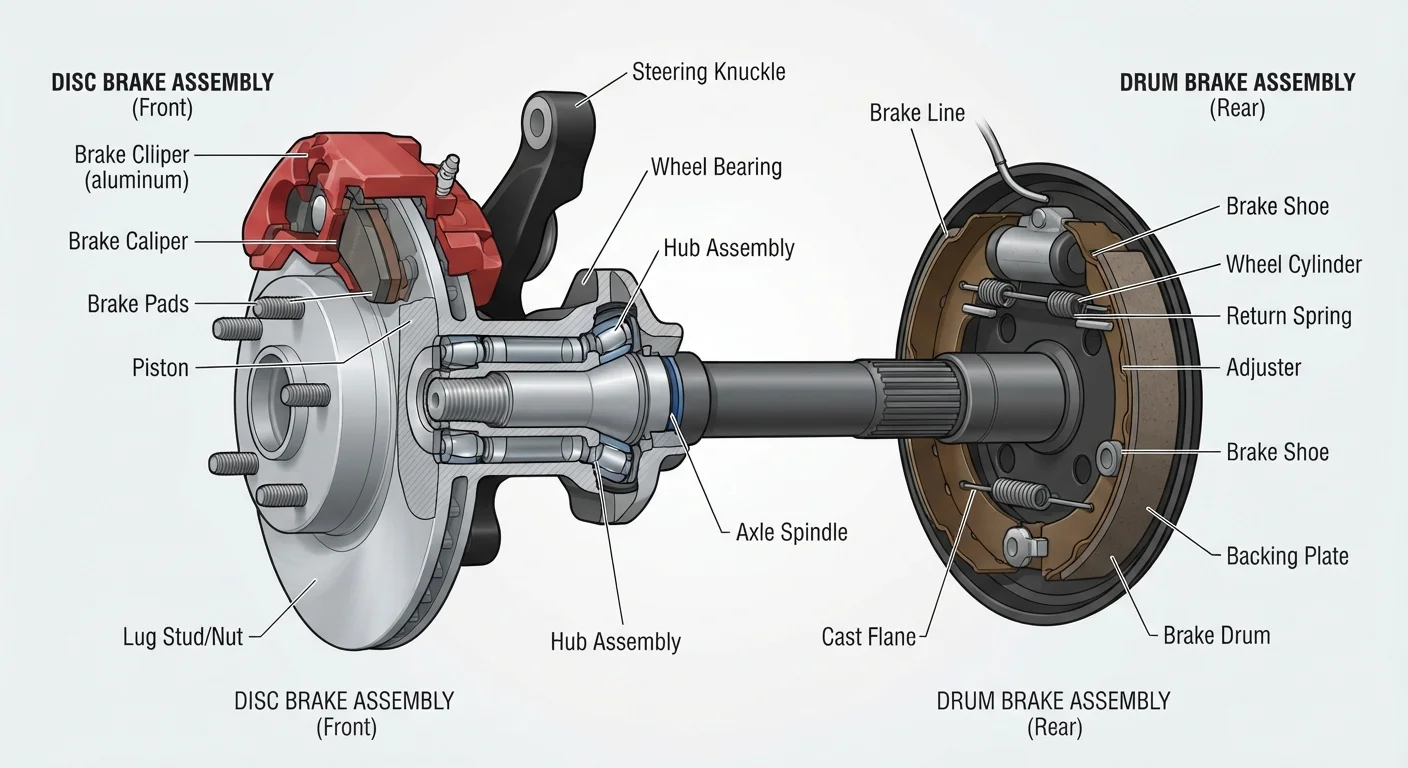
How Each Brake System Actually Works
Both disc and drum brakes convert your car's kinetic energy (motion) into heat through friction - but they do it in completely different ways.
A disc brake works like a bicycle brake you can actually see. A flat, round metal rotor spins with the wheel. When you press the brake pedal, hydraulic pressure squeezes a caliper - a clamp-like device - against both sides of that rotor. The friction pads inside the caliper grip the spinning rotor and slow it down. Because the rotor is exposed to open air, the heat generated escapes quickly.
A drum brake works from the inside out. A hollow metal drum spins with the wheel. Inside the drum sit curved brake shoes lined with friction material. Hydraulic pressure pushes those shoes outward against the inner surface of the spinning drum, creating friction that slows the wheel. The drum encloses the whole mechanism, which is why heat management is drum brakes' biggest weakness.
| Criterion | Disc Brakes | Drum Brakes |
|---|---|---|
| Mechanism | Caliper clamps rotor from outside | Shoes push outward inside drum |
| Heat dissipation | Excellent - open to airflow | Poor - heat trapped inside drum |
| Resistance to brake fade | High | Lower under heavy/repeated use |
| Typical placement | Front axle (often all four wheels on higher trims) | Rear axle on everyday vehicles |
| Parking brake integration | Requires separate mechanism | Integrates naturally with shoe assembly |
| Manufacturing cost | Higher | Lower |
| Wet weather performance | Self-cleaning - water flings off rotor | Can retain moisture; momentary fade possible |
Why Heat Management Changes Everything
Braking is essentially controlled heat production. Every time you slow down, your brake system is converting speed into thermal energy. The question is: where does that heat go?
Disc rotors dissipate heat rapidly because they're open to airflow. Many rotors are also vented - they have internal channels that act like a fan, drawing cool air through the rotor as it spins. This makes disc brakes highly resistant to brake fade, which is the gradual loss of stopping power that occurs when friction surfaces get too hot to work effectively.
Drum brakes trap heat inside the drum housing. Under light, everyday use - a gentle stop at a traffic light - this barely matters. But during extended braking, such as descending a long hill or repeated hard stops, drum brakes can overheat and fade significantly. This is the primary reason modern vehicles reserve drums for the rear axle, where braking loads are much lower.
~70%
Braking force absorbed by front axle
Weight transfer under braking means front brakes handle the majority of stopping load on most passenger vehicles.
4-wheel discs
Disc brakes on all four wheels
Higher-trim and performance-oriented vehicles increasingly use disc brakes at all four corners for maximum consistent stopping power.
For a deeper look at how braking technology interacts with emergency stopping systems, see our article on ABS vs. standard brakes.
The Logic Behind the Front-Disc, Rear-Drum Combination
If disc brakes perform better, why haven't drums been eliminated entirely? The answer comes down to physics and practicality.
When a car brakes, weight shifts forward. This means the front wheels bear significantly more of the stopping load than the rear wheels - often absorbing roughly two-thirds of total braking force. High-performance braking at the front demands the heat dissipation and consistent friction that disc brakes provide.
The rear wheels, carrying less braking load, don't need that level of performance. Drum brakes at the rear handle the lighter forces adequately. They also offer a distinct packaging advantage: the drum mechanism integrates a mechanical parking brake more cleanly than most disc setups, which typically require a separate small drum-within-a-disc assembly or an electric motor to hold the vehicle stationary.
Drum brakes are also less expensive to manufacture and replace, which matters in a competitive vehicle market. For everyday passenger cars, the combination of front discs and rear drums is a well-established engineering compromise that balances safety, cost, and durability.
Four-Wheel Disc Brakes Are Increasingly Common
While the front-disc, rear-drum setup remains widespread on base and mid-trim vehicles, many higher-trim models and nearly all performance-oriented cars now use disc brakes at all four wheels. The cost savings of rear drums matter less as vehicle prices rise, so manufacturers opt for the performance consistency of four-wheel disc setups. If you're unsure what your vehicle has, a quick look through the rear wheel spokes - or your owner's manual - will tell you.
Understanding how forces are distributed between axles also connects to drivetrain layout. Our guide on all-wheel drive vs. four-wheel drive explores how power delivery affects traction and handling.
What This Means for Maintenance
Knowing which brake type sits at each corner of your car helps you understand normal wear patterns and what to expect at a service visit.
Front brake pads typically wear faster than rear brake shoes or pads because the front axle does the heavier work. It's common for front brakes to need replacement two or three times more frequently than rear brakes on everyday driving patterns. A qualified mechanic will inspect brake pad and shoe thickness as part of routine service.
Disc brake pads are straightforward to inspect visually through the wheel spokes in many cases. Drum brake shoes require removing the drum assembly to assess, though many shops include this during a standard brake inspection. Both systems have wear indicators - a squeal or grinding sound often signals it's time to have brakes checked by a professional.
Never attempt brake repairs without proper training, tools, and safety precautions. Brake systems are safety-critical components, and any concerns should be assessed by a qualified mechanic. The transmission type your car uses can also influence how braking loads are distributed, particularly with engine braking in manual vehicles.