
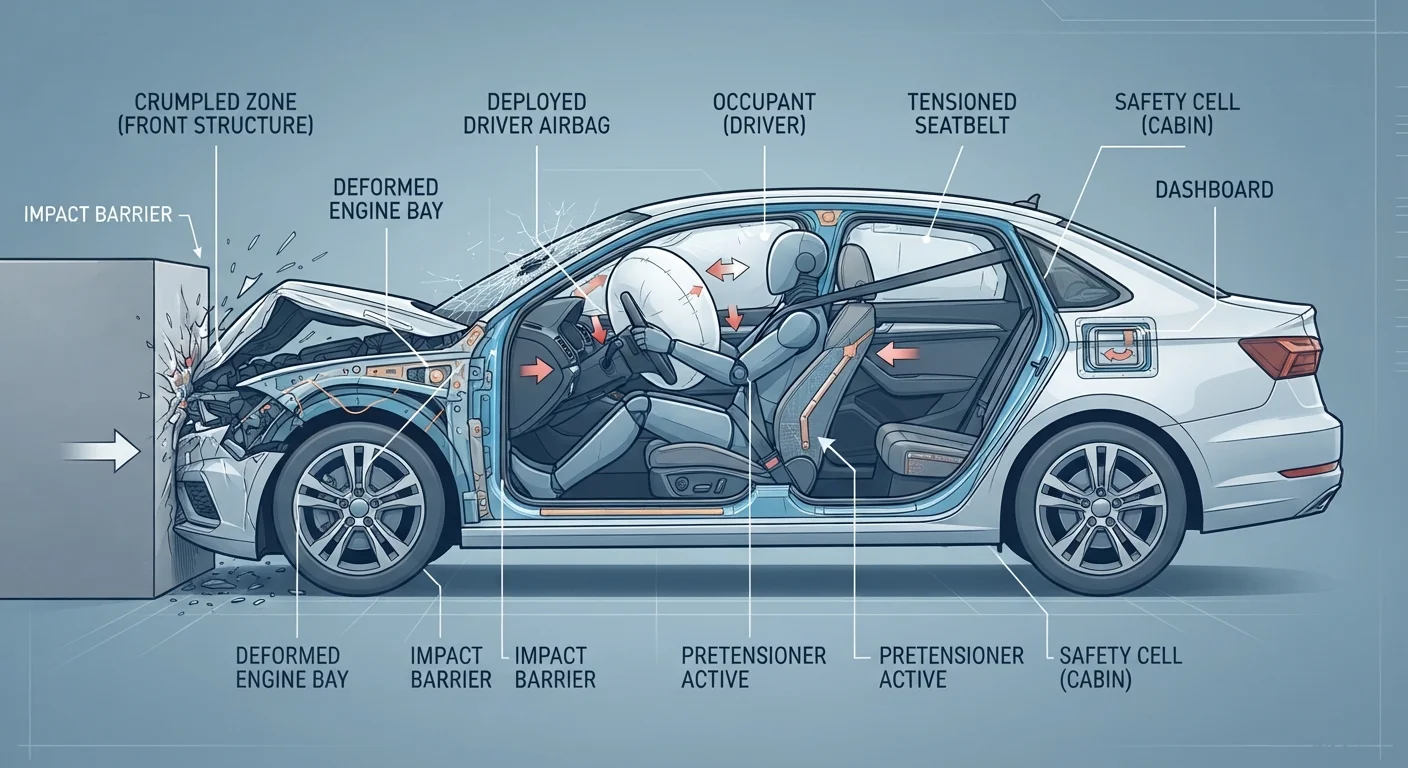
The Crash Physics Problem Every Car Must Solve
When two vehicles collide - or a vehicle strikes a fixed object - a tremendous amount of kinetic energy (the energy of motion) must go somewhere. The human body can only tolerate a certain rate of deceleration before injury occurs. The engineering challenge is straightforward in concept but complex in execution: slow the occupant down as gradually as possible while keeping the passenger compartment intact.
That is exactly what passive safety systems are designed to do. Rather than three separate features bolted into a car, seatbelts, airbags, and crumple zones form a single system with three distinct roles - each one dependent on the others to function correctly. For a broader view of how this fits into overall vehicle design, see our introduction to how cars work.
~45%
Reduction in front-seat fatality risk with seatbelt use
According to the National Highway Traffic Safety Administration (NHTSA), seatbelts reduce the risk of death for front-seat passenger car occupants by approximately 45%.
20-30 ms
Time for a front airbag to fully inflate
Airbag inflator systems are engineered to reach full deployment in roughly 20 to 30 milliseconds - faster than the human blink reflex.
~50%
Crash energy absorbed by front crumple zones
Automotive engineers design front structures to absorb roughly half or more of a frontal collision's kinetic energy before it reaches the passenger compartment.
Crumple Zones: Managing Energy Before It Reaches You
A crumple zone is a section of the vehicle - typically the front and rear - deliberately engineered to deform in a controlled way during a collision. Rather than the car holding its shape rigidly (which would transfer the full force of the crash directly to occupants), the crumple zone collapses progressively, converting kinetic energy into the work of bending metal.
Think of it like a shock absorber for the entire front end. By extending the time it takes for the cabin to decelerate - even by fractions of a second - engineers dramatically reduce the peak force experienced by the people inside. The passenger cabin itself is built from a much stiffer 'safety cage' structure that resists deformation, preserving the survival space around occupants.
Crumple Zones Are a Feature, Not a Flaw
Drivers sometimes worry when they see how severely a modern car's front end collapses after a collision. This visible damage is actually evidence the system worked as intended. Older, all-steel body designs that held their shape transferred far more force to occupants. A car that looks badly damaged but has a largely intact cabin has done its engineering job correctly.
Seatbelts: The First and Most Important Restraint
Seatbelts do the fundamental work of keeping occupants connected to the vehicle's deceleration. Without that connection, a passenger continues moving at the original speed of the car even after the car itself has begun to stop - an outcome that results in striking the interior or, in severe crashes, ejection.
Modern seatbelts include two key active components. A pretensioner fires a small explosive charge at the moment of crash detection, instantly pulling the belt tight to remove any slack. A load limiter then allows a controlled amount of belt feed-out as force increases, spreading the restraint load across the chest and pelvis to reduce the risk of belt-induced injury.
This combination means the seatbelt is not simply a static strap - it is a dynamic restraint system timed precisely with airbag deployment. For a plain-language reference to terms like pretensioner, see the Car Systems Glossary.
Airbags: Supplemental Cushioning, Not a Primary Restraint
Airbags are officially classified as Supplemental Restraint Systems (SRS) - a label that reflects their intended role. They are not a substitute for seatbelts; they are designed to protect a seatbelt-restrained occupant from striking hard interior surfaces (steering wheel, dashboard, A-pillar) during the final phase of deceleration.
When crash sensors detect a qualifying collision, an inflator unit releases nitrogen gas to fill the bag in about 20-30 milliseconds. By the time an occupant - already slowed by the seatbelt - reaches the bag, it has already begun to vent and soften. The timing of this sequence is precisely engineered so the bag is at the correct inflation level when contact occurs.
Sit at Least 10 Inches From the Steering Wheel
NHTSA recommends maintaining at least 10 inches between your breastbone and the center of the steering wheel. This distance gives the front airbag room to fully inflate before your body arrives, maximizing its protective cushion. Adjust your seat position and use the steering wheel's tilt and telescoping features if needed to achieve this clearance comfortably.
Modern vehicles deploy a range of airbags beyond the front pair: side curtain airbags, seat-mounted torso airbags, and knee airbags all address different collision geometries. Each is tuned individually while still being part of the same coordinated system.
How the Three Systems Work in Sequence
In a real crash, the sequence unfolds roughly like this: the crumple zone begins deforming immediately, extending the duration of the collision event by milliseconds. Crash sensors confirm a qualifying impact and trigger pretensioners and airbag inflators simultaneously. The seatbelt locks the occupant in place and begins managing load. The airbag reaches full inflation just as the restrained occupant approaches the forward cabin surfaces, then deflates to provide a controlled cushion.
Remove any one element and the system is compromised. An unbelted occupant arrives at the airbag too fast and at an unpredictable angle. A vehicle without crumple zones delivers a sharper, shorter deceleration spike that overwhelms the restraint system's ability to manage force gradually. The interdependence is intentional - and understanding it reinforces why seatbelt use is non-negotiable.
For more on how vehicle systems coordinate during emergency situations, see our article on ABS vs. standard brakes.
“The safety cage concept treats the passenger compartment as a rigid vault - you want energy to be absorbed everywhere else in the vehicle so the space around the people stays intact.”
— Cars Explained Editorial Team, Summarizing the core engineering philosophy behind modern occupant protection design