
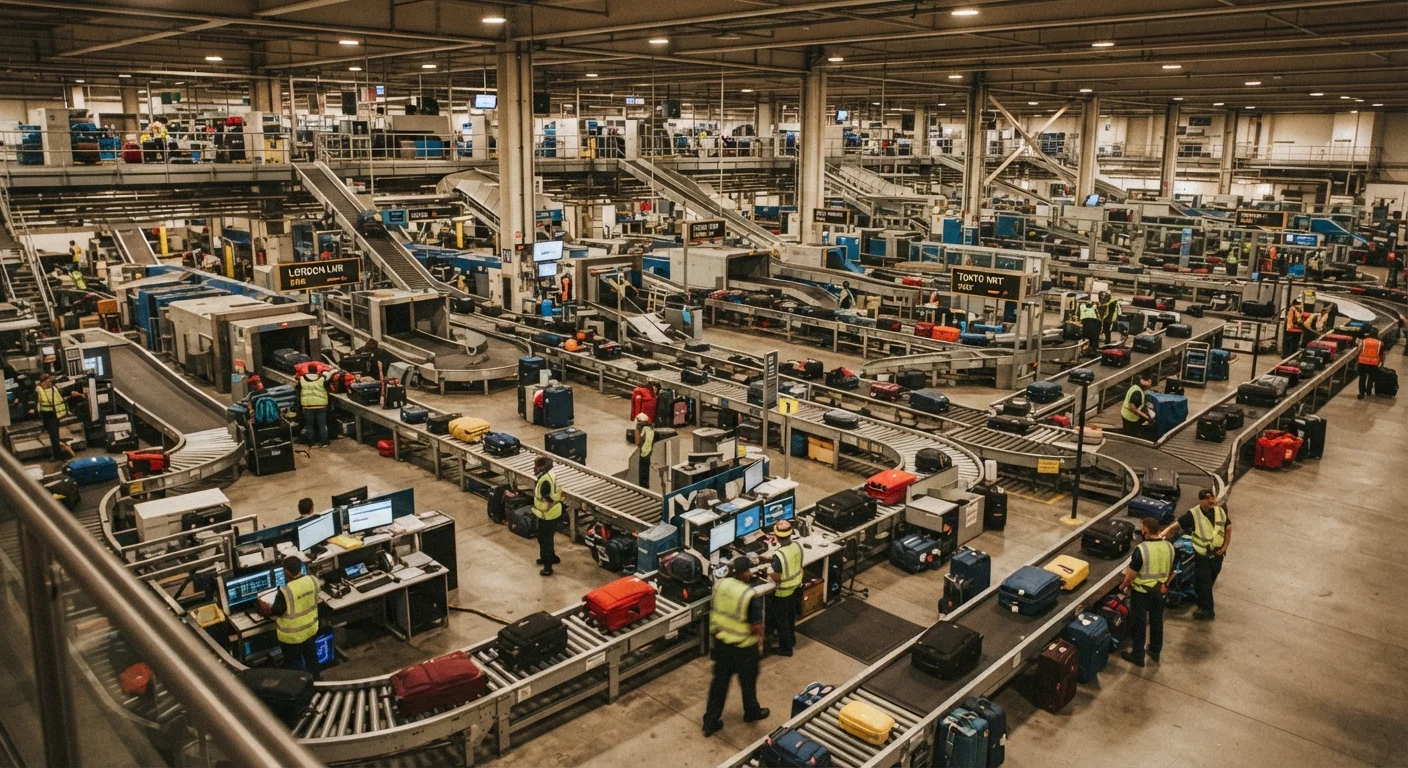
The Moment You Hand Over Your Bag
The journey begins at the check-in counter or self-service kiosk. An agent — or the kiosk itself — prints a bag tag containing a unique barcode and flight routing data. This tag is the bag's passport through the airport. It links to your booking, your destination, and any connecting flights.
Once tagged and weighed, your bag drops onto an induction belt behind the counter. From this point, you will not see it again until the arrivals carousel — but a great deal happens in between. If you are curious about what you should keep out of checked luggage entirely, our guide on carry-on vs. checked luggage covers what travels better in the cabin.
Security Screening: Every Bag Goes Through
Before any bag reaches a plane, it passes through a security screening system operated by the Transportation Security Administration (TSA). Large airports use automated inline screening, meaning bags move directly from the check-in conveyor into CT or X-ray machines without being carried to a separate area.
The machines analyze bag contents for prohibited or suspicious items. If the automated scan raises a flag, the bag is diverted to a secondary screening lane where a TSA officer may inspect it by hand. Physical searches are a routine part of the process, not an accusation. If an officer opens your bag, they are required to leave a paper notice inside.
What Triggers a Physical Bag Search
Dense or overlapping items — such as stacks of books, tightly packed electronics, or food in metal containers — can produce ambiguous images on X-ray machines. This is not unusual and does not imply suspicion. Packing in an organized way and keeping cables or devices near the top of your bag can reduce the likelihood of an unclear scan, though it is never a guarantee.
Once screening is complete, the bag re-enters the main conveyor network, now cleared for loading.
How Automated Sorters Route Your Bag
After screening, bags enter a high-speed sorting system. Scanners read the barcode on the bag tag and match it to departure data held in the airport's baggage management database. Diverter arms or tilt-tray mechanisms then route each bag toward the correct outbound pier or gate area — all without human involvement in most large airports.
~4.5 billion
Bags handled globally per year
SITA's Baggage IT Insights reports that global airlines process billions of checked bags annually across the commercial aviation network.
6 per 1,000
Mishandled bag rate (approximate industry average)
SITA's annual baggage reports have consistently tracked mishandling rates — including delays, damage, and loss — in the low single digits per thousand bags carried.
80%+
Bags scanned without human intervention
At airports with fully automated inline screening, the vast majority of bags complete security checks without requiring a manual physical inspection.
Bags that cannot be read — due to a crumpled tag, smudged barcode, or tag that has fallen off — are diverted to a manual coding station, where staff attempt to identify them. This is one of the main reasons a bag can fall behind schedule, which is explored more fully in our article on why checked bags get lost.
Loading Into the Aircraft
Once routed to the correct gate area, bags are collected by ramp agents — the ground crew you may see driving carts across the tarmac. On wide-body aircraft (typically twin-aisle planes used on long-haul routes), bags are packed into aluminium containers called unit load devices (ULDs). These pre-loaded containers are lifted directly into the cargo hold, saving significant time.
On narrow-body aircraft — common on domestic and short-haul routes — bags are loaded individually, a process called bulk loading. Ramp agents arrange bags by hand in the hold, which takes longer and requires more physical sorting on the tarmac.
The cargo hold is pressurized and temperature-controlled on commercial passenger aircraft, meaning your luggage travels in conditions similar to (though not identical to) the cabin.
Make Your Bag Easier to Identify and Track
Write your name and a contact email inside your bag — not just on the outside tag, which can be torn off. A distinctive luggage strap or colorful tag makes your bag easier to spot on the carousel and harder to accidentally taken by someone else. If your airline supports bag tracking in its app, activate it before you check in so you can follow your bag's progress.
At Your Destination: From Hold to Carousel
When the aircraft arrives, ramp agents offload bags in roughly reverse order from how they were loaded — a process that typically takes 15 to 30 minutes depending on aircraft size and staffing. Bags then travel via conveyor or cart to the baggage claim hall, where they are fed onto the carousel assigned to your flight.
The order bags appear on the carousel depends on offload sequence, not seat class or check-in time. A bag checked early might appear late if it was loaded deep in the hold. If your bag does not arrive, report it immediately at the airline's baggage service desk before leaving the claims area — staff can initiate a trace using the tag barcode while the trail is still fresh.
For a broader look at navigating the airport before you even reach baggage claim, see our airport security screening walkthrough for what to expect at the checkpoint.