
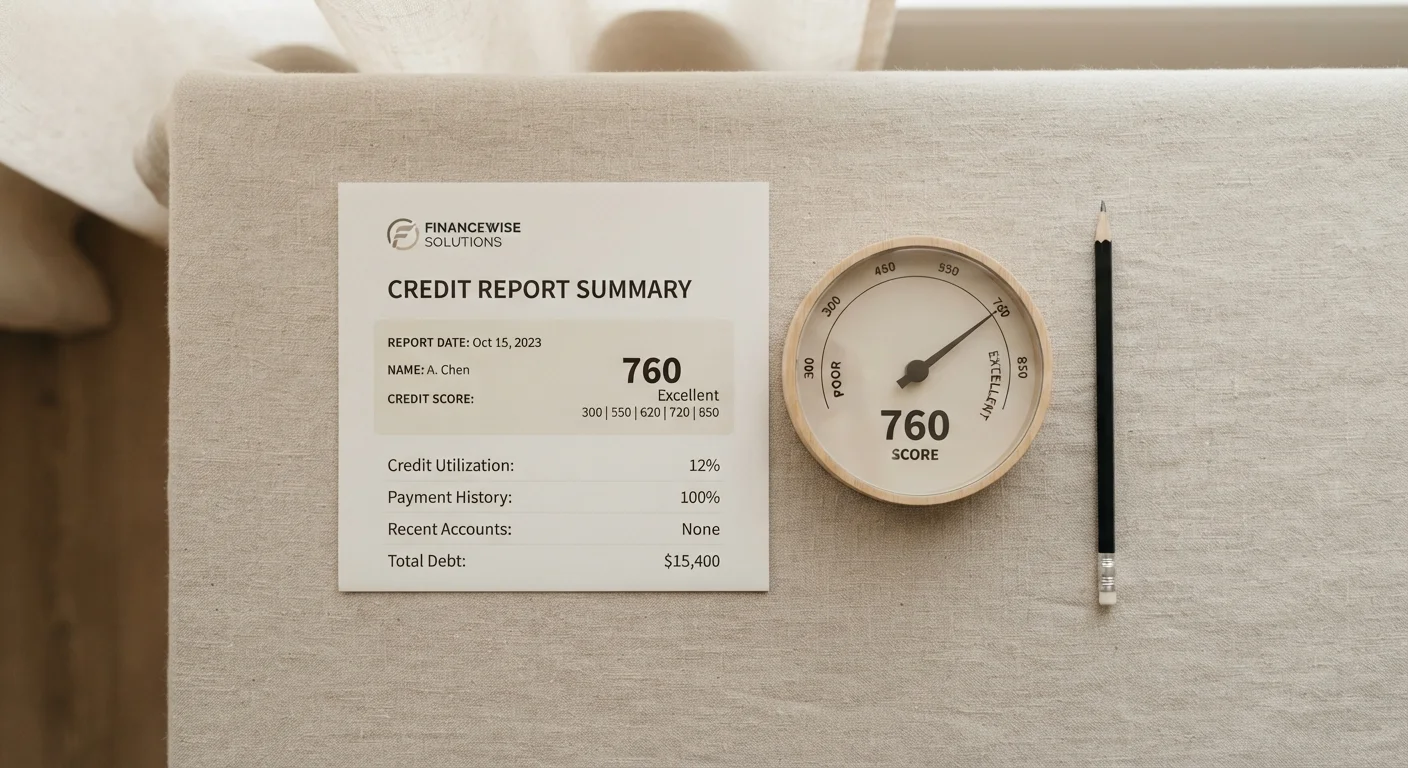
What a Credit Score Is Actually Measuring
At its core, a credit score answers one question: how likely are you to repay borrowed money on time? It does not measure how responsible you are with money overall, how much you earn, or how financially secure you feel. It measures a narrow but consequential slice of your financial behavior — your track record with credit products like loans and credit cards.
Scoring models analyze the data sitting in your credit reports, which are compiled by the three major U.S. credit bureaus: Equifax, Experian, and TransUnion. Those reports capture things like whether you've paid accounts on time, how much of your available credit you're currently using, how long you've had credit accounts open, what types of credit you carry, and how recently you've applied for new credit.
See our plain-language breakdown of all five scoring factors to understand exactly how each element is weighted.
300–850
Standard FICO Score range
FICO Scores — the most widely used model in the U.S. — fall on a scale from 300 to 850, with higher scores indicating lower lending risk.
35%
Weight of payment history in FICO scoring
According to FICO, payment history — whether you pay on time — is the single largest factor in your score, accounting for roughly 35% of the calculation.
3
Major U.S. credit bureaus
Equifax, Experian, and TransUnion each maintain their own version of your credit report, which means your score may differ slightly depending on which bureau's data is used.
What a Credit Score Doesn't Measure
This is where many people get tripped up. A credit score is not a comprehensive measure of financial health, and the gap between what it does and doesn't capture is significant.
- Income: You could earn $200,000 a year and have a poor credit score — or earn $40,000 and have an excellent one. Earnings simply don't enter the calculation.
- Savings and net worth: Having $50,000 in a savings account is invisible to a credit score. Savings behavior isn't tracked in credit reports.
- Everyday spending habits: How you budget, whether you use cash, and how frugally you live are all outside the scoring model's view.
- Rent and utility payments: In most cases, on-time rent and utility payments are not automatically reported to bureaus. Some newer programs allow consumers to opt in to reporting these, but it isn't standard.
This creates a real gap: someone who manages their everyday finances extremely well but has limited credit history may have a lower score than someone with more borrowing activity and a mixed track record. Understanding this distinction helps set realistic expectations.
Why People with No Credit History Score Low
If you've never taken out a loan or used a credit card, you may have little to no credit history — and therefore a very low or nonexistent score. This doesn't mean you're financially irresponsible; it simply means the scoring model has no data to work with. Building a credit history, even with a small secured credit card used sparingly, gives the model the information it needs to generate a meaningful score.
Common Misconceptions Worth Clearing Up
A handful of persistent myths surround credit scores. Two of the most widespread are worth addressing directly.
Myth: Checking your score damages it. Viewing your own credit score — whether through a bank app, a credit bureau, or a free monitoring service — is a soft inquiry and has zero effect on your score. Only hard inquiries, which occur when a lender formally reviews your file for a new application, can cause a small, temporary dip.
Myth: Carrying a credit card balance helps your score. There is no scoring benefit to carrying a balance from one month to the next. In fact, keeping your credit utilization — the share of your available credit that you're using — low tends to help your score, not hurt it. Credit utilization has an outsized effect on your score, and paying your balance in full each month is generally better for both your score and your wallet.
For a wider look at what the evidence actually shows, see our article on credit score myths that hold people back.
“A credit score is a snapshot of your credit risk at a particular moment in time. It doesn't capture the full picture of your financial life — just how you've managed credit obligations.”
— Consumer Financial Protection Bureau, U.S. government agency responsible for consumer financial protection
How Lenders Actually Use Your Score
It's also worth understanding that a credit score is an input — not the final word. When you apply for a mortgage, auto loan, or credit card, most lenders look at your score alongside other information: your debt-to-income ratio, employment status, the size of a down payment, and the type of credit you're applying for.
A strong score can open doors — lower interest rates, higher credit limits, and easier approvals — but a score alone rarely tells the complete story a lender needs. Conversely, a score that needs improvement isn't a permanent barrier; it reflects past behavior and can be changed by building new, consistent habits over time.
Learn how lenders assess creditworthiness during an application to see the broader picture of what goes into a lending decision.
This article is for general informational and educational purposes only. It is not personalized financial or credit advice. For guidance specific to your financial situation, consult a qualified financial professional.