
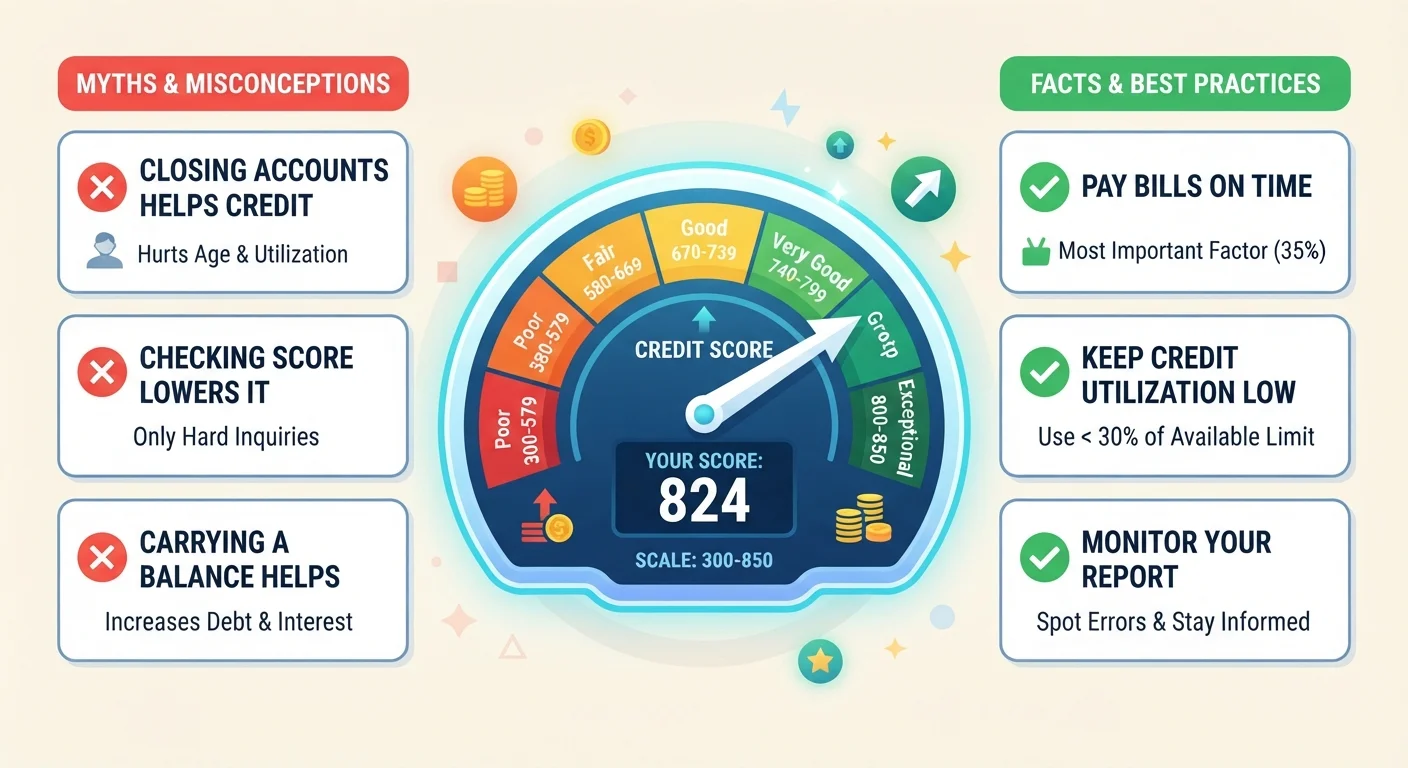
Why Credit Myths Are So Costly
Credit scores influence mortgage rates, apartment applications, car loans, and sometimes even job offers. Yet many Americans make daily decisions based on misconceptions about how scores actually work. Acting on bad information can quietly hold your score back — or actively push it down — while you believe you're doing everything right.
This article addresses the most persistent credit myths using the principles behind mainstream credit scoring models. For a fuller picture of the underlying mechanics, see what a credit score actually measures and the five factors behind every credit score.
Myth
Checking your own credit score will lower it.
Fact
Checking your own score is a soft inquiry and has zero effect on your credit score.
There are two types of credit checks: hard inquiries and soft inquiries. When you check your own score — through your bank, a credit monitoring service, or AnnualCreditReport.com — that's a soft inquiry. Soft inquiries are invisible to lenders and never affect your score. Hard inquiries occur only when a lender pulls your report as part of a credit application, and even those typically lower a score by only a few points temporarily. You can check your own score as often as you like without any penalty. In fact, monitoring it regularly is one of the best ways to catch errors or signs of fraud early. Hard inquiries vs. soft inquiries explains this distinction in detail.
Myth
Carrying a small balance on your credit card each month helps build your score.
Fact
Carrying a balance does not improve your score — it just costs you interest charges.
This is one of the most financially damaging myths in circulation. The idea seems to be that using credit and leaving a balance shows lenders you're actively using your account. In practice, credit scoring models reward low utilization — meaning the less of your available credit you're using, the better. Paying your full statement balance every month demonstrates responsible use without triggering interest charges. Carrying even a modest balance month to month can push your utilization ratio up and cost you significantly in interest over time. Why your credit utilization ratio matters explains how this single factor can have an outsized impact on your score.
Myth
Closing old or unused credit cards will improve your credit score.
Fact
Closing old accounts often hurts your score by reducing available credit and shortening credit history.
It feels logical to tidy up your finances by closing cards you no longer use. But closing a credit card reduces your total available credit, which can raise your overall utilization ratio — even if your balances haven't changed. It also removes the account's history from your active profile over time, potentially shortening the average age of your accounts. Both effects can push your score downward. If a card has no annual fee, keeping it open and making an occasional small purchase (paid off immediately) is generally a better strategy than closing it outright. If a card does carry an annual fee you can't justify, weigh the cost carefully before closing.
Myth
Missing one payment won't make much difference to your credit score.
Fact
A single missed payment can cause a significant score drop and remains on your credit report for up to seven years.
Payment history is the single most heavily weighted factor in mainstream credit scoring models, typically accounting for around 35% of a score. A payment reported as 30 or more days late can cause a meaningful drop — often more damaging to a previously strong score than to one that was already low. The missed payment then stays on your credit report for up to seven years. The good news is that its impact tends to diminish over time, especially if you build a consistent on-time payment record afterward. Setting up autopay for at least the minimum due is one of the simplest ways to protect yourself from accidental late payments.
Myth
You need to be in debt to have a credit score.
Fact
A credit score is built through credit activity — not debt. Responsible use of credit products, even paid off in full, builds your profile.
Many people assume that carrying debt is a prerequisite for having or improving a credit score. This conflates two separate concepts. A credit score measures how reliably you manage credit — not how much you owe. Paying a credit card balance in full each month, making on-time installment loan payments, or being an authorized user on someone else's account all generate positive credit history without requiring you to hold ongoing debt. The goal is demonstrating responsible credit behavior, not maintaining a balance. Being debt-free while actively using and paying off credit is an ideal credit-building strategy.
What These Myths Have in Common — and How to Move Forward
Each of the myths above stems from a kernel of related truth twisted out of context. Hard inquiries do affect scores — just not the ones you generate yourself. Utilization does matter — but the goal is keeping it low, not manufactured. Account age does count — which is why closing cards casually can backfire.
35%
Weight of payment history in FICO scoring
Payment history is the largest single factor in the widely used FICO scoring model, making consistent on-time payments the highest-leverage habit for score improvement.
30%
Weight of credit utilization in FICO scoring
Amounts owed — particularly the share of available credit in use — is the second-largest scoring factor, underscoring why keeping balances low relative to limits matters.
7 years
How long a late payment stays on your report
Under the Fair Credit Reporting Act, most negative items including missed payments can remain on a consumer credit report for up to seven years from the date of the delinquency.
The good news is that once you understand the actual rules, the path forward becomes clearer. Pay on time, keep balances low relative to your limits, and avoid unnecessary new credit applications. These habits, applied consistently, do more for your score than any shortcut. For a practical roadmap, principles that support long-term credit health walks through the ongoing behaviors that matter most.
Misinformation Can Cost You Real Money
Acting on credit myths isn't just academically wrong — it can lead to higher interest rates, loan denials, and years of slower financial progress. A lower credit score can mean paying thousands of dollars more over the life of a mortgage or auto loan. Understanding the actual rules of credit scoring is a foundational step toward better financial outcomes. When in doubt, refer to official resources such as the Consumer Financial Protection Bureau (CFPB) or consult a nonprofit credit counselor.
Credit health and saving habits are deeply intertwined. A strong score can lower borrowing costs, which frees up more money to save. If you've encountered myths about saving as well, common things people get wrong about saving money covers similar ground. And if you've ever wondered how lenders actually interpret your score once you apply, how lenders use credit scores when you apply for credit explains the broader picture.
This article is for general informational and educational purposes only and does not constitute personalized financial advice. Consult a qualified financial professional for guidance tailored to your individual circumstances.