
What Makes Up a Credit Score?
Your credit score is a three-digit number — typically ranging from 300 to 850 — that summarizes how reliably you manage borrowed money. Lenders, landlords, and sometimes employers use it to gauge financial trustworthiness. But the number itself can feel like a black box.
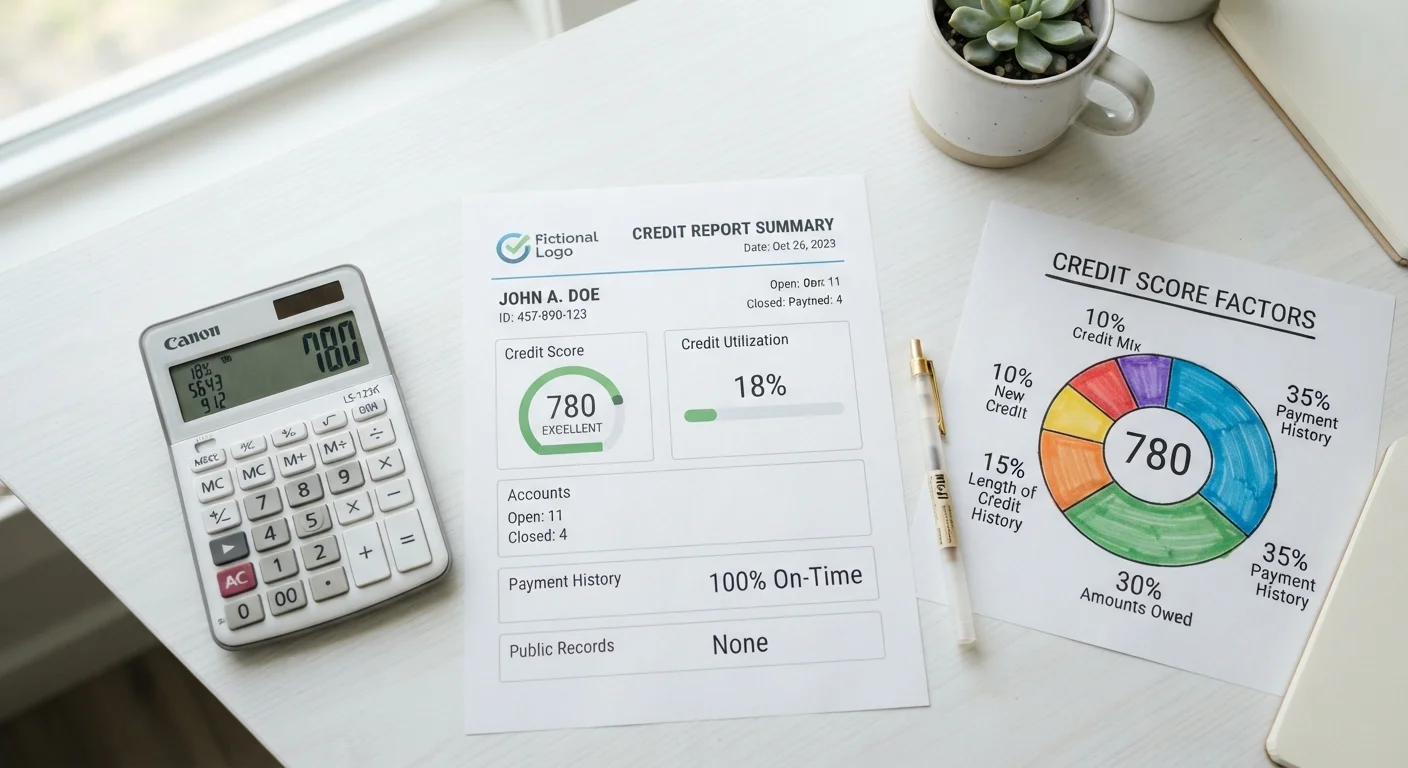
In reality, it's built from five distinct factors, each weighted differently. The most widely referenced scoring model, FICO®, publicly describes these five categories and their approximate influence on your score. Knowing what each factor does — and how much it matters — gives you a map for improving where you stand.
For a broader look at what scores are actually designed to measure, see what a credit score actually measures.
| Payment History Weight | 35% (FICO® scoring model) |
| Credit Utilisation Weight | 30% (FICO® scoring model) |
| Length of Credit History Weight | 15% (FICO® scoring model) |
| Credit Mix Weight | 10% (FICO® scoring model) |
| New Credit Weight | 10% (FICO® scoring model) |
| Typical Score Range | 300–850 (Standard FICO® scale) |
The Five Factors, Explained
1. Payment History — 35%
This is the single largest factor. It tracks whether you've paid your bills on time across credit cards, loans, and other accounts. Late payments, collections, and bankruptcies leave marks that can take years to fade. Consistent on-time payments, over time, are the most reliable way to build this portion of your score.
2. Credit Utilisation — 30%
Utilisation measures how much of your available revolving credit (mostly credit cards) you're currently using. If your combined credit limit is $10,000 and your current balances total $3,000, your utilisation rate is 30%. Most scoring guidance suggests keeping this figure below 30%, and lower is generally better. Credit utilisation has an outsized effect on your score and is one of the fastest-moving factors when you pay down balances.
3. Length of Credit History — 15%
Scoring models consider how long your oldest account has been open, how long your newest account has been open, and the average age of all accounts. A longer history generally helps because it gives more data about your borrowing behavior. This is why closing old, unused credit cards can sometimes lower your score — it may shorten your average account age.
4. Credit Mix — 10%
This factor looks at the variety of credit types you carry: revolving accounts (like credit cards) and installment accounts (like auto loans or mortgages). A mix can signal that you manage different types of credit responsibly. That said, you shouldn't open accounts you don't need just to diversify — the benefit is modest.
5. New Credit — 10%
Each time you apply for new credit and a lender pulls your report (a hard inquiry), it can temporarily lower your score by a small amount. Opening several new accounts in a short period may also suggest financial stress to scoring models. Rate-shopping for a mortgage or auto loan within a short window is typically treated as a single inquiry by most models.
Credit Score
A three-digit number, typically between 300 and 850, that summarizes your creditworthiness based on your borrowing and repayment history. Higher scores generally indicate lower lending risk.
Credit Utilisation
The percentage of your available revolving credit that you're currently using. It's calculated by dividing your total balances by your total credit limits across revolving accounts.
Hard Inquiry
A credit check initiated when you apply for new credit, such as a loan or credit card. Hard inquiries appear on your credit report and can temporarily lower your score by a small amount.
Revolving Credit
A type of credit account — like a credit card or line of credit — where you can borrow, repay, and borrow again up to a set limit. Your balance and minimum payment can vary each month.
Installment Account
A loan with a fixed repayment schedule, such as a mortgage, auto loan, or student loan. You borrow a set amount and repay it in regular installments over a defined period.
FICO® Score
A credit scoring model developed by the Fair Isaac Corporation and widely used by lenders in the United States. It generates scores based on data from your credit report, broken into five weighted categories.
How to Use This Knowledge
The weighting tells you where to focus first. Because payment history and utilisation together account for roughly 65% of a typical FICO® score, these two areas offer the most leverage. Setting up automatic payments eliminates the most common cause of missed due dates. Paying down revolving balances — even partially — can move utilisation quickly.
The remaining three factors matter, but they tend to improve naturally over time as you maintain good habits. Avoid frequently opening new accounts, keep older accounts active, and let your credit history grow steadily.
To separate fact from common misconception, credit score myths worth knowing about can help you avoid steps that feel helpful but aren't. And if you want to understand how lenders actually apply your score during an application, how lenders use credit scores explains the broader decision process. For the habits that sustain a strong profile over the long run, see principles that support long-term credit health.
This article is for general informational and educational purposes only and does not constitute personalised financial or credit advice. Consult a qualified financial professional for guidance specific to your situation.