
The Problem Suspension Is Solving
Imagine riding a bicycle with no tires - just metal rims on asphalt. Every pebble would send a sharp shock straight up through the frame into your hands and body. A car without a suspension system would work the same way: the rigid steel of the chassis would transmit every surface irregularity directly into the cabin.
Roads are never perfectly flat. Even well-maintained highways have micro-variations in surface height. Suspension exists to absorb that constant stream of small (and not-so-small) energy inputs, converting them into controlled mechanical movement rather than passenger discomfort.
But ride comfort is only part of the equation. Suspension also keeps your tires pressed firmly against the road. When a tire loses contact - even briefly - steering and braking effectiveness drop. So the system is simultaneously about passenger comfort and vehicle control. For a broader map of how this fits into the car as a whole, see A Curious Non-Mechanic's Introduction to How Cars Work.
Springs: The First Line of Energy Absorption
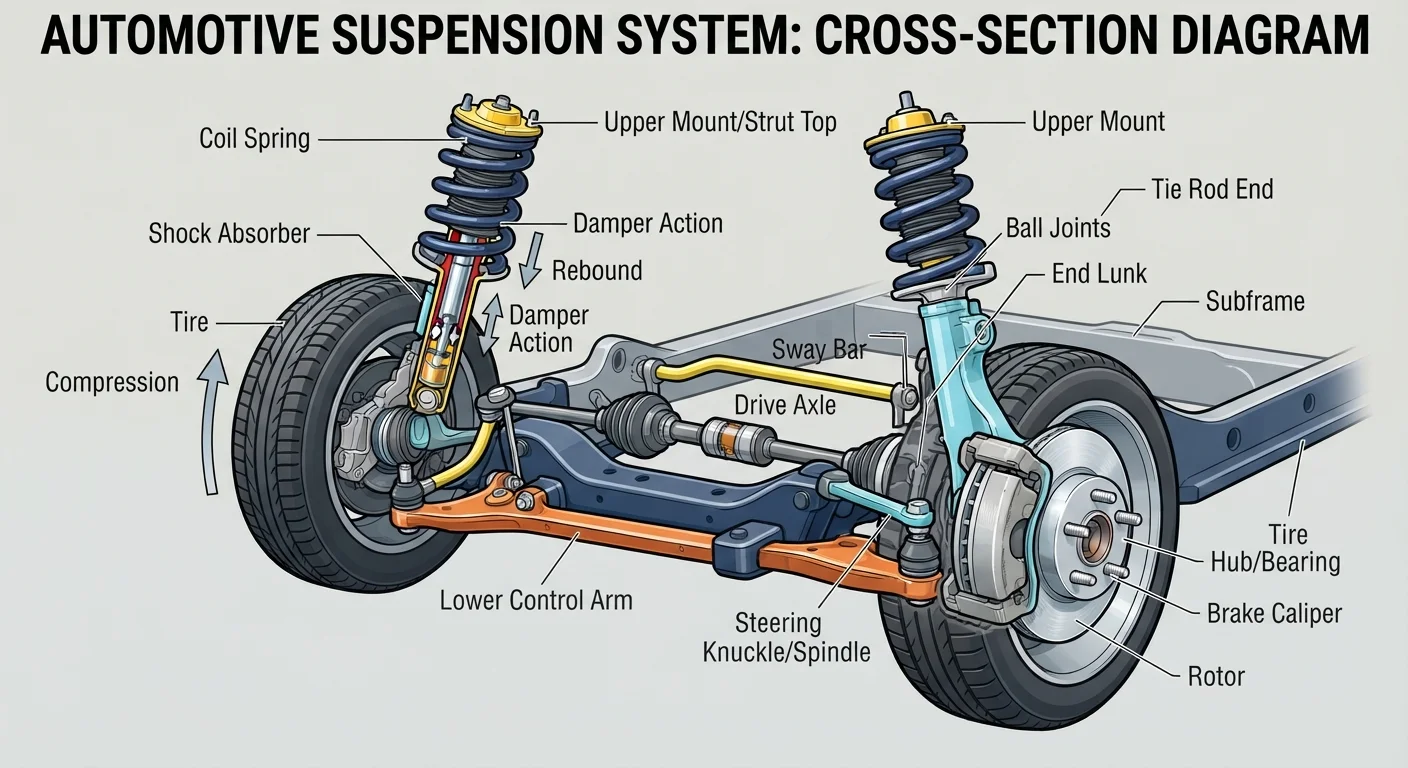
When a wheel hits a bump, the first component to respond is the spring. Most passenger cars use coil springs - tightly wound steel coils that compress under load and then extend back to their original shape. Some trucks and older vehicles use leaf springs, which are stacked flat strips of metal that flex similarly.
A spring's job is to absorb the sudden upward energy of a bump by compressing, then release that energy by extending. The problem is that a spring alone would keep bouncing - compressing and extending repeatedly like a trampoline - long after the bump has passed. That's where the shock absorber comes in.
4-6 inches
Typical suspension travel range on a passenger car
This is the distance each wheel can move up or down within the suspension system before reaching its limit - enough to absorb most everyday road imperfections.
50,000 mi
Common inspection interval for shock absorbers
Many mechanics recommend a thorough suspension inspection around this mileage, though driving conditions - especially rough roads - can accelerate component wear.
20%+
Potential increase in braking distance with worn shocks
Industry testing has shown that significantly worn shock absorbers can extend stopping distances, particularly at highway speeds, due to reduced tire-road contact.
Shock Absorbers and Struts: Controlling the Bounce
A shock absorber (often called a damper) is a hydraulic device that converts the spring's kinetic energy into heat. Internally, it's essentially a piston moving through oil inside a sealed cylinder. As the spring compresses or extends, the shock absorber resists that movement, slowing it down so the car settles quickly rather than bouncing repeatedly.
A strut is a variation that integrates the spring and shock absorber into a single structural unit. Struts are also load-bearing, meaning they contribute to the car's structural geometry - which is why replacing them is more involved than swapping a standalone shock.
A Simple Bounce Test for Worn Shocks
Press down firmly on each corner of your car and release. If the car bounces more than once or twice before settling, the shock absorbers at that corner may be worn. This isn't a substitute for a professional inspection, but it's a useful first indicator that something may need attention.
The combined effect of spring and damper is what gives a car its characteristic ride feel. A stiffer setup (common on sports cars) means less body movement but a firmer ride. A softer setup (common on luxury sedans) prioritizes comfort, allowing more controlled body motion over bumps.
Control Arms, Ball Joints, and Bushings: Guiding the Movement
Springs and shock absorbers manage energy. Control arms manage geometry - they're the hinged metal links that connect the wheel hub to the car's frame and guide exactly how each wheel moves as the suspension travels up and down.
At the ends of control arms are two key components. Ball joints are spherical pivot points (similar to the ball-and-socket joint in your shoulder) that allow the wheel to steer left and right while still moving vertically. Bushings are rubber or polyurethane sleeves that cushion the connection between metal components, reducing noise and vibration transmission into the cabin.
When these components wear out, wheels can shift out of alignment, causing uneven tire wear and pulling to one side. For a plain-language breakdown of terms like these, the Car Systems Glossary is a useful reference.
Alignment vs. Suspension: Not the Same Thing
Wheel alignment refers to the precise angles at which tires contact the road, adjusted by a technician using specialized equipment. Suspension refers to the physical components - springs, dampers, arms - that support and guide the wheels. Worn suspension components often cause misalignment, but getting an alignment won't fix worn-out hardware.
Independent Suspension vs. Solid Axles
Older vehicles - and many modern trucks - use a solid axle design, where both wheels on an axle are connected by a single rigid bar. When one wheel hits a bump, the other is affected too. This setup is durable and well-suited to heavy loads, but it compromises ride comfort and handling on varied terrain.
Most modern passenger cars use independent suspension on at least the front wheels, and often all four. Each wheel moves on its own in response to what the road is doing beneath it, without directly disturbing the wheel across from it. This produces a noticeably smoother, more controlled ride and better handling.
When to Have Your Suspension Inspected
Suspension components wear gradually, so the decline in ride quality can be subtle. Key warning signs include: a bouncing sensation that continues well after a bump; the front of the car dipping sharply when braking (called nose dive); excessive body lean when cornering; clunking or knocking sounds over rough surfaces; or uneven tire wear patterns.
If any of these appear, have a qualified mechanic inspect the suspension. Attempting to diagnose or repair suspension components without proper tools and experience carries real safety risks - this is one area where professional assessment is strongly recommended.
Keeping on top of suspension health is part of a broader routine. For a full seasonal maintenance checklist, see Seasonal Car Maintenance: What to Check as the Weather Changes, and for a comprehensive routine maintenance overview, Car Care From Every Angle covers the full picture.