
Why a Small Number Carries a Lot of Weight
Most drivers glance at their tires and, if they look roughly round, move on. But the actual pressure inside each tire - a number typically sitting between 30 and 36 PSI for most passenger cars - quietly governs how your vehicle handles, stops, and even how much gas it consumes.
Tire pressure works because a tire isn't just rubber; it's a carefully calibrated air chamber. That air supports the weight of the vehicle, absorbs road shock, and maintains the flat footprint of rubber that connects you to the asphalt. When that pressure is off - even modestly - every one of those jobs gets harder.
For a deeper look at how under- or over-inflation affects grip and stopping distance, see our guide on how tire pressure affects handling and braking.
~1 PSI
Pressure lost per 10°F temperature drop
A general rule of thumb widely cited by tire manufacturers and automotive engineers for estimating seasonal pressure change.
25%
Drop needed to trigger TPMS warning light
Per U.S. federal TPMS regulations (FMVSS No. 138), the warning must activate when pressure falls 25% or more below the recommended level.
0.3% per PSI
Estimated fuel economy loss when underinflated
The U.S. Department of Energy estimates fuel economy decreases by approximately 0.2-0.3% for each PSI drop in average tire pressure.
Where to Find Your Correct PSI - and What to Ignore
The most common mistake drivers make is reading the large number stamped on the tire sidewall and using that as their target. That number - often labeled MAX PRESS - is the maximum pressure the tire structure can hold safely, not the recommended operating pressure for your vehicle. Driving at max pressure routinely will cause problems.
Your actual target PSI lives in two places:
- Driver's door jamb sticker: A small placard on the inside edge of your driver's door or door frame. This is the most reliable source and accounts for your specific vehicle's weight distribution.
- Owner's manual: Lists front and rear pressures, and may include an adjusted figure for when you're carrying a full load of passengers or cargo.
Note that front and rear tires sometimes require different pressures, so check both sides of the placard before you start inflating.
Use Your Door Jamb, Not the Tire
Before you inflate, photograph your door jamb sticker with your phone so you always have the correct front and rear PSI on hand. Many gas station air pumps are used in a hurry, and having the number ready prevents the temptation to guess or use the sidewall maximum.
How to Check Tire Pressure the Right Way
Checking pressure correctly takes about two minutes per tire. The most important rule: check tires cold - meaning the car has been parked for at least three hours or driven fewer than a mile at low speed. Driving heats the air inside tires, temporarily raising PSI by 4-6 points and giving a misleading reading.
- Remove the small cap from the tire's valve stem (the short rubber or metal post on the inner edge of the wheel).
- Press a tire pressure gauge firmly and squarely onto the valve stem. A hiss of air usually means the gauge isn't seated flush.
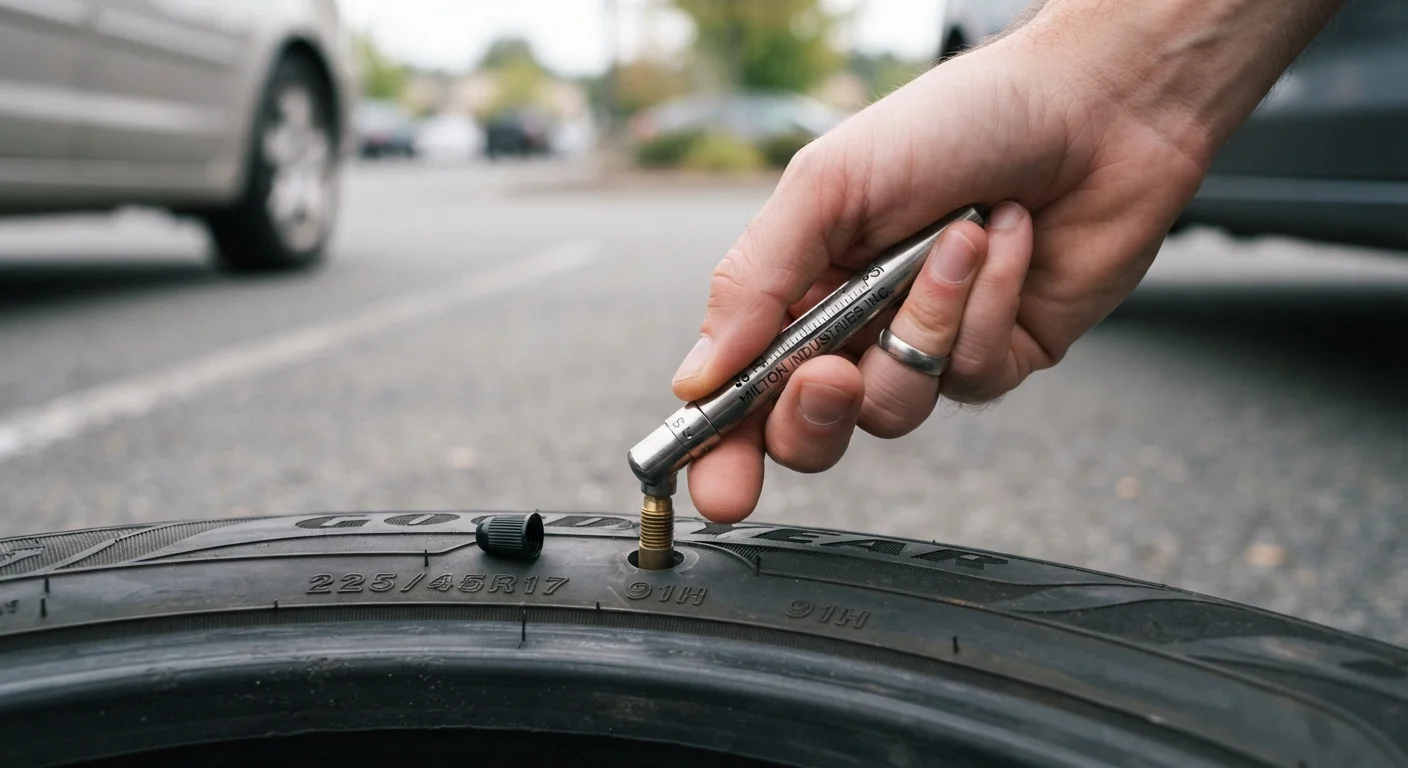
- Read the PSI shown. Digital gauges display it on a screen; dial gauges show it on a needle; pencil-style gauges push out a calibrated bar.
- Compare the reading to your door jamb sticker. Add air if low; release small amounts using the pin inside the valve stem if slightly over.
- Replace the valve cap.
Once a month is the minimum frequency most mechanics recommend. Before long trips and at the start of each new season - especially heading into winter - is when pressure checks matter most.
Tire pressure is just one part of a thorough pre-drive routine. Our pre-drive safety checklist covers mirrors, lights, and other key items worth confirming before you set off.
The TPMS Light: Helpful, but Not the Whole Story
Most vehicles sold in the US since 2008 include a TPMS - a sensor system that illuminates a dashboard warning light when one or more tires drops significantly below the recommended pressure. The symbol looks like a cross-section of a tire with an exclamation mark inside.
TPMS is a useful safety net, but it has a known limitation: the light typically doesn't trigger until pressure falls roughly 25% below the recommended level. For a tire recommended at 32 PSI, that means the light may not appear until pressure is around 24 PSI - a level where handling and fuel efficiency are already compromised.
Think of TPMS as an emergency alert, not a monthly check. Regular manual checks catch the moderate drops that the sensor won't flag. If your TPMS light comes on, check all four tires as soon as safely possible. For context on other dashboard alerts and what they signal, see our article on engine warning lights and dashboard symbols.
TPMS Does Not Replace Manual Checks
The TPMS system is federally mandated on US passenger vehicles built after September 2007, but it is designed as a last-resort alert - not a maintenance tool. A tire can be meaningfully under-inflated for weeks without ever triggering the light. Monthly manual checks with a quality gauge remain the most reliable way to stay ahead of pressure problems.
Temperature, Seasons, and Pressure Drift
Air expands when it warms and contracts when it cools. For tires, this means pressure naturally rises during summer driving and drops as temperatures fall in autumn and winter. A commonly cited rule of thumb: tires lose approximately 1 PSI for every 10°F drop in ambient temperature.
A vehicle that was correctly inflated at 75°F in September may be running 4-5 PSI low by the time December temperatures hit 35°F - without a single nail or puncture. This is one reason the TPMS light frequently appears on cold winter mornings and then disappears after driving warms the tires back up. The warning is real even if it temporarily resolves.
Pairing correct tire pressure with healthy tread depth gives your tires the best chance of performing safely year-round. Our guide on checking tyre tread depth explains how to measure tread at home and what the legal minimum means for safety.
“Tire pressure is one of the simplest things a driver can check and one of the most consistently neglected. It affects everything from how the car corners to how quickly it can stop in an emergency.”
— National Highway Traffic Safety Administration, U.S. Federal Vehicle Safety Agency